DHCC Project Self-Assessment Tool (v1.0)

This self-assessment tool is intended to support Digital Humanities practitioners, researchers, technicians, curators, software engineers, and related professionals seeking to embed environmental sustainability into their project design, delivery, and reporting. In line with the EPSRC AREA framework for responsible research and innovation, the Digital Humanities Climate Coalition recommends using the tool to reflect on how project design, delivery, and reporting might Anticipate, Reflect on, Engage with, and Act to mitigate the environmental impacts of Digital Humanities work.

At DH2026 I heard Adi Keinan-Schoonbaert present on DH and sustainability. The Digital Humanities Climate Coalition has produced a DHCC Project Self-Assessment Tool (v1.0). This tool is a series of questions to get people to think about the sustainability of their project. It was inspired by the Framework for responsible research and innovation.

She talked about different events she organized at the British Library, inviting people who had developed workshops to run them at the BL. Another project to look at is the The Carbon Literacy Project.

With Chelsea Miya I worked on a paper on “Platitudes: The Carbon Weight of the Post-Platform Scholarly Web.” The Journal of Electronic Publishing. Vol. 28, No. 2. 2025. https://doi.org/10.3998/jep.7247 .

What I like about the Self-Assessment Tool is that it asks questions, though they are leading questions rather than questions that don’t have obvious answers. I think it could be used by students to assess DH projects.
Pacing the Frontier

We request that the U.S. government support an international effort to develop the technical and governance tools needed to deliberately pace the frontier of automated AI development.

Over a 1000 employees of frontier AI companies, including Dario Amodei, have issued a statement, Pacing the Frontier, that calls for the AI governance. Some of the things to note:

  • It is similar to the 2023 Pause Giant AI Experiments: An Open Letter that was also signed by all sorts of important people (and some unimportant people like me. In both, the idea is that we need to go more slowly if we are to make sure that AI is safe and used for good.
  • This version doesn’t ask the AI labs to “immediately pause”, but asks for the U.S. government to “support an international effort” which is an interesting shift. That international effort already exists in the form of the network of AI Safety Institutes set up after the Bletchley Summit. (I am on the Research Council of the Canadian AISI.) I also note that the statement calls for “support” not leadership. This is realistic as few countries are likely to sign up to be led by the U.S. right now. This U.S. Administration has squandered any international good will they had, at least from Canada.
  • Another difference is the call for “governance tools.” This sounds a lot like the “regulation” word that normally isn’t welcome in innovation focused circles. To be fair there are other sorts of tools that can be used to govern companies and products. Many exist now, they just have to be used. The problem is that governing is something humans do. No amount of tools left on the shop floor of government are going to substitute for consistent, public, articulate governing. Who has a track record doing this? Who would trust the U.S. to support them?
  • I should add that “technical and governance tools” sounds again like a techno-solutionism where you solve problems that arise from the poor governance of technology with more technology. (See Morozov’s book To Save Everything, Click Here: The Folly of Technological Solutionism.)
  • Finally, I should mention that the opening to the Statement has a now tired hinge statement of the sort “AI will save us all, BUT ….” where after the hinge (the BUT) there is a little problem raised for which, of course, the authors have a solution.

AI could help create a dramatically better future, but that outcome is not guaranteed. The world’s leading AI companies believe they could be close to automating AI research. It is hard to predict exactly how much this will accelerate AI progress, but there is a real risk that capability development rapidly accelerates beyond our ability to understand or control the resulting systems.

To realize AI’s potential, industry, government, and society at large may need the option to buy time to address emerging risks, develop security measures, and strengthen oversight. But each company—and country—is under intense competitive pressure not to unilaterally slow that acceleration. And today, the world lacks the technical and governance tools to deliberately pace frontier-wide progress.

Sorry, Sam and Elon, we have not reached the Singularity

Gary Marcus has a nice substack gathering recent (and not so recent) inflated statements from the titans of the AI industry (Sam Altman, Elon Musk, Demis Hassabis) to the effect that we are in the Singularity.

Is this more Singularity Theatre, a performance designed to keep us glued to our seats waiting for the next act (and paying as we sit)? Or is it the Rapture of Nerds to name a Cory Doctorow and Charles Stross novel. The Rapture would be the supposedly inevitable end when we are swept up from this corrupt meat world and immortalized in a virtual heaven.

Either way, a history of science-fiction works like Stross’s Accelerando deserve attention as imaginative ground in which such technological speculations grow.

Archive Zaro

Ralph Padilla, a DH (graduate) student that I work with, gave a talk today about a neat project of his own, Archive Zaro. The project is archiving video games from the Philippines. It has just launched.

This archive is part of an ongoing academic project on game preservation and digital heritage. It explores how stories, creative processes, and design histories of Filipino video games can be documented and studied without relying on commercial hosting or proprietary platforms. Each entry serves as both a cultural record and a research artifact, contributing to the broader understanding of how local game development reflects art, labor, and identity.

Mockaroo – Random Data Generator

A free test data generator and API mocking tool – Mockaroo lets you create custom CSV, JSON, SQL, and Excel datasets to test and demo your software.

Reading a draft journal article I came across Mockaroo – Random Data Generator and API Mocking Tool | JSON / CSV / SQL / Excel. This tool lets you generate testing datasets following different rules. You could generate a test dataset of personae with different configurations of personal characteristics for testing bias.

Neat!

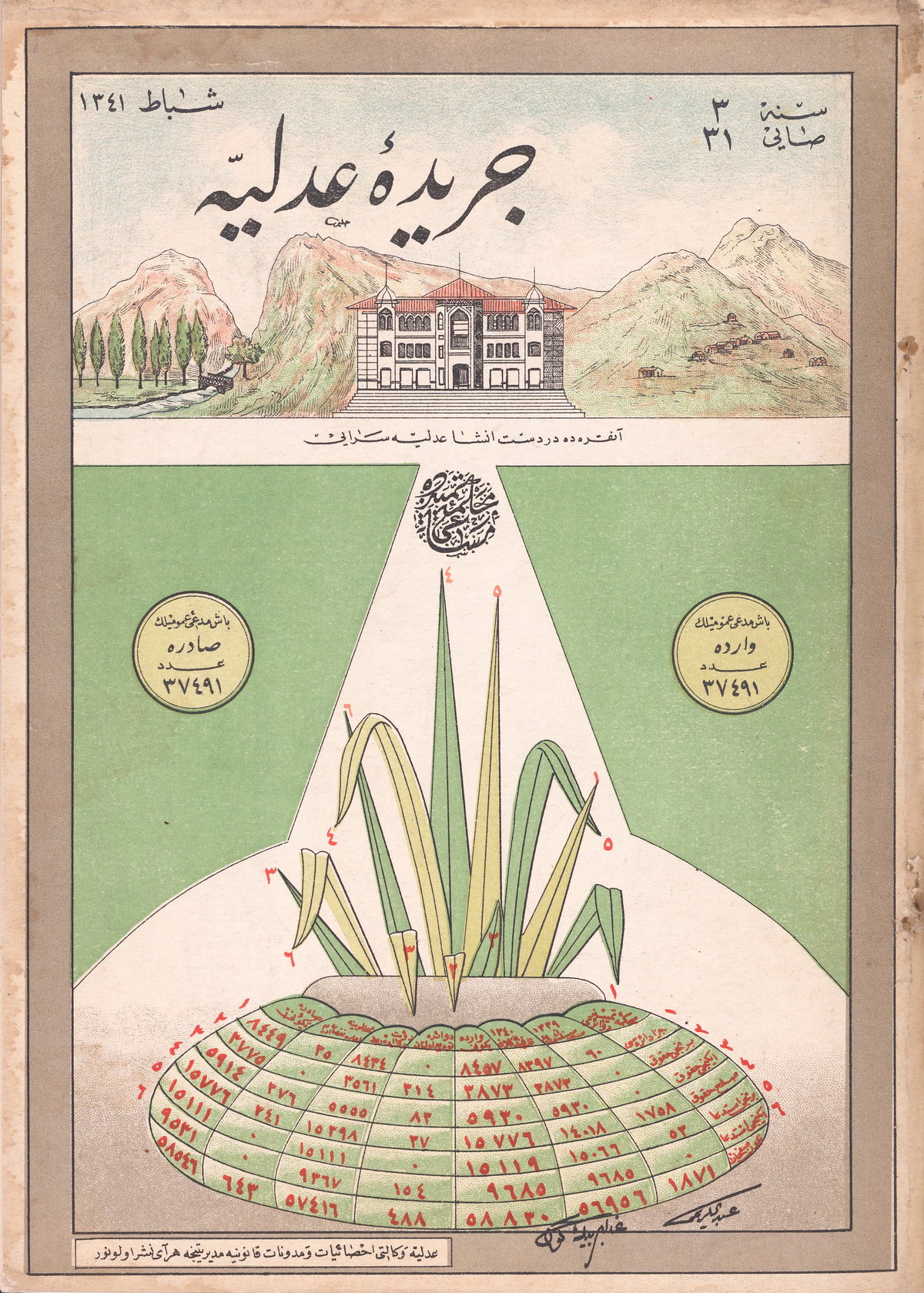
Visualizations on Covers from Cerîde-i Adliye, a Turkish Law Journal (1924–26)

Cover art with a visualizaton beneath a building.

In the The Public Domain Review I came across a collection of Covers from Cerîde-i Adliye, a Turkish Law Journal (1924–26). The covers include some extraordinary visualizations. Check it out.

There is an essay on Measure of Justice: Covering the Cerîde-i Adliye Covers that discusses the covers and an exhibition of them.

The research exhibition “Speak to the Eyes: Visualizing Information from the Ottoman Era to the Republic” curated by Ömer Durmaz studies information visualization with a specific focus on the Late Ottoman and the Early Turkish Republic periods while also taking into account the history of informational design in the West.

Multilingual Voyant – DH2026

Yesterday I led a workshop at DH2026 on “Multilingual Skins for Digital Humanities Tools: Translating Voyant and Beyond.” The workshop was designed by Ayushi Khemka and Arun Ghosh and I taught it with help from John Bradley. You can see the materials we developed at Multilingual Voyant. Here is our abstract for the workshop:

While many DH tools are designed and implemented in English, their uptake remains limited due to linguistic barriers. As the Multilingual DH SIG of ADHO states, DH scholarship itself has often been questioned for being Anglo-centric and thus, culturally and technologically biased. There are consistent attempts being made to address the linguistic hegemony of English in DH, for instance, the ADHO Multilingual DH SIG (Special Interest Group) and DARIAH Working Group on Multilingual DH. As a team of collaborators working on Voyant Tools, we are offering a hands-on workshop to explore the processes, challenges, and opportunities of translating interfaces of DH tools, with Voyant Tools as a primary case study, as Voyant has had success in creating international language interfaces (of which there are currently 16).

Translating interfaces is not just a technical task of translating strings. Instead, it is a methodological intervention into multilingual representation, diversity, equity, and sustainability of the tool(s). Our workshop is in alignment with the sub-theme of “Translating | Translinguality in the Era of AI” of the conference. Our workshop invites participants from all career stages to collaboratively translate sections of Voyant’s interface into multiple languages that they are familiar with, including Korean, the language of the host institution. The workshop will introduce participants to a broader translation workflow and tool management workflow. The workshop will be an opportunity to discuss and experiment with different ways to brainstorm such translations, including trying AI-assisted translation practices.

One thing that became clear in the workshop is that we need to run more workshops for people who want to use Voyant and teach with it.

Once again we are told AI may be conscious – Anil Seth

Anil Seth, who wrote Being You, a great and accessible book about the study of consciousness, has an opinion in The Guardian on Once again we are told AI may be conscious – I study consciousness, and I have my doubts. He makes a couple of interesting points in response to recent Anthropic research claiming they have found something like (consciousness) workspace using new techniques for looking into LLMs like Claude.

  • He returns to Nagel’s point that for some organism to be conscious “there is something that it is like to be that organism”. The question then is whether there is something that it is like to be an AI. Does that make sense at this point?
  • Consciousness is experience and is not the same as intelligence. Intelligence is about the doing of tasks, consciousness is about feeling and experience. Can an AI feel?
  • Consiousness is also continuous and reflective. Claude isn’t continuously conscious reflecting back on its consciousness.
  • Above all, for Seth, it is about the body. Our consciousness is about the experience of being me, in this mortal body, in this place, at this time. Claude has no experience of being in finite body thrown into a time and place.

CSDH Conference 2026

The CSDH-SCHN 2026 conference was held this year at the Université de Montreal.

The Bridging Divides team had a number of papers at the conference that I was part of:

  • “Platformed Racism: Anti-South Asian Immigration Narratives in Canadian Telegram Networks” was presented by Ayushi Khemka. (I was a co-author, along with Leonardo Nascimento and Yasmeen Abu-Laban, Yasmeen).
  • “From Black Boxes to Glass Boxes: Auditable Voyant Workflows (with Bounded LLM Assistance) for Evidence-Based Distant Reading” was presented by Augustine Farinola. (John Bradley and I were co-authors.)
  • “Abstract Rhetorics of Algorithmic Governance: A Bilingual Corpus Study of Canadian AIA” was presented by Augustine Farinola and Ralph Padilla. (Yasmeen Abu-Laban and I were co-authors.)

We also had a panel which was introduced by Yasmeen Abu-Laban and moderated by me on “Critical Digital Humanities and Immigration Research.” The participants were Sawafta, Eleyan; Le, Huong; Alzubaidi, Abdullah; Farinola, Augustine; Khemka, Ayushi; and Padilla, Ralph.

Then we had two posters:

  • “Constellation Word2Vec Viewer in Voyant” was presented by Ryan Chartier.
  • “Making AI Legible: Visual workflows for Critical Reflexivity and Ethical LLM Use in the Social Sciences and Humanities” was presented by Abhik Hasnain.

Congratulations also to Ayushi Khemka for her own paper on “Misnaming in the Machine: Epistemic Injustice, Digital Translation, and the Racialisation of “Indian””, and Augustine Farinola who had a paper on “Untranslatable Lived Experience: Persona‑Driven RAG for Digital Humanities Pedagogy in Immigration Systems.”

Immigration Research at CPSA

I’m at the 2026 Canadian Political Science Association annual conference in Ottawa. The lab I and Yasmeen Abu-Laban run on advanced digital technology and immigration has a number of papers and a round table that I’m involved in.

  • “Rebordering North America: The Political Economy and Migration Implications of Canada’s Strong Border and Strengthening Canada’s Immigration System and Borders Acts” was presented by Huong Le. Huong used Voyant and close reading to look at speeches and media discourse around bills C-2 and C-12. A major dynamic is the rebordering that is happening due to US pressure on Canada.
  • “Borders, Surveillance, Human Rights, and the 2026 FIFA World Cup” was presented by Abdullah Alzubaidi. Abdullah looked at the differences between the USA, Canada and Mexico when it comes to visitors for the 2026 World Cup. The World Cup is a major international sporting event which is supposed to celebrate human rights and international cooperation, but the differing border regulations belie that ideal.
  • “Roundtable: Procuring Digital Policy? Private Vendors, Advanced Digital Technology, and the Immigration Sector” is a roundtable organized by sasha skaidra, with Geoffrey Rockwell (me), Kuba Jablonowski, and Louisa Taylor. We discussed the challenges faced by necomers and the immigrant sector as jurisdictions like Canada and the UK automate their interfaces.