Mockaroo – Random Data Generator

A free test data generator and API mocking tool – Mockaroo lets you create custom CSV, JSON, SQL, and Excel datasets to test and demo your software.

Reading a draft journal article I came across Mockaroo – Random Data Generator and API Mocking Tool | JSON / CSV / SQL / Excel. This tool lets you generate testing datasets following different rules. You could generate a test dataset of personae with different configurations of personal characteristics for testing bias.

Neat!

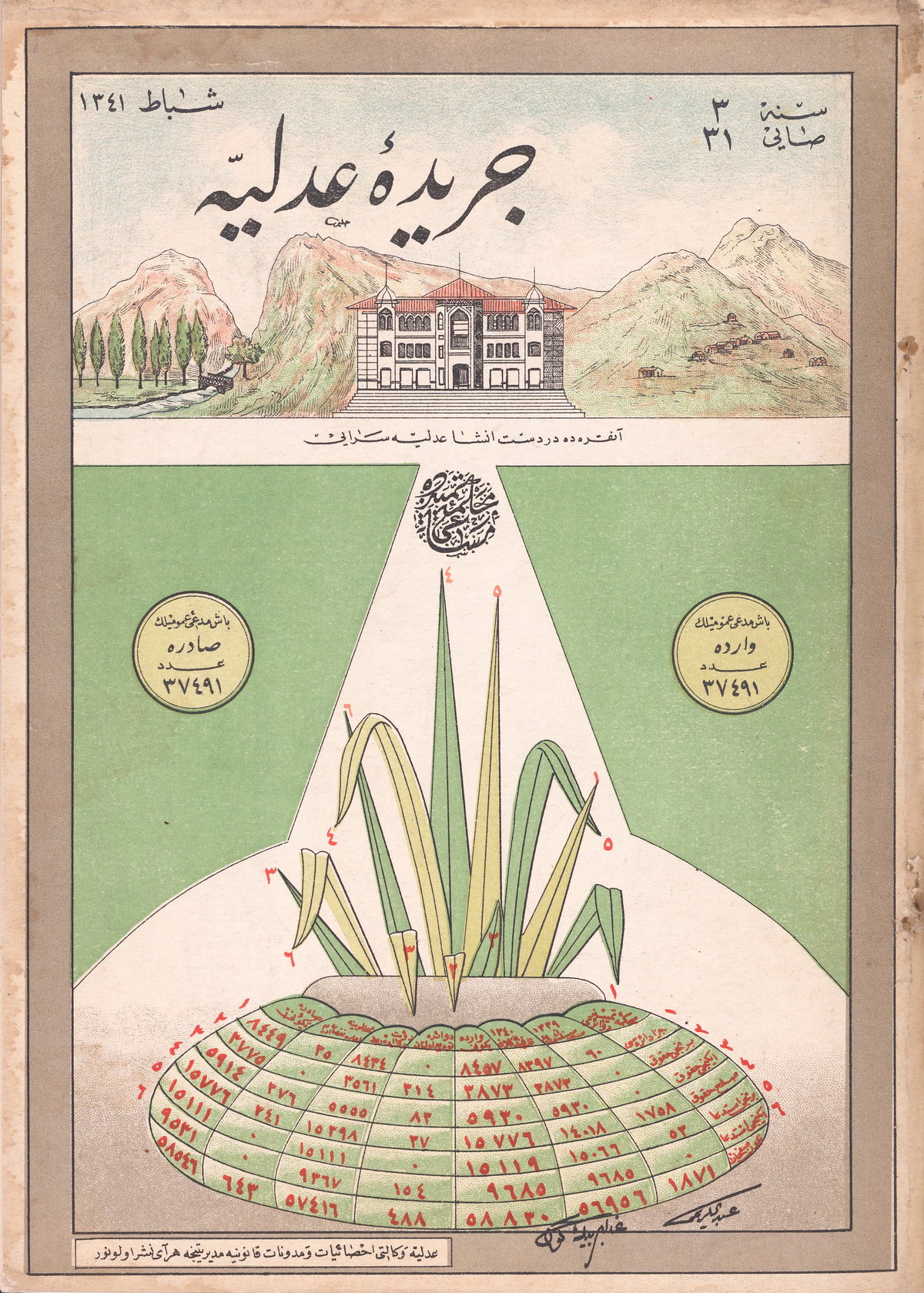
Visualizations on Covers from Cerîde-i Adliye, a Turkish Law Journal (1924–26)

Cover art with a visualizaton beneath a building.

In the The Public Domain Review I came across a collection of Covers from Cerîde-i Adliye, a Turkish Law Journal (1924–26). The covers include some extraordinary visualizations. Check it out.

There is an essay on Measure of Justice: Covering the Cerîde-i Adliye Covers that discusses the covers and an exhibition of them.

The research exhibition “Speak to the Eyes: Visualizing Information from the Ottoman Era to the Republic” curated by Ömer Durmaz studies information visualization with a specific focus on the Late Ottoman and the Early Turkish Republic periods while also taking into account the history of informational design in the West.

Multilingual Voyant – DH2026

Yesterday I led a workshop at DH2026 on “Multilingual Skins for Digital Humanities Tools: Translating Voyant and Beyond.” The workshop was designed by Ayushi Khemka and Arun Ghosh and I taught it with help from John Bradley. You can see the materials we developed at Multilingual Voyant. Here is our abstract for the workshop:

While many DH tools are designed and implemented in English, their uptake remains limited due to linguistic barriers. As the Multilingual DH SIG of ADHO states, DH scholarship itself has often been questioned for being Anglo-centric and thus, culturally and technologically biased. There are consistent attempts being made to address the linguistic hegemony of English in DH, for instance, the ADHO Multilingual DH SIG (Special Interest Group) and DARIAH Working Group on Multilingual DH. As a team of collaborators working on Voyant Tools, we are offering a hands-on workshop to explore the processes, challenges, and opportunities of translating interfaces of DH tools, with Voyant Tools as a primary case study, as Voyant has had success in creating international language interfaces (of which there are currently 16).

Translating interfaces is not just a technical task of translating strings. Instead, it is a methodological intervention into multilingual representation, diversity, equity, and sustainability of the tool(s). Our workshop is in alignment with the sub-theme of “Translating | Translinguality in the Era of AI” of the conference. Our workshop invites participants from all career stages to collaboratively translate sections of Voyant’s interface into multiple languages that they are familiar with, including Korean, the language of the host institution. The workshop will introduce participants to a broader translation workflow and tool management workflow. The workshop will be an opportunity to discuss and experiment with different ways to brainstorm such translations, including trying AI-assisted translation practices.

One thing that became clear in the workshop is that we need to run more workshops for people who want to use Voyant and teach with it.

Once again we are told AI may be conscious – Anil Seth

Anil Seth, who wrote Being You, a great and accessible book about the study of consciousness, has an opinion in The Guardian on Once again we are told AI may be conscious – I study consciousness, and I have my doubts. He makes a couple of interesting points in response to recent Anthropic research claiming they have found something like (consciousness) workspace using new techniques for looking into LLMs like Claude.

  • He returns to Nagel’s point that for some organism to be conscious “there is something that it is like to be that organism”. The question then is whether there is something that it is like to be an AI. Does that make sense at this point?
  • Consciousness is experience and is not the same as intelligence. Intelligence is about the doing of tasks, consciousness is about feeling and experience. Can an AI feel?
  • Consiousness is also continuous and reflective. Claude isn’t continuously conscious reflecting back on its consciousness.
  • Above all, for Seth, it is about the body. Our consciousness is about the experience of being me, in this mortal body, in this place, at this time. Claude has no experience of being in finite body thrown into a time and place.

CSDH Conference 2026

The CSDH-SCHN 2026 conference was held this year at the Université de Montreal.

The Bridging Divides team had a number of papers at the conference that I was part of:

  • “Platformed Racism: Anti-South Asian Immigration Narratives in Canadian Telegram Networks” was presented by Ayushi Khemka. (I was a co-author, along with Leonardo Nascimento and Yasmeen Abu-Laban, Yasmeen).
  • “From Black Boxes to Glass Boxes: Auditable Voyant Workflows (with Bounded LLM Assistance) for Evidence-Based Distant Reading” was presented by Augustine Farinola. (John Bradley and I were co-authors.)
  • “Abstract Rhetorics of Algorithmic Governance: A Bilingual Corpus Study of Canadian AIA” was presented by Augustine Farinola and Ralph Padilla. (Yasmeen Abu-Laban and I were co-authors.)

We also had a panel which was introduced by Yasmeen Abu-Laban and moderated by me on “Critical Digital Humanities and Immigration Research.” The participants were Sawafta, Eleyan; Le, Huong; Alzubaidi, Abdullah; Farinola, Augustine; Khemka, Ayushi; and Padilla, Ralph.

Then we had two posters:

  • “Constellation Word2Vec Viewer in Voyant” was presented by Ryan Chartier.
  • “Making AI Legible: Visual workflows for Critical Reflexivity and Ethical LLM Use in the Social Sciences and Humanities” was presented by Abhik Hasnain.

Congratulations also to Ayushi Khemka for her own paper on “Misnaming in the Machine: Epistemic Injustice, Digital Translation, and the Racialisation of “Indian””, and Augustine Farinola who had a paper on “Untranslatable Lived Experience: Persona‑Driven RAG for Digital Humanities Pedagogy in Immigration Systems.”
Immigration Research at CPSA

I’m at the 2026 Canadian Political Science Association annual conference in Ottawa. The lab I and Yasmeen Abu-Laban run on advanced digital technology and immigration has a number of papers and a round table that I’m involved in.

  • “Rebordering North America: The Political Economy and Migration Implications of Canada’s Strong Border and Strengthening Canada’s Immigration System and Borders Acts” was presented by Huong Le. Huong used Voyant and close reading to look at speeches and media discourse around bills C-2 and C-12. A major dynamic is the rebordering that is happening due to US pressure on Canada.
  • “Borders, Surveillance, Human Rights, and the 2026 FIFA World Cup” was presented by Abdullah Alzubaidi. Abdullah looked at the differences between the USA, Canada and Mexico when it comes to visitors for the 2026 World Cup. The World Cup is a major international sporting event which is supposed to celebrate human rights and international cooperation, but the differing border regulations belie that ideal.
  • “Roundtable: Procuring Digital Policy? Private Vendors, Advanced Digital Technology, and the Immigration Sector” is a roundtable organized by sasha skaidra, with Geoffrey Rockwell (me), Kuba Jablonowski, and Louisa Taylor. We discussed the challenges faced by necomers and the immigrant sector as jurisdictions like Canada and the UK automate their interfaces.

Anthropic co-founder remarks on “Magnifica humanitas”

Anthropic co-founder Chris Olah was one of the respondents on Pope Leo XIV’s encyclical Magnifica humanitas. (You can see my blog post here.) His remarks have been posted on the Anthropic site. Unlike some accelerationists who don’t want to listen to anyone outside the magic circle, he is humble and invites dialogue. Some of the points he makes:

  • He starts by recognizing how those who work in the AI industry operate “inside a set of incentives and constraints that can sometimes conflict with doing the right thing.”
  • Which is why he welcomes “Magnifica humanitas” and calls for dialogue.
  • He hopes that “if this technology is coming, it must go well—for our common home, and for the children to come.” Note that he doesn’t assume it is coming.
  • He describes it in almost human terms. “They are grown, on a structure roughly modeled after the brain, on an enormous inheritance of human thought and speech.” He says they are not the cold beings we expected but developing them is, “a little like bringing a fictional character to life.” Note that he doesn’t say it is like bringing a person to life, but making close as fiction. (Remember that “fiction” comes etymologically from “fashioning.”)

He names three questions where the Church’s discernment is needed. For that matter, he is clear that these discussion are not just for the engineers or Church, but for all.

  • The first is our duty to the global poor. 
  • The second is the need for moral imagination and ambition regarding human flourishing.
  • The third is the need for discernment on the nature of AI models. 

I would like to ask how a dialogue that goes beyond those in and with power could take place? Many just wait and hope they don’t lose their jobs or end up managed by a machine.

Ross Douthat has an opinion piece on Leo’s encyclical that is interesting. He says, “the core idea that we need to treat the A.I. future as a fundamentally political sphere, requiring democratic deliberation and political constraint, seems essential and correct.”

Pope Leo’s ‘Magnifica humanitas’: AI must serve humanity not concentrate power

Pope Leo the XIV just released an encyclical on artificial intelligence, Magnifica humanitas: On Safeguarding the Human Person in the Time of Artificial Intelligence. The encyclical was released on the 135th anniversary of the encyclical Rerum Novarum: On Capital and Human Labor by his namesake pope, Leo XIII.

The two are clearly meant to be connected. Magnifica humanitas, or “magnificent humanity” doesn’t paint AI as either good or bad, or for that matter, neutral. It is about humans making choices that safeguard (or not) our dignity (and magnificence.) I rather like the emphasis on our magnificence and the suggestion and AI could be one of our great deeds.

The encyclical identifies 5 principles that are not the usual principles for AI as they are principles of Social Doctrine with application to AI:

  • Common good
  • Universal destination of good (that not all goods be concentrated in the hands of the few)
  • Subsidiarity (that have shared responsibility, not paternalistic welfare)
  • Solidarity (that we care for others and future generations)
  • Social justice

The encyclical is long and deals with a number of issues including the need for dialogue. You can read a summary on the Vatican news web site here. The New York Times has an article on Main Takeaways From Pope Leo’s Encyclical on A.I. and one on how At the Epicenter of A.I., Pope Leo’s Warnings Are Dismissed. This last article captures the attitude of some that “no one outside of Silicon Valley understands AI and therefore we don’t need to listen to them.” No need for dialogue with others when you think you are magnificent.

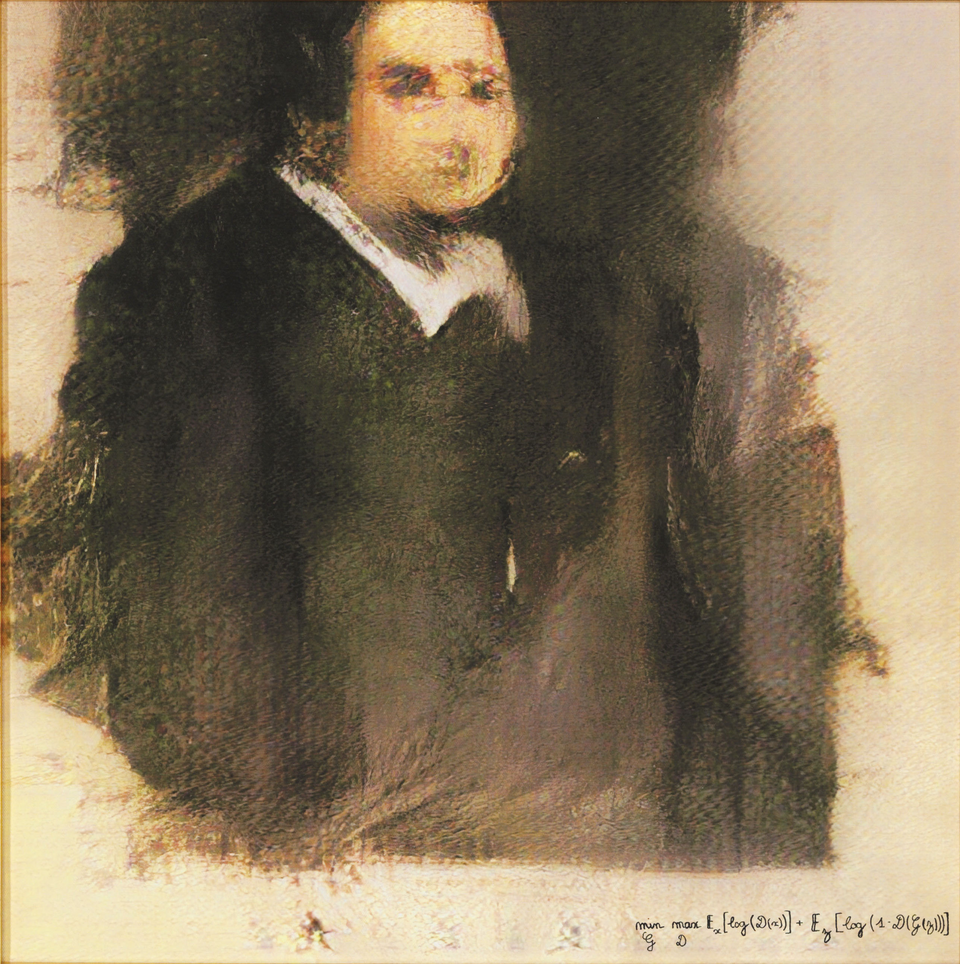
Edmond de Belamy by Obvious

The Portrait of Edward de Belamy is a Generative Adversarial Network (GAN) ink print created by the art group Obvious.

The name “Belamy” is a joke on the name of the developer of GAN, Ian Goodfellow.

The print was bought at auction for $432,500 (USD), a first for AI generated art.

I learned about this from a talk on “Alternative Histories of genAI” by Lauren Tilton. She talked about the institutions involve in authorizing art. Is it art because it was bought for a lot of money?

This talk was part of a conference in Nice and Cannes, Colloque “Créativités artificielles: Approches critiques de l’IA” @ Nice that I also presented at. My talk was on “Thinking-Through Trust in AI”.

The Coming Tsunami of Transnational Repression

Professor Ronald Deibert, Director of the Citizen Lab at U of Toronto, appeared before the House of Commons’ Subcommittee on International Human Rights of the Standing Committee on Foreign Affairs and International Development (SDIR) on March 23rd, 2026, to testify on transnational repression. His brief included a discussion of artificial intelligence and its potential use for repression. He also had a clear recommendation that the government should regulate AI. Here is the recommendation from the text of his testimony:

Regulate AI. The government must squarely and soberly address the huge potential for widespread harm associated with LLMs and AI systems, as well as social media
platforms which are connected to them. Although there are many potential economic and other benefits associated with these systems, the current political and economic context all but assures there will also be major harms emanating from their use and abuse. The government should cease any cooperation with governments on AI that are known perpetrators of TNR and DTR. It should engage in meaningful public consultation with affected communities on how these systems have begun to negatively affect peoples’lives, as called for by the People’s Consultation on AI. And it should find ways to regulateAI uses, particularly among public agencies, to mitigate harms and ensure equitable outcomes. Part of this regulation must include independent due diligence audits of all tech platforms in a transparent and accountable manner consistent with Charter of Human Rights protections on freedom of speech and access to information.

I read about this in a story in the Globe and Mail.