SimRefinery and Maxis Business Simulations

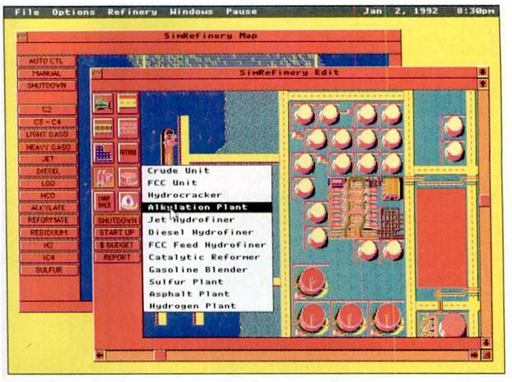
SimRefinery Screenshot

SimRefinery was the first simulation developed by a Maxis spin-off company called Maxis Business Simulations (MBS). The simulation was for Chevron and was developed using the development tools Maxis had developed for their games like SimCity. Phil Salvador tells a wonderful story about MBS and SimRefinery in a thoroughly research essay When SimCity got serious: the story of Maxis Business Simulations and SimRefinery. Take some time out and read it.

Part of what is interesting in the essay is how Salvador documents the different views about what such simulations were good for. SimRefinery was not a accurate simulation that would cover the complexity of the chemical engineering of a refinery; so what was it good for. Chevron apparently wanted something to help the staff who weren’t engineers to understand some of the connectiveness of a refinery – how problems in one area could impact others. Will Wright, the genius behind Maxis, didn’t think serious simulations were possible or something they wanted to do. He saw SimCity as a caricature that was fun. At best it might give people a “mental model” of the issues around city management. It was for that reason that MBS was a spin-off designed to contract with businesses that felt serious simulations were feasible and useful.

I learned about the Salvador article from a Ars Technica story about SimRefinery and how A lost Maxis “Sim” game has been discovered by an Ars reader [Updated]. The story talks about how someone found and uploaded to the Internet Archive a prototype of SimRefinery only to later take in back down so it is no longer available. In the meantime Phil Salvador recorded a Twitch stream of checking out the game so you can get a sense of how it worked.

Codecademy vs. The BBC Micro

The Computer Literacy Project, on the other hand, is what a bunch of producers and civil servants at the BBC thought would be the best way to educate the nation about computing. I admit that it is a bit elitist to suggest we should laud this group of people for teaching the masses what they were incapable of seeking out on their own. But I can’t help but think they got it right. Lots of people first learned about computing using a BBC Micro, and many of these people went on to become successful software developers or game designers.

I’ve just discovered Two-Bit History (0b10), a series of long and thorough blog essays on the history of computing by Sinclair Target. One essay is on Codecademy vs. The BBC Micro. The essay gives the background of the BBC Computer Literacy Project that led the BBC to commission as suitable microcomputer, the BBC Micro. He uses this history to then compare the way the BBC literacy project taught a nation (the UK) computing to the way the Codeacademy does now. The BBC project comes out better as it doesn’t drop immediately into drop into programming without explaining, something the Codecademy does.

I should add that the early 1980s was a period when many constituencies developed their own computer systems, not just the BBC. In Ontario the Ministry of Education launched a process that led to the ICON which was used in Ontario schools in the mid to late 1980s.

HyperCard at the Internet Archive

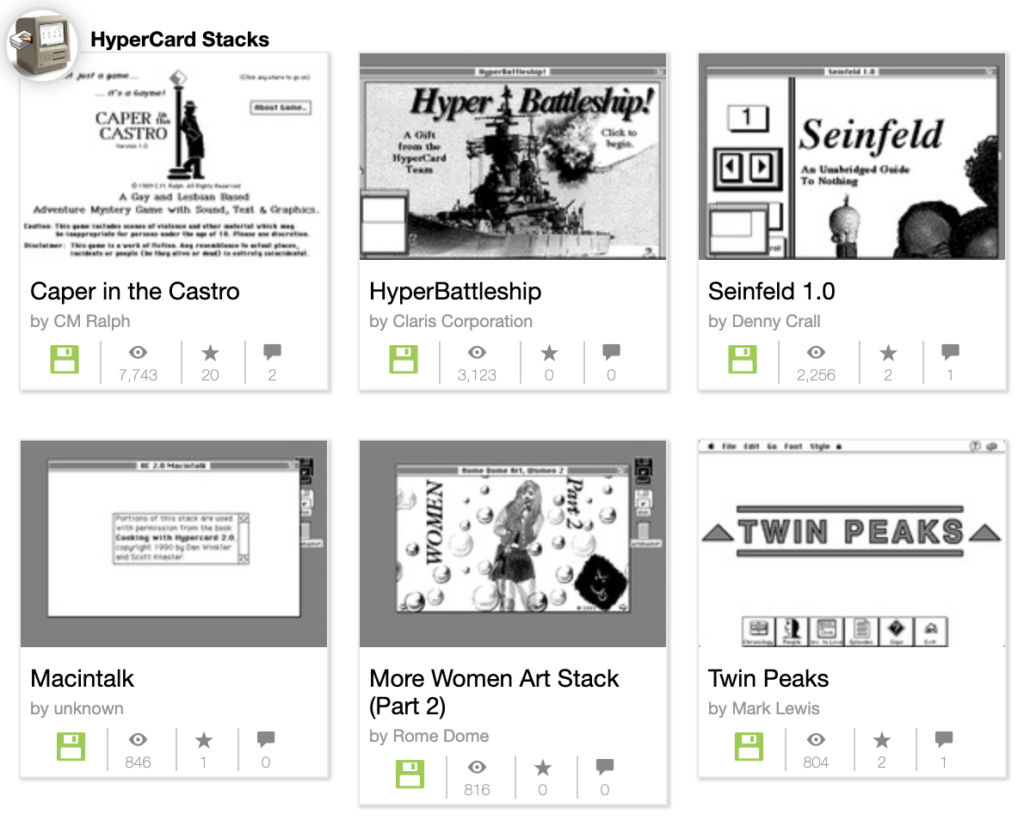
Screen Shot of Internet Archive HyperCard Collection

The Internet Archive is now collecting HyperCard Stacks and has an emulator so they can be run in the browser. If you have old ones to contribute you can upload them to hypercardonline.tk (which has a nerdy HyperCard like interface.)

Like many, I learned to program multimedia in HyperCard. I even ended up teaching it to faculty and teachers at the University of Toronto. It was a great starting development environment with a mix of graphical tools, hypertext tools and a verbose programming language. It’s only (and major) flaw was that it wasn’t designed to create networked information. HyperCard Stacks has to be passed around on disks. The web made possible a networked hypertext environment that solved the distribution problems of the 1980s. One wonders why Apple (or someone else) doesn’t bring it back in an updated and networked form. I guess that is what the Internet Archive is doing.

For more on the history of HyperCard see the Ars Technica article by Matthew Lasar, 30-plus years of HyperCard, the missing link to the Web.

What is cool is that artists are using HyperCard to make art like Formality* discussed in the previous post.

Linked Infrastructure For Networked Cultural Scholarship Team Meeting 2019

This weekend I was at the Linked Infrastructure For Networked Cultural Scholarship (LINCS) Team Meeting 2019. The meeting/retreat was in Banff at the Banff International Research Station and I kept my research notes at philosophi.ca.

The goal of Lincs is to create a shared linked data store that humanities projects can draw on and contribute to. This would let us link our digital resources in ways that create new intellectual connections and that allow us to reason about linked data.

Di GRA 2019 And Replaying Japan 2019

Read my conference notes on Di GRA 2019 And Replaying Japan 2019 here. The two conferences were held back to back (with a shared keynote) in Kyoto at Ritsumeikan.

Kieji Amano deserves a lot of credit for putting together the largest Replaying Japan programme ever. The folks at the Ritsumeikan Center for Games Studies should also be thanked for organizing the facilities for both conferences. They have established themselves as leaders in Japan in the field.

I gave two papers:

  • “The End of Pachinko” (given with Amano) looked at the decline of pachinko and traditional forms of gambling in the face of the legalization of casinos. It looked at different types of ends, like the ends of machines.
  • “Work Culture in Early Japanese Game Development” (with Amano, Okabe, Ly and Whistance-Smith) used text analysis of Szczepaniak’ series of interviews, the Untold History of Japanese Game Developers, as a starting point to look at themes like stress and gender.

The quality of the papers in both conferences was very high. I expect this of DiGRA, but it was great to see that Replaying Japan, which is more inclusive, it getting better and better. I was particularly impressed by some of the papers by our Japanese colleagues like a paper delivered by Kobayashi on the “Early History of Hobbyist Production Filed of Video Games and its Effect on Game Industries in Japan.” This was rich with historical evidence. Another great one was “Researching AI technologies in 80’s Japanese Game Industry” delivered by Miyake who is involved in some very interesting preservation projects.

Rights Statements

At the SpokenWeb symposium at SFI I learned about a web site RightsStatements.org. This site provides example rights statements to use and put on the web. For example In Copyright – Rights-Holder(s) Unlocatable or Unidentifiable. These often use American language rather than Canadian language, but they are a useful resource.

Another, better known source for rights statement is Creative Commons, but it is more for creators than for cultural heritage online.

Burrows and Antonia Archives: Centre For 21st Century Humanities

What happens to old digital humanities projects? Most vanish without a trace. Some get archived like the work of John Burrows and others at the Centre For Literary And Linguistic Computing (CLLC). Dr. Alexis Antonia kept an archive of CLLC materials which is now available from the Centre For 21st Century Humanities.

Distant Reading after Moretti

The question I want to explore today is this: what do we do about distant reading, now that we know that Franco Moretti, the man who coined the phrase “distant reading,” and who remains its most famous exemplar, is among the men named as a result of the #MeToo movement.

Lauren Klein has posted an important blog entry on Distant Reading after MorettiThis essay is based on a talk delivered at the 2018 MLA convention for a panel on Varieties of Digital Humanities. Klein asks about distant reading and whether it shelters sexual harassment in some way. She asks us to put not just the persons, but the structures of distant reading and the digital humanities under investigation. She suggests that it is “not a coincidence that distant reading does not deal well with gender, or with sexuality, or with race.” One might go further and ask if the same isn’t true of the digital humanities in general or the humanities, for that matter. Klein then suggests some thing we can do about it:

  • We need more accessible corpora that better represent the varieties of human experience.
  • We need to question our models and ask about what is assumed or hidden.


DPLA Primary Source Sets

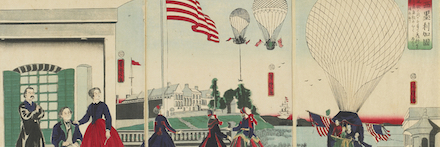
Commodore Perry’s Expedition to Japan

The Digital Public Library of America (DPLA) has a fascinating collection of Primary Source Sets that bring together materials around a subject for teaching and historical thinking. For example they have a set on Commodore Perry’s Expedition to Japan that allows you to see both American and Japanese representations of Perry and the important visit. These sets show how a digital archive can be repurposed in different ways.

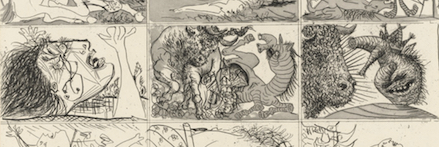
Composite Image by Picasso
From the Pablo Picasso’s Guernica and Modern War Set

Busa Letter Outlining Textual Informatics

Page 1 of “Conditional Agreement” by Father Busa

Domenico Fiormonte has recently blogged about an interesting document he has by Father Busa that relates to a difficult moment in the history of the digital humanities in Italy in 2002. The two page “Conditional Agreement”, which I translate below, was given to Domenico and explained the terms under which Busa would agree to sign a letter to the Minister (of Education and Research) Moratti in response to Moratti’s public statement about the uselessness of humanities informatics. A letter was being prepared to be signed by a large number of Italian (and foreign) academics explaining the value of what we now call the digital humanities. Busa had the connections to get the letter published and taken seriously for which reason Domenico visited him to get his help, which ended up being conditional on certain things being made clear, as laid out in the document. Domenico kept the two pages Busa wrote and recently blogged about them. As he points out in his blog, these two pages are a mini-manifesto of Father Busa’s later views of the place and importance of what he called textual informatics. Domenico also points out how political is the context of these notes and the letter eventually signed and published. Defining the digital humanities is often about positioning the field in the larger academic and public political spheres we operate in.

Continue reading Busa Letter Outlining Textual Informatics