The GRAND network has just posted a nice story on the upcoming conference on Japanese Game Studies, see Industry-academic engagement focus of upcoming Japan-Canada game studies symposium. It is nice to have GRAND (a network I am part of) commissioning stories.
Future Hype: Near Futures
I gave a lecture at Kim Solez’s course on the future of medicine and he taped it and put it up on YouTube here:
Geoffrey Rockwell FutureHype LABMP 590 2013 March 7 – YouTube.
This talk came out of a conversation we had at a pub about Ray Kurzweil where I disagreed with Kim about Kurzweil’s predictions. Thinking about Kurzweil I realized how fundamental prediction is. We call it hope. It is easy to make fun of the futurists, but we need to recognize how we always look forward to the near future.
Tool Discourse
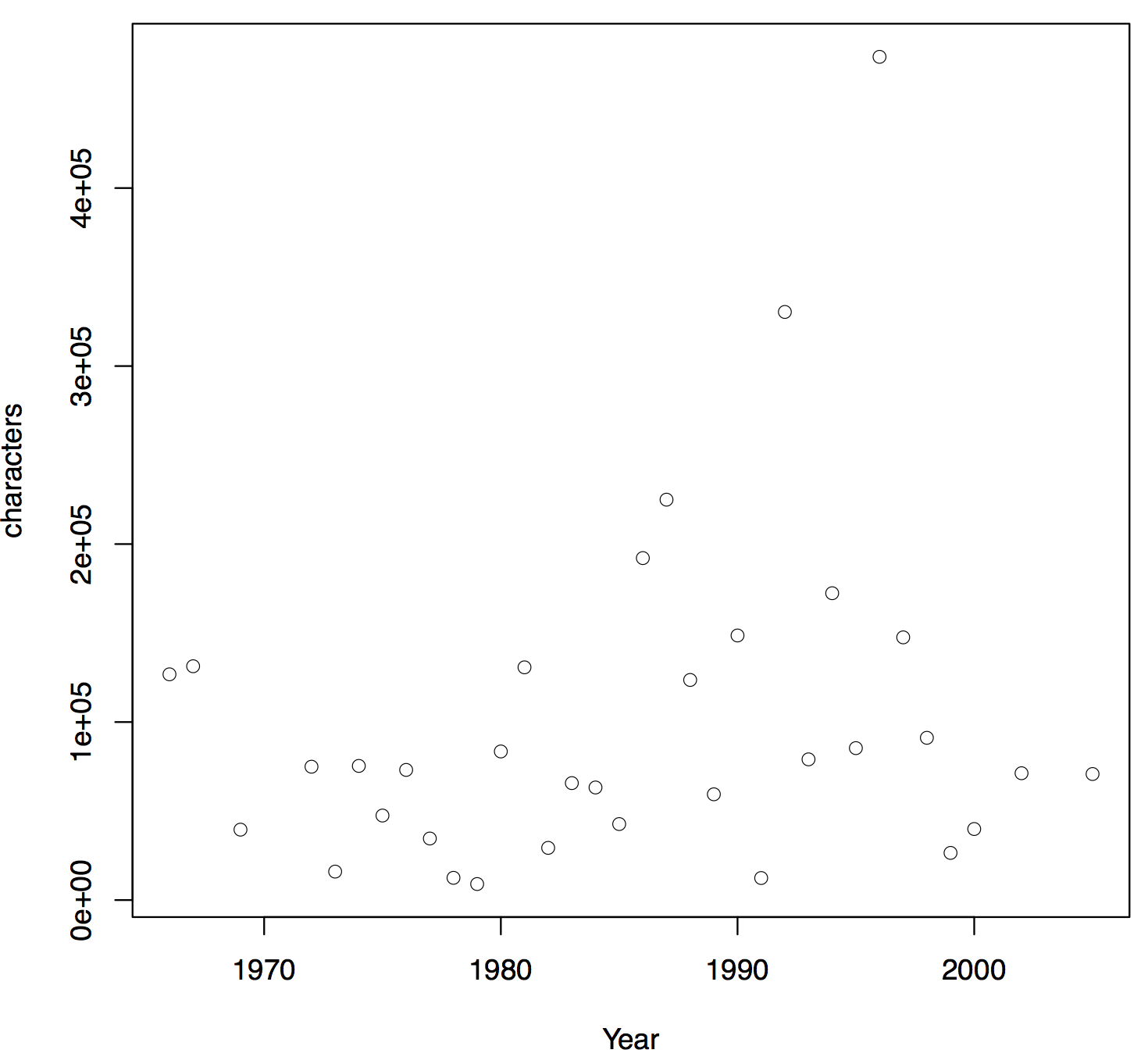 We are finally getting results in a long slow process of trying to study tool discourse in the digital humanities. Amy Dyrbe and Ryan Chartier are building a corpus of discourse around tools that includes tool reviews, articles about what people are doing with tools, web pages about tools and so on. We took the first coherent chunk and Ryan has been analyzing it with R. The graph above shows which years have the most characters. My hypothesis was that tool reviews and discourse dropped off in the 1990s as the web became more important. This seems to be wrong.
Here are the high-frequency words (with stop words removed). Note the modal verbs “can”, “will”, and “may.” They indicate the potentiality of tools.
“can” 2305
“one” 1996
“text” 1940
“word” 1931
“words” 1859
“program” 1606
“ii” 1514 (Not sure why)
“will” 1361
“language” 1307
“data” 1285
“two” 1188
“system” 1183
“computer” 1116
“used” 1115
“use” 942
“user” 939
“file” 890
“first” 870
“may” 853
“also” 837
Diagramming Text Analysis
I asked some graduate students to draw diagrams theorizing text analysis. This was partly so that we could test ideas about how things (like diagrams) communicate. Here you can see the diagrams that Carmen, Jared, Samia, Sandra, and Tianyi developed.
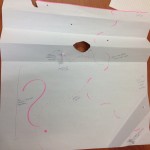
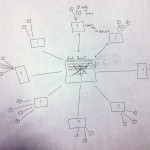

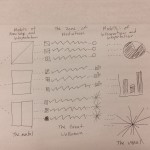
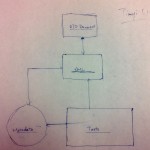
I must admit I would never have thought of some of the visual ideas they deployed.
Humanities Unraveled – The Chronicle
Michael Bérubé has written an important essay in The Chronicle titled The Humanities, Unraveled. He revisits the question of accepting all these grad students for whom there aren’t jobs and, following an essay No More Plan B by Anthony Grafton, makes the case for graduate programmes designed for alternative careers.
[W]hen we look at the public reputation of the humanities; when we compare the dilapidated Humanities Cottage on campus with the new $225-million Millennium Science Complex thats a real example, from my home institution; when we look at the academic job market for humanists, we cant avoid the conclusion that the value of the work we do, and the way we theorize value, simply isnt valued by very many people, on campus or off.
The alt-ac community poses a timely and bracing challenge to that attitude. It asks us what graduate curricula might be most readily transferable to careers outside academe perhaps curricula that include semester-long internships and/or administrative experience?—and whether those careers will be honored and validated by deans and provosts, who remain likely to evaluate the success of graduate programs in the humanities by their placement rates, which are likely to continue to refer exclusively to placements in academic positions.
I think the time has come to stop talking about Alt-Ac careers as only an alternative and start seriously designing graduate programmes for Alt-Ac first. Why first? Because I think the academy would actually benefit from students prepared for Alt-Ac. So what should we be thinking about?
- Despite what Grafton says, we should scale back the dissertation to something that can be written in a year or two. We have to scale it back or be open to alternative dissertations so that there is time/opportunity for other things. We should encourage project driven dissertations and funded dissertations where a Ph.D student is funded by a research team to do their research on the subject of the grant as part of the team. This is normal in the sciences and engineering and leads to faster completion times and healthier interaction between student and team. Imagine working on a thesis other people were actually interested in because it connected to what they were doing? Imagine being funded to complete in a timely fashion?
- We should stop trying to protect graduate students from things like internships, other disciplines, computing, and yes … jobs. Instead we should encourage them to try the things they are interested in while they have time. While for many of us the time of writing the dissertation has become an idealized moment of peace and focus before the chaos of a job, that doesn’t mean that is the only way to be a graduate student. Lets encourage students to get breadth along with some depth.
- Whether we leave the dissertation as is, we should change how they are supervised to make sure that students get more open and broad support. There are all sorts of healthy models out there that are less feudal. Even if we leave things as is we should expect of ourselves that read the literature (and university policies) about best practices in supervision. To my colleagues who supervise – RTFM!
- The trend has been to get rid of Masters programmes and focus on the PhDs. Direct-entry PhDs generate more money, but they are creating a situation where students have no way to test the waters before entering immediately into a stick-it-out-for-years-or-fail programme. I think this is a mistake as a significant MA could be the Alt-Ac degree, freeing the PhD to be the academic extension. Our 2 year MA in Humanities Computing has a thesis that forces students to embark on a substantial project. The two years give them enough time to learn skills and then apply them. Most take a third year either because they are in the joint MA/MLIS programme that gives them the professional degree or because they involved in so many neat projects (for which they are paid.) Most of our students have no trouble getting work even before they finish and it is because the programme gives them real apprenticing opportunities.
- We should break down the disciplinary barriers that make it difficult for students to take courses in other department or for students to apply to do an interdisciplinary PhD. Despite the best of intentions, students who want to cross boundaries find they have to do all the requirements for both units. There are all sorts of reasons for this and interdisciplinary escape hatches are expensive to maintain for the number of students that take them, but it should still possible and we should be vigilant to maintain those escape hatches. It would be interesting to imagine more radical approaches (as in accepting students into the humanities and helping them to develop their own programme.)
- We should get away from the sacred 3 unit – one semester course. We should encourage shorter intense courses and longer languid ones. I learned Aristotle by taking two solid, but slow years of it with a prof who basically had us think about a page of Aristotle a week. We went so slow it began to make sense as a way of thinking. Likewise I’ve been at intense retreats like THATcamps where I learn a lot in four days. Such short courses can help students engage a breadth of Alt-Ac perspectives without making too much of a commitment.
- Comprehensives and other forms of exams should be thrown out and replaced with internships, experiential applications, project apprenticeships or teaching apprenticeships. Lets give PhD students a choice of professional experiences instead of exams. Ask students to embark on 3 projects (from a teaching project to a community-based one) and then report back in different ways. That would give us a much better measure of whether a student was ready to write about a subject so as to make a career of it. Exams just relieve our fears of granting degrees to people who don’t know enough when the problem is we are granting degrees to people who can’t do much.
- Make it easy to do a graduate degree part-time. Many of the people who would actually benefit from an MA or PhD already have careers. Why aren’t we helping them expand their horizons and acquire knowledge/skills within the context of a real career? Many of our students end up working almost full time anyway, why not recognize the realities of their lives. We no longer live in a world that can provide a 7 year retreat experience for any more than a handful of students. Part-time students should be our primary audience, not an add on.
- Build graduate programs across universities. It is doubtful that universities will have the new resources to be able to start new graduate programs unless we collaborate. We have to find ways to build multi-university programs, as difficult as they are to administer. Properly done they provide students with access to a greater breadth of faculty and experiences. They also give us the capacity to innovate without having to make the case for 5 tenure-track positions in order to start a programme.
All of these may sound too radical, and none of this is original or easy. I certainly wouldn’t want all programmes to change just for the sake of a crisis (that has lasted a while so it may not count as a crisis). Rather, I would like to see a breath of experiments from the alternative to the purist that show that humanists value what they do enough to keep on adapting it for the next generation. Lets relax the reins and give some space to those who want to experiment (or not). It may be that the best approach is one of paying attention to the care of a programme however alternative or not it is.
I should add that I think the term “alternative” is misleading. There should be nothing alternative about careers beyond the academy. Extramural careers should be the norm not the alternative.
Textal – Text Analysis for your mobile

Textal is a moble app (for the iPhone) that lets you “explore the words used in your favourite book, document, website, or twitter stream.” It looks beautiful, but I can’t find it on the app store. I like the idea of having something like this for my iPad on which I read more and more.
Clay Shirky: How to Save College
 Clay Shirky has another essay on MOOCs titled, How to Save College. This essay from February 7th is in the Awl. He makes a couple of important points:
- The cost of college is going up faster than its value (see graph above that originally comes from here). Costs have been going up 5.6% (in the USA) and the earnings of people with just a Bachelors have been going down 1.6% a year. That doesn’t mean you shouldn’t get a Bacherlor’s, and I think the graph is a bit deceptive, but the rise in cost of higher education in the USA is unsustainable.
- “Things that can’t last don’t. This is why MOOCs matter.” While I am not sure MOOCs are the answer, I agree that higher-education can’t continue as is if the costs continue to go up at this rate. Various forms of competition are cropping up and more will.
- Shirky reminds us that for most people college is not the elite residential liberal arts colleges or even the large public universities. It is the commuter colleges teaching 2-year degrees (that people do part-time in many more years.) He could also have pointed out that it is becoming the millions of youth in India and China who can’t get into the coveted university positions, but still want to learn. The elite liberal arts colleges and public universities are not threatened by MOOCs – they will continue to offer an elite education to a minority who can afford the time and money it costs. It is just that cheaper alternatives to college will become how a larger and larger percentage of citizens learn.
- Shirky is particularly critical of the defensiveness of academics in the face of change. For Shirky what we do “is run institutions whose only rationale—whose only excuse for existing—is to make people smarter.” We should be open to new technologies and configurations that can do this better or reach a different audience rather than getting huffy and looking for reasons to dismiss MOOCs.
- Shirky feels academics shouldn’t be trusted “when we claim that there’s something sacred and irreplaceable about what we academics do.” We are inside the existing institutions and are invested in them. There is a danger that we will get more defensive and less willing to experiment as we feel more threatened.
- Shirky also addresses the issue of why all the fuss now when MOOCs and other alternatives have been around for a while. For him it is a matter of perception. Only now are people taking alternatives to the university seriously and that change in perception could lead to all sorts of people trying alternatives.
As I’ve mentioned before, I’m less convinced MOOCs will make such a difference, but do think that rising costs will lead to more and more people trying alternatives (of which MOOCs are only one.) The cost issues is also very different outside of the United States in countries that don’t have super expensive private colleges. In Quebec, for example, tuition is below $3,000 a year. Student protests have made it very difficult for governments to raise tuition. It is hard to imagine students choosing MOOCs that cost almost as much once you add all the course fees. Instead MOOCs will probably just be woven into public university education as a way of cutting costs so you will end up with more or less the same education.
The good news is that there is renewed interest in education which is important to education. Even better is that people still want to learn whether through MOOCs or college or reading books. Even if MOOCs turn out to be no better than reading a how-to book we should still welcome any addition to our collective knowledge and learning opportunities.
Virtual Research Worlds: New Technology in the Humanities – YouTube
The folk at TextGrid have created a neat video about new technology in the humanities, Virtual Research Worlds: New Technology in the Humanities. The video shows the connection between archives and supercomputers (grid computing). At around 2:20 you will see a number of visualizations from Voyant that they have connected into TextGrid. I love the links tools spawning words before a bronze statue. Who is represented by the statue?
Continue reading Virtual Research Worlds: New Technology in the Humanities – YouTube
Antique Pachinko
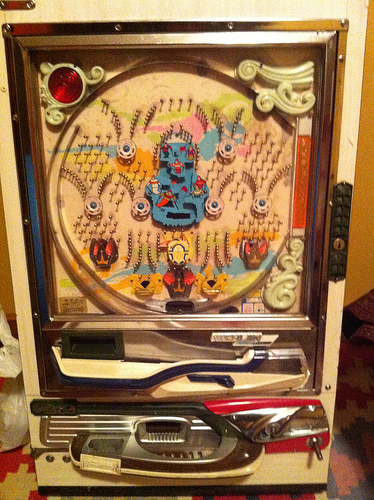
This weekend I bought the “antique” pachinko machine above. (To learn about pachinko see this clip from a Wim Wenders documentary Tokyo-Ga.) It looks similar to the Monkeys and Elephants Nishijin type B machine from 1976 from this collection on Flickr. My Japanese collaborator Dr. Keiji Amano tells me it was placed in the Gomangoku pachinko parlor in Shizuoka in 1977 based on the license stickers in the lower left of the playing field.
There are a number of great resources on the web for people who like to collect and restore older machines. Here are some that friends have pointed me to:
- Vintage Pachinko is a nice clean site that has lots of information including videos and useful services.
- Dan’s Pachinko Data Page has useful information and videos. The machine on his home page is close to the one I bought.
- Pachinko Planet has historical information, services and again videos. James King has even written a book (available in e-formats) on Pachinko Machine Restoration.
- EBay has a number of vintage machines and parts listed.
- Dr. Amano has put up some scans of a Japanese book on very old machines. See Scrapbook photos.
- PachiTalk.com has a forum for Pachinko and Pachislo and a section with playing manuals (that I haven’t looked at)
A question that people have asked me is how a 1970s pachinko machine ended up in an Edmonton antique mall (which is actually more like a flea market)? James King has a good post, Pachinkos in America: Where Are They? on research he has done using analytics (on Pachinko Planet) which suggests it may be been brought over by a serviceman or by a company that imported used ones to the US. Here is part of what he says,
Japanese pachinko parlors for decades only allowed machines to remain in service for about a year before they had to be removed and disposed. This led to huge numbers of used machines available in Japan, and most were simply destroyed. However, it was not unusual for American servicemen to send or bring them back to the states as souvenirs. The numbers that trickled in spread out from our major military installations, but in the 1950’s and 1960’s these numbers were small, somewhere in the thousands. Few of these pachinkos have survived today.
In the early 1970’s a few enterprising gentlemen got a good idea for a use for all of those piles of expired pachinkos. They formed a company called Target Abroad LTD, and started buying them up by the thousands and filling shipping crates with them. They then shipped these crates by the thousands to America, and sold them through major chain stores such as Woolworth, K-Mart, and even Sears. Several other smaller companies quickly formed and opened pachinko specialty stores across the country. Two of the most successful were Pachinko Palace and The Pachinko Factory, and many vintage pachinkos in America today still bear their stickers. Literally millions were sold between 1972 and 1976, but sales began to plummet when video games were invented and then mass- produced. By 1978 nearly all imports of pachinkos to America had ended, and the retailers sold off their inventory and closed their doors forever.
It is possible that collecting and restoring vintage machines is more popular in the USA than in Japan. Dr. Amano tells me that there is little in Japanese to match the restoration manuals and videos available in English. Pachinko may have a charm for people in North America that it doesn’t have in Japan. To us it is an exotic pinball-like game with lovely designs (especially the vintage ones before they got video screens) from the mysterious orient. For the Japanese it is a reminder of noisy smoky pachinko parlours where older men gamble endlessly alone. Given how little Japanese research there is into pachinko (considering the extraordinary amount of money spent on it) it is likely that to many Japanese it is an embarrassment which they wouldn’t want to collect.
@samplereality and Twitter fiction (?)
A week or so ago I began to follow Mark Sample’s tweets carefully as his tweeted what at first sounded like a nightmare at Dulles when he went to catch a flight. As he tweeted through the days it became more surreal. It seemed he was sequestered and being interrogated. He reported shots and deaths. It was hard to tell what was going on and then it was all over with a link to a YouTube video of him whispering into the phone. Then when you clicked on @samplereality you got “Internal Server Error” and if you tried to find his page you got a “Sorry, that page doesn’t exist!”
Someone had deleted his account.
Fortunately there was an off-site archive of his tweets that he had backed up here. And, as a useful hint, there was an entry on ProfHacker by Sample on how to Keep Your Official Twitter Archive Fresh which the editors introduced with,
this is a draft that Mark Sample uploaded to Profhacker last week. We have been unable to contact Mark for the final revisions, so we are posting it as-is. Our apologies for any errors.
It seemed more and more likely that the dramatic events in Dulles were a work of net fiction or an alternate reality game, something Mark is interested in and claimed to be working on for 2013 in his blog entry From Fish to Print: My 2012 in Review. I was also suspicious that none of his colleagues at George Mason seemed to be that worked up about his experience. And that’s the fun of this sort of alternate reality fiction. You don’t really know if you’re being taken or not and so you start poking around. Like many I was initially sympathetic (who hasn’t been inconvenienced by delays) and then worried. Eventually I decided the stream of posts were a work of fiction, but of course I’m still not sure. When alternate reality fiction is done well you never know whether This Is Not A Game.
I still don’t, but I’ll risk a guess and congratulate Mark … Bravo! If I’m wrong I apologize.