This weekend I’m at the Tomorrow’s Ideas Now 2013 Conference. This is the third international undergraduate research conference that the Kule Institute for Advanced Studies has organized. I’ll tweeting using the #TIN2013 hashtag.
Animethon 20
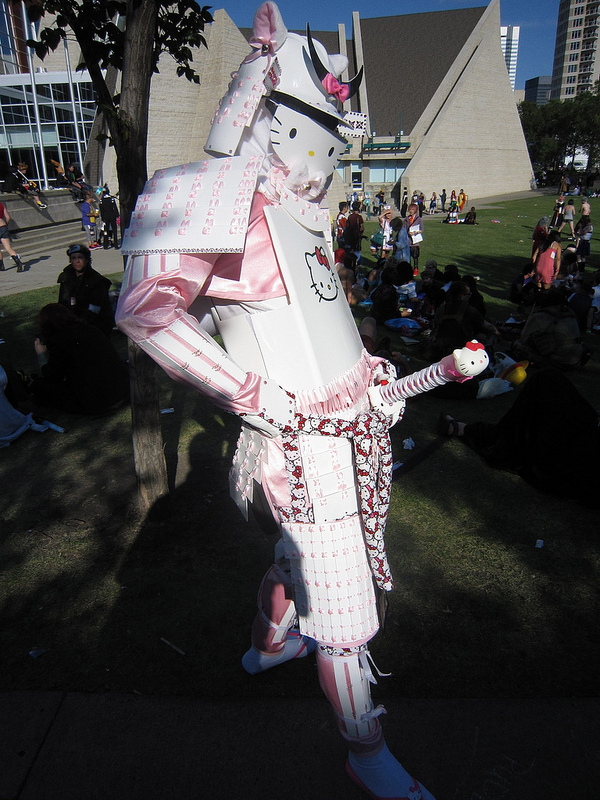
Yesterday I went to the Animethon. This is a convention about Japanese anime, manga, games, cosplay and related culture that takes place every year in Edmonton on the campus of Grant MacEwan City Centre Campus. The three day event attracts thousands (probably around 6000). A sgnificant portion of participants are dressed up for cosplay. You can see my photographs on Flickr in my Animethon 2013 set. The best of the cosplayers I saw was the Hello Kitty samurai knight in the photo above.
It is tempting to compare this Japanese pop culture event in Canada to ones I saw in Japan, but I haven’t seen enough on either side of the Pacific to be sure. What is clear to me is that Japanese pop culture is big here in Edmonton and not just among youth. While there were a lot of kids (some with parents), there were also older fans (like me.) I loved the inventive costumes and there seemed to be almost as many men cosplayers as women. Many took real pride in their costumes.
Some of the panels I went to included one on the Touhou Project and one on ball-jointed dolls (BJD). There was a cosplay contest with some fabulous costumes. I also spent time in the exhibit hall were I picked up a WonderSwan and some games, including a copy of Rez. Now I need a PS2 to play it on!
The ball-jointed doll session was the most interesting as it was a community I didn’t know much about. There is apparently a strong BJD club in Edmonton and they meet to trade and teach each other. Many of the participants had brought their dolls (see my photos) and they seemed to be mostly mature women, though there were some men there too with dolls. I can’t help wondering about the differences between the doll culture in Japan and here. Here it seemed to be a hobby in the tradition of collecting dolls. In Japan there seemed to be a subset of male owners for whom these dolls are more than collectibles, but that may be a projection.
Why the spammers are winning
The Guardian has a good article on spam,Why the spammers are winning that is based largely on a new book Spam: A Shadow History of the Internet by Finn Brunton. The article tells about what may be the first modern spam message which was distributed on a Sunday evening of 1864 by a telegraph company. The urgent message was from a dentists company advertising their hours.
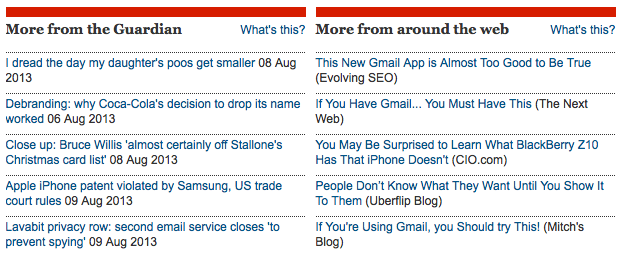
What is interesting is that spam filtering and spam filter bypassing agents are text technologies that are getting more and more sophisticated. As filters got better spam is no longer a matter for amateurs. Spam is also changing – there are more an more inventive ways to get you to read junk ads. For that matter at the end of Guardian articles there has been a collection of links to articles in the Guardian and elsewhere that feels a lot like clickbait. The links are paid for and provided by Outbrain. They tend to be ad cloaked as stories.
Digital Humanities 2013
I’m at the end of the Digital Humanities 2013 conference at the University of Nebraska. Inclusivity is a major issue. The final keynote was by Isabel Galina on “Is There Anybody Out There? Building a Global DH Community.” My conference notes are here.
It was a great conference and the organizers deserve praise.
Multipoint Touch Variorum
Luciano Frizzera has put the video up that he showed at Digital Humanities 2013 in our INKE panel. His video shows his multi-point touch variorum edition prototypes. He has been prototyping how we could use gestures on large screens, especially tables. He has interesting ideas about how people can discuss something on different sides of a table.
Rowling and “Galbraith”: an authorial analysis
JK Rowling has been recently uncovered at the author of The Cuckoo’s Calling which was submitted under the name Robert Galbraith. The Sunday Times revealed this after a hint on Twitter and some forensic stylometry. Patrick Juola, one of the two people to do the analysis has a guest blog where he talks about what he did at: Rowling and “Galbraith”: an authorial analysis. Great short description of an authorship attribution project.
NSA slides explain the PRISM data-collection program

The Washington Post has been publishing NSA slides that explain the PRISM data-collection program. These slides not only explain aspects of PRISM, but also allow us to see how the rhetoric of text analysis unfolds. How do people present PRISM to others? Note the “You Should Use Both” – the imperative in the voice.
Vicar – Access to Abbot TEI-A Conversion!
The brilliant folk at Nebraska and at Northwestern have teamed up to use Abbott and EEBO-MorphAdorner on a collection of TCP-ECCO texts. The Abbot tools is available here, Vicar – Access to Abbot TEI-A Conversion! Abbot tries to convert texts with different forms of markup into a common form. MorphAdorner does part of speech tagging. Together they have made available 2,000 ECCO texts that can be studied together.
I’m still not sure I understand the collaboration completely, but I know from experience that analyzing XML documents can be difficult if each document uses XML differently. Abbot tries to convert XML texts into a common form that preserves as much of the local tagging as possible.
Social Digital Scholarly Editing
On July 11th and 12th I was at a conference in Saskatoon on Social Digital Scholarly Editing. This conference was organized by Peter Robinson and colleagues at the University of Saskatchewan. I kept conference notes here.
I gave a paper on “Social Texts and Social Tools.” My paper argued for text analysis tools as a “reader” of editions. I took the extreme case of big data text mining and what scraping/mining tools want in a text and don’t want in a text. I took this extreme view to challenge the scholarly editing view that the more interpretation you put into an edition the better. Big data wants to automate the process of gathering and mining texts – big data wants “clean” texts that don’t have markup, annotations, metadata and other interventions that can’t be easily removed. The variety of markup in digital humanities projects makes it very hard to clean them.
The response was appreciative of the provocation, but (thankfully) not convinced that big data was the audience of scholarly editors.
Data Analytics’ Next Big Feat: Sarcasm Detection
Slashdot has a story about Data Analytics’ Next Big Feat: Sarcasm Detection. The BBC article that this draws from says the French company Spotter has algorithms for 29 different languages and that they can “identify sentiment up to an 80% accuracy rate.”
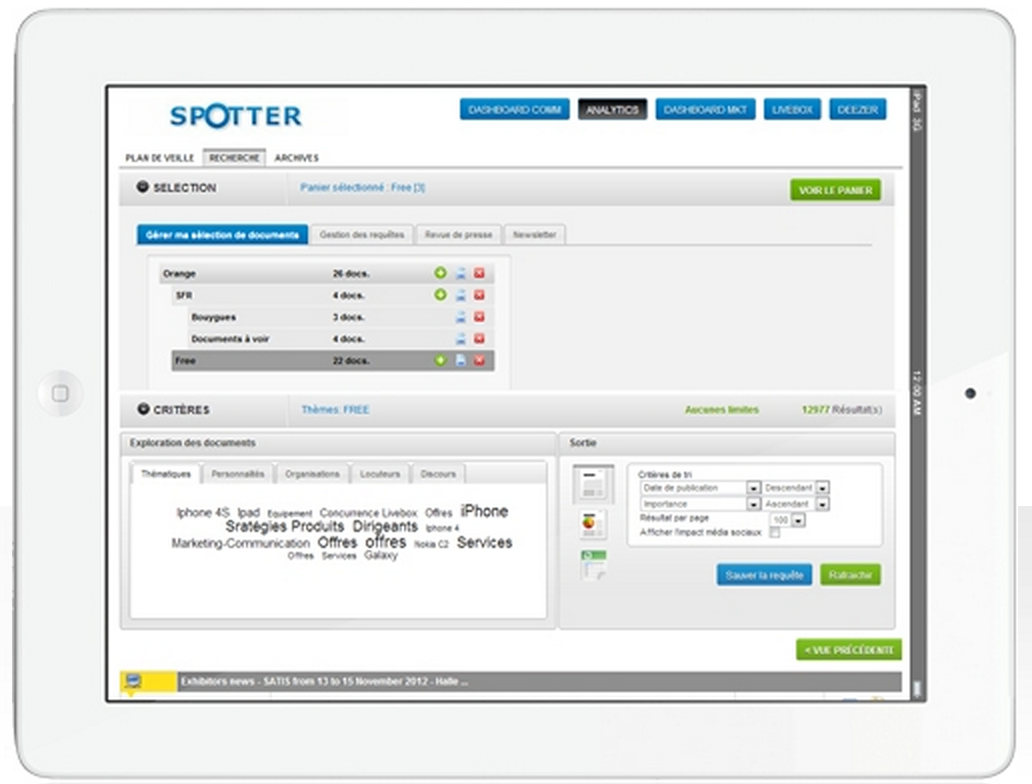
A screen shot from Spotter shows a tool running on an iPad with a word cloud for exploration and selection tools.
The same Slashdot story sent me also to a Wall Street Journal story about how the Obama 2012 campaign used Salesforce for sentiment analysis on email coming into the campaign.