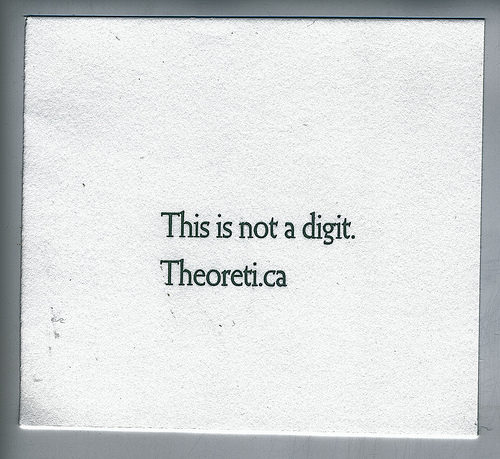
I’m taking a Letterpress course at SNAP (Society for Northern Alberta Print-Artists) and today I set my first type and printed my first text. I love being a student again. See the photos at Letterpress (a Flickr set).
I’m taking a Letterpress course at SNAP (Society for Northern Alberta Print-Artists) and today I set my first type and printed my first text. I love being a student again. See the photos at Letterpress (a Flickr set).
Brian Croxall has put up a useful reflection on a course he is teaching on an Introduction to Digital Humanities. His post describes his approach to the class (it is organized around some projects) and he provides his syllabus with links. I like how he used DH resources like DH Answers putting the course together.
Calen sent me this link of two chatbots talking with each other, AI vs. AI. Two chatbots talking to each other. I can’t help thinking the dialogue was scripted, but that doesn’t change the pleasure of imagining a chatbot getting irritated with another.
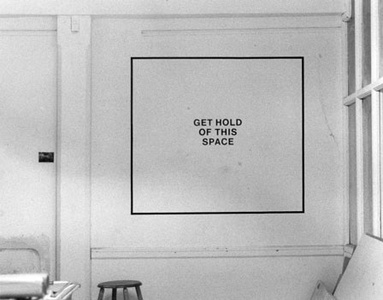
Gordon Lebredt Get Hold Of This Space 1974
Go see the TRAFFIC: Conceptual Art in Canada 1965-1980 exhibit at the Art Gallery of Alberta. It is a dense exhibit with hundreds of works and relevant documentation. It is organized by cities (a room for Halifax, one for Montreal …) and seems carefully researched. You will find yourself bewildered and amused at the variety of conceptual art projects executed in Canada. You will notice that everything was done back then with typewriters, video and tape recorders. The colors look bleached the way old and cheap photographs are. The aging of all those postcards and paper forms dates the works as if they were brought out of the attic or from the back of the family station wagon left in the sun.
This show was developed by a number of museums (from Vancouver to Halifax) and is touring those museums. You can read about the show when it was in Toronto. Or you can read about it in Magenta.

I came across a nice short essay by Alex Leavitt on Minecraft, “Open-Source Culture,” and Networked Game Development. Leavitt has a site, titled, Minecraft Ph.D. where he is documenting a project “about Minecraft that looks at the effect of large networks of people online on production in the creative industries.”
Peigi sent me a link to Locacious a great new iPhone app that lets you create walking tours. (Location + Loquacious = Locacious … Get it?) The walking tours are made up of locations with an image, text (links), and audio. Historians are using it to author urban history tours like “Jane Jacobs in Greenwich Village; The Flatiron District.” the app is free, but you apparently have to pay to upload your tour so that others can access it.
Note: the Locacious app seems to have been retired. See iOSnoops entry.

DIYLILCNC is a Do-It-Yourself little (LIL) Computer Numerical Controled mill. Useful for all those small wood-working projects.
Thanks to Scott for this.
The New York Times now has an article on the Criminal Intent project I was part of. See, Old Bailey Trials Are Tabulated for Scholars Online. They quote a historian who is sceptical of the results of mining, though he appreciates the resource.
“The Old Bailey Online project has done a great service in making those sources widely (and costlessly) available,” Mr. Langbein wrote in an e-mail. But he complained that the claims about data mining have “a breathless quality: ‘you can expect big things from us,’ but as yet it’s all method and no results.” He said that the new findings belittle the work of a generation of scholars who focused on the 18th century as the turning point in the evolution of the criminal justice system.
Alas, he seems didn’t read our report, but the summary in the Chronicle. It is easy to use cute phrases like “breathless quality”, but is he right? Time will tell, but I think the historians on our team have backed up the results found with mining and they never belittled the work of previous scholars – we saw ourselves building on it.
What can mining do? I think mining can give you a big picture so that you see the forest rather than trees in a way that no one could before. Conclusions about the shape of the forest have to be checked against other evidence, but the results of mining is evidence that is not breathless even if it takes your breath away. As Bill Turkel put it,
Mr. Turkel, who developed some of the digital tools, said that data mining reveals unexpected trends and connections that no one would have thought to look for before. Previous scholars “tended to cherry-pick anecdotes without having a sense that it was possible to measure all of that text and treat the whole archive as a single unit,” he said.
Of course, if you then leverage traditional evidence to buttress your argument then the mining is forgotten or trivialized.
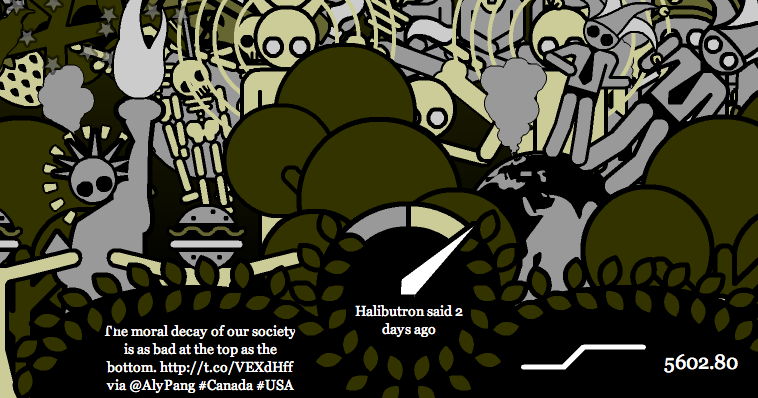
The Garden of Error and Decay is a real-time visualization of disasters mentioned in Twitter and other feeds. The text about the interactive says “this innovative moving image format is something like a real-time data driven narrative. This project is not a film, not a game, and not a nonlinear interactive story.” The visualization uses pictograms that represent the type of disaster. You can see the original twitter text.
Thanks to Scott for this.
I had heard about Bill Turkel’s ‘super secret’ project and how he had decided to keep the idea of the project secret but share the method, which is the opposite of what we usually do. As I am not on research leave (sabbatical) and working on 5 books (ha!) I thought I should learn from Bill. Here is the link to his excellent research workflow, How To « William J Turkel. What I like is that it is all stuff you can do with off-the-shelf tools, though not necessarily free ones.