Inside Higher Ed has a good article on the gender imbalance in Philosophy titled, Georgia State tries new approach to attract more female students to philosophy. The article discusses an experiment at Georgia State University to increase the number of women philosophers on the syllabus to at least 20 percent and then see if that makes a difference in how women students see the field. The article also goes beyond just the Georgia experiment to discuss reasons and reactions. I can’t help feeling that there is a connection between the statistics (see previous post) about women leaving the humanities for business and a philosophy curriculum with so few women philosophers.
Theoreti.ca: more than 10 years
I realized the other day that I have been blogging for 10 years, as of June 11th, which seems like an anniversary. You can see my Welcome message here. The WordPress Dashboard tells me I have 1,921 posts which means I have posted approximately once every two or three days. I confess there are times when I think I should just wrap it up and stop the blog as it feels like one more thing I have to do. On the other hand Theoreti.ca has been useful to me as a place where I know I can find my own notes (as long as I can get to the net). I think I’ll keep on going a bit more.

Theoreti.ca is not the first blog I started. Back in 2001-2 when blogs were the new thing (for me) I actually tried starting one a couple of times. The problem was that they were aspirational – I started blogs hoping I would live up to the aspirations for witty commentary I set myself. Needless to say, after a few posts I stopped writing and the blogs thankfully disappeared. Theoreti.ca worked because I set out only to keep research notes. I set myself a low bar – write stuff that you might find useful later. The second post is an example of that – a list of possible “intersections of mathematics, computer science, philosophy and multimedia” that could make for a nice lecture series or conference. Not a lot of context, no wit, and not that useful to anyone but me.
The question I ask myself now is whether blogging of this sort is out of date. Others tweet such short notes and WordPress is used more for web sites that need a news or essay function.
Perhaps I’ll keep going on a bit more, just in case blogs come back like bell-bottom jeans.
Humanities Committee Sounds an Alarm – Quants Answer
There has recently been a fair amount of discussion in venues like the New York Time (Humanities Committee Sounds an Alarm) about how the liberal arts (and humanities) are endangered.
This discussion was triggered by a report by the Commission on the Humanities & Social Sciences of the American Academy of Arts & Sciences.
As we strive to create a more civil public discourse, a more adaptable and creative workforce, and a more secure nation, the humanities and social sciences are the heart of the matter, the keeper of the republic—a source of national memory and civic vigor, cultural understanding and communication, individual fulfillment and the ideals we hold in common. They are critical to a democratic society and they require our support.
This report was requested by Senators from both parties and will be distributed back to Congress. It engages some of the current perceptions that the humanities are useless while STEM should promoted. Nationwide (in the USA) only 7.6 % of bachelor’s degrees are in the humanities (compared to 36% in 1954.)
Needless to say there are different views as to why the decline. Some have blamed the left-wing concern with race, class, and gender. Others blamed public rhetoric or emphasis on STEM. The New York Times now has an interesting article that references work by Ben Schmidt that shows the change might be due to women shifting from the humanities to business. See Ben Schmidt’s recent blog entry. The issues seem much more complex. Perhaps we should celebrate the success of newer professional disciplines in engaging segments of students that might not have attended college before.
What also stands out is how quantitative historians as providing answers to these questions that are at odds with the more theory driven answers.
CBC.ca alberta@noon Monday June 10, 2013
Last week I was interviewed by Judy Aldous on the CBC programme alberta@noon Monday June 10, 2013. We took calls about social media. I was intrigued by the range of reactions from “I don’t need anything other than messaging” to “I use it all the time for my company.” One point I was trying to make is that we all have to now manage our social media presence. There are too many venues to be present in all of them and, as my colleague Julie Rak points out, we are now all celebrities in the sense that we have to worry about how we appear in media. That means we need to educate ourselves to some degree and experiment with developing a voice.
Kyary Pamyu Pamyu: “Ninja ri Bang Bang”
Kyary Pamyu Pamyu has two new singles with neat videos on YouTube. Above you can see “Invader Invader” and the other is Ninja Re Bang Bang.
These two both have an anime/game theme. Could “Invader” refer to Space Invaders? Probably not. Here are the lyrics (translated into English) and it seems to be more about a fashion invasion from Japan.
Zyngas and Facebook woes

The Economist has a short story about Zyngas woes: The chips are down. The story talks about how Znyga is struggling after being the darling of the casual games industry. Znyga hasn’t adapted to mobile gaming and spent too much money.
From Twitter I learned of Sam Biddle’s article on Fired Zynga Staff Hits Reddit to Talk Life Before the Massacre. This gathers some comments about life and business in Zynga from recently fired staff including a strategy of “fast follow” which means copying the good ideas of others.
At the same time I came across a story on a study Teens, Social Media, and Privacy by the Pew Research Center and the Berkman Center for Internet & Society. They report that teens are turning away from Facebook as adults join. Teens are moving to using different tools for different tasks.
I can’t help wondering if there is a connection? If Facebook use by teens is dropping then Zynga’s Facebook games could run into trouble.
Text Visualization
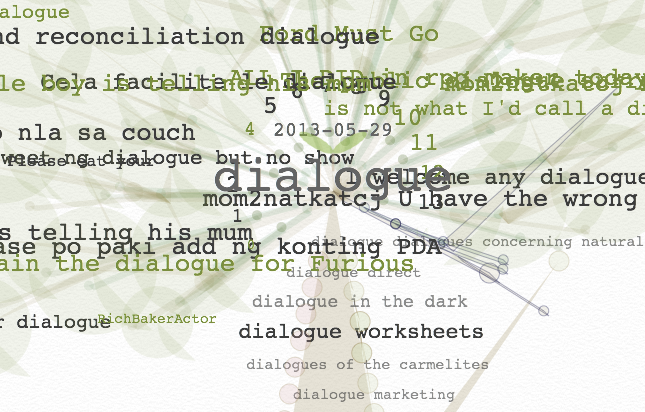
I came across a neat Japanese visualization tool whose name I think means something like “language leaves”, コトバノキ. The visualization uses a tree metaphor and will work with a url so you can pass it English text.
Around the World Symposium on Digital Culture
Tomorrow we are organizing an Around the World Symposium on Digital Culture. This symposium brings together scholars from different countries talking about digital culture for about 17-20 hours as it goes from place to place streaming their talks and discussions. The Symposium is being organized by the Kule Institute for Advanced Study here at the University of Alberta. Visit the site to see the speakers and to tune in.
Please join in using the Twitter hashtag #UofAworld
Japanese Game Studies 2013

I just got back from the International Japan Game Studies 2013 conference at Ritsumeikan University in Kyoto and I’ve been keeping a conference report at, Japanese Game Studies 2013. This is a follow up conference to the Re-playing Japan symposium we had last summer here in Edmonton. The plan is to have another one in August 2014 to continue the dialogue.
The conference was one of the best I’ve been to in a while. The mix of Japanese and North American scholars and designers coming at the issues from different traditions made for a fascinating confrontation of who games can be studied. At the end I was on a panel that talked about where we are going next. I suggested that we need to think about the following:
- How to conduct cross-cultural research so that we avoid the danger of generalizing about Japanese and Western players/designers.
- How the academy can engage the stakeholders including business, but only business. For example we should be engaging the doujin community, the indie developers, the journalists and the fans.
- Figuring out how to archive games and game related materials for future study is a priority.
- Training new researchers should also be a priority.
The MOOC Moment and the End of Reform – The New Inquiry
Sam sent me a great and careful article about MOOCs,The MOOC Moment and the End of Reform. The article is a longer version of a paper given by Aaron Bady at UC Irvine as part of a panel on MOOCs and For Profit Universities. In his longer paper Bady makes a number of points:
- We need to look closely at the rhetoric that is spinning this a “moment” of something new. Bady questions the sense of time and timing to the hype. What is really new? Why is this the moment?
- There isn’t much new to MOOCs except that prestige universities are finally trying online education (which others have been trying since the 1980s) and branding their projects. MOOCs represent Harvard trying to catch up with the University of Phoenix by pretending they have leapfrogged decades of innovation.
- The term MOOC was coined by in the context of an online course at the U of Manitoba. See the Wikipedia article on MOOCs. The Manitoba experiment, however was quite different. “[T]he goal of these original MOOCs was to foster an educational process that was something totally different: it would be as exploratory and creative as its participants chose to make it, it was about building a sense of community investment in a particular project, a fundamentally socially-driven enterprise, and its outcomes were to be fluid and open-ended.”
- MOOCs are speculative bubble that will burst. The question is what will things look like when it does?
- MOOCs are not necessarily open as many are being put on by for-profit companies. Perhaps they could be called MOCks.
- The economics of MOOCs need to be watched. They look a lot like other dot com businesses.
- MOOCs are the end of the change that happens when learning is in dialogue not the beginning of change. MOOCs could freeze innovation as they take so many resources to develop by so few.
Here is a quote:
If I have one overarching takeaway point in this talk, it’s this: there’s almost nothing new about the kind of online education that the word MOOC now describes. It’s been given a great deal of hype and publicity, but that aura of “innovation” poorly describes a technology—or set of technological practices, to be more precise—that is not that distinct from the longer story of online education, and which is designed to reinforce and re-establish the status quo, to make tenable a structure that is falling apart.