Heidegger: The Age of the World Picture

I’ve been reading some Martin Heidegger to try to understand how he approaches technology and methodology. An interesting essay in this regard is The Age of the World Picture. Here is an outline of the argument regarding research and method:

  • P. 114. Metaphysics, in the specific interpretation of what is, grounds an age. (He will return at the end to the metaphysics of our age which turns out to be representation and how we make scientific pictures of things like worlds. Thus the title of the essay only makes sense in an age represents the world as an object of which you could make a picture with science.)
  • P. 115. Science is one of the essential phenomena of the modern age (along with machine technology, art into aesthetics, human activity consumed as culture, and the loss of Gods.)
  • P. 117. The essence of science in this age is research. “knowing establishes itself as a procedure within some realm of what is, in nature or in history.”
  • P. 117. “Procedure does not mean here merely method or methodology. For every procedure already requires an open sphere in which it moves. And it is precisely the opening up of such a sphere that is the fundamental event in research.” The opening up or fundamental event in establishing a science is a projection that “sketches out in advance the manner in which the knowing procedure must bind itself and adhere to the sphere opened up.”
  • P. 119. Rigor: “Science becomes research through the projected plan and through the securing of that plan in the rigor of procedure. Projection and rigor, however, first develop into what they are in methodology.”
  • P. 119-20. Methodology: “Methodology, through which a sphere of objects comes into representation, has the character of clarifying on the basis of what is clear – of explanation.”
  • P. 120. A science doesn’t become research through experiment, but it is when the sphere is opened through projection and rigor that it becomes research and science in the modern sense.
  • P. 121. “Source criticism in the historical humanistic sciences corresponds to experiment in physical research.” He sees the historical disciplines as very similar when they become research to science.
  • P. 123. Ongoing activity is a fundamental event for modern science and research. “research is not ongoing activity because its work is accomplished in institutions, but rather institutions are necessary because science, intrinsically as research, has the character of ongoing activity.” H. compares research to erudition. Erudition is being replaced in the historical sciences by the ongoing activity or busyness of research which creates the need for institutions to support it. That is the punch line for humanities computing – we are about research in Heidegger’s sense of instituionally supported project ongoing activity. H. describes us thus,

The scholar disappears. He is succeeded by the research man who is engaged in research projects. These, rather than the cultivating of erudition, lend to his work its atmosphere of incisiveness. The research man no longer needs a library at home. Moreover, he is constantly on the move. He negotiates at meeting and collects information at congresses. (p. 124)

  • P. 133. “The fundamental event of the modern age is the conquest of the world as picture. The word ‘picture’ [Bild] now means the structured image [Gebild] that is the creature of man’s producing which represents and sets before.” To ask about the picture of the world is to ask from a metaphysical stance that takes the world as something that can be represented and set before us. That is why the title of the essay tells you more about age in which it is asked.

Heidegger ends on a strange not about the Gigantic leading into a Shadow on 134:

A sign of this event is that everywhere and in the most varied forms and disguises the gigantic is making its appearance. In so doing, it evidences itself simultaneously in the tendency toward the increasingly small. We have only to think of numbers in atomic physics. The gigantic presses forward in a form that actually seems to make it disappear – in the annihilation of great distances by the airplane, in the setting before us of foreign and remote worlds in their everydayness, which is produced at random through radio by a flick of the hand. Yet we think too superficially if we suppose that the gigantic is only the endlessly extended emptiness of the purely quantitative. We think too little if we find that the gigantic, in the form of continual not-ever-having-been-here-yet, originates only in a blind mania for exaggerating and excelling. We do not think at all if we believe we have explained this phenomenon of the gigantic with the catchword “Americanism” (Appendix 12).

The gigantic is rather that through which the quantitative becomes a special quality and thus a remarkable kind of greatness. Each historical age is not only great in a distinctive way in contrast to others; it also has, in each instance, its own concept of greatness. But as soon as the gigantic in planning and calculating and adjusting and making secure shifts over out of the quantitative and becomes a special quality, then what is gigantic, and what can seemingly always be calculated completely, becomes, precisely through this, incalculable. This becoming incalculable remains the invisible shadow that is cast around all things everywhere when man has been transformed into subiectum and the world into picture (Appendix 13).

TPM: The Philosophers’ Magazine | The real thing?

Thanks to Peter I came across an article in The Philosophers’ Magazine titled The real thing? (by Julian Baggini, Issue 43, posted May 5, 2009) about social epistemology. Social epistemology according to Alvin Goldman, who was interviewed for the article, examines the social dimension of knowing. Goldman is quoted as saying,

Historically, epistemology focused on how you can get the truth about the world. The question for social epistemology is something like, how does the social affect people’s attempts to get the truth? So what I want to do, and this has been part of my efforts for these 10 years or so, is to try to give a bigger focus to the social side of epistemology, while remaining continuous with the philosophical tradition.

Hacking as a Way of Knowing: Our Project on Flickr

Photo of Projection

I put a photo set up on Flickr for our Hacking as a Way of Knowing project. The set documents the evolution of the project which I’ve tentatively named the “ReReader for the Writing on the Wall”. Thanks to all those who made the project and the workshop a success. Now I have to think a bit deeper about making as knowing and things as theories.

Hacking as a Way of Knowing – Digital History

At the end of the week I’ll be going to Toronto for what I expect will be one of the most interesting workshops ever. William J. Turkel at Western has organized a hands-on workshop on Hacking as a Way of Knowing to reflect on electronic waste and data about the environment. The short description of the purpose is,

This three-day workshop will explore the theme of E-waste and environmental data. Working in small groups, participants will be given the task of hacking some typical consumer e-waste to create reflective technological assemblages that incorporate ‘nature’ in some form while calling one or more of our basic assumptions into question.

This is not so much about building something, but about thinking about how fabrication (hacking) is a way of thinking through AND in this case we will be thinking through the environment and all the waste around computing. I suspect I’m going to be embarassed by how much I waste.

Gary Hall: Digitize this book

A couple of weeks ago I posted a blog entry about Gary Hall’s book Digitize This Book! I noted that I couldn’t find a digitized copy of the book and asked if others knew of one. To my surprise Gary wrote me back and pointed to the items listed below. Now that is the Internet at work! He is trying to get the publisher to allow a digital copy to be posted online, but in the meantime pointed out online versions of what became chapters in the book:

(2003) ‘Digitise This’, Mediactive, Vol. 1, No. 1 (pp. 76-90); republished in (2004), The Review of Education, Pedagogy and Cultural Studies, Vol. 26, No. 1, January-March (pp. 23-46) at http://scm-rime.tees.ac.uk/VLE/DATA/CSEARCH/MODULES/CS/2006/03/0147/_.doc (MS Word Document)

(2007) ‘IT, Again: or, How to Build an Ethical Virtual Institution’, in Experimenting: Essays With Samuel Weber, edited by Gary Hall and Simon Morgan Wortham (Fordham University Press: New York) (pp.116-140) at http://scm-rime.tees.ac.uk/VLE/DATA/CSEARCH/MODULES/CS/2008/01/0740/_.doc (MS Word Document)

Gary Hall says that “Since the book came out I’ve also published a new piece on open access publishing and the humanities” at http://www.culturemachine.net/index.php/cm/issue/current. A video of him presenting it as a talk is available at Pirate Philosophy – Steal This! .

I take back any irony in my previous post. (Can one take back irony? Perhaps I can only apologize for being ironic to early.)

A Collaborative Research Commons

Computing With The Infrastructure At Hand is an essay I wrote last weekend and have been editing that tries to think about how to do humanities computing if you don’t have grants and don’t have lots of support. I ended up trying to imagine a Collaborative Research Commons that imagines crowdsourcing digital humanities work.

While research as a gift economy may seem idealistic, I’ve been surprised by the extraordinary collaboration you get when you set up a structured way for people to contribute to a project. The Suda On Line project first showed (me at least) the potential for social and volunteer research. I’ve had luck with the Dictionary of Words in the Wild and the upcoming Day of Digital Humanities. This last project has yet to happen, but we have close to 100 participants signed up. My point is that we can imagine ways to research that don’t start with how to get a grant before we can talk.

Hall: Digitize This Book!

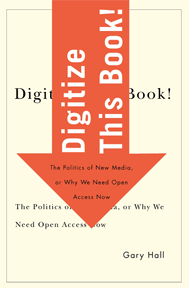
Cover of BookDigitize This Book! by Gary Hall is an interesting book at the intersection of cultural studies and humanities computing. The book seems to be addressed mostly to the cultural studies crowd arguing that “do cultural studies writers, thinkers, and practitioners not also need to experiment with ways of being ‘militant’ in a positive, innovative, creative, and constructive fashion in their own situations, institutions, and places of work?” (p. 206) The book is a sustained defense of the Cultural Studies e-Archive (CSeARCH) and other computing projects that Hall has initiated. He is trying to make space in cultural studies for projects we would recognize as humanities computing projects. To do this he argues against “transcendental politics” which assume a commitment to a particular political analysis in order to open room for actions, like starting an open archive, that cannot be demonstrated a-priori to be in support of capitalism or not. He ends the book with,

A fixed, pure and incorruptible institution could only be a violent, transcendental, totalizing, and totalitarian fantasy. One could even argue, after Derrida, that it is precisely the structurally open and undecidable nature of the situation – the fact that an institution or archive can be used to facilitate the forces of capitalism and globalization – that gives it ethical and political force. (p. 214)

Now I tend to shudder when I read phrases like “the forces of capitalism”, partly because I don’t understand the tradition of thought that takes such things as givens, but I don’t, as many colleagues do, believe we should therefore shun cultural studies or other forms of post-modern thought. Hall is interested in something important and that is the ethics and politics of digital work. To avoid discussing the ethics and politics of what we do in the university or as developers of digital works is to ascribe to a naive and unexamined ethic. Many avoid politics because the discourse has been politicized by second rate cultural studies folk who think shaming others for not being militant is a form of engagement. Hall is trying to open room for a form of politics beyond politics (or hyperpolitics) where we can act without knowing for sure what the consequences of our actions will be. That is the heart of ethics for me, acting (or not, which in turn is a form of acting) in the face of insufficient knowledge or ability. We always do things without being sure, ethics is knowing that and trying to deal thoughtfully with the ignorance.

Part of what I am saying here, then, is that certain forms, practices, and performances of new media – including many of those associated with open-access publishing and archiving – make us aware that we can no longer assume that we unproblematically know what the “political” is, or what sorts of interventions count as political. (p. 196)

Hall in his actions (like CSeARCH and the Open Humanities Press) and in his writing is trying to reach out to those in open access circles and in computing circles. We who are too buried in the techne should reach back.


You can find earlier versions of sections on CSeARCH like The Cultural Studies E-Archive Project (Original Pirate Copy), but, ironically, I can’t, find a copy of Digitize This Book!. No one has bothered to digitize it, no doubt due to the copyright notice as the beginning (p. iv) that states,

All rights reserved. No part of this publication may be reproduced, stored in a retrieval system, or transmitted, in any form or by any means, electronic, mechanical, photocopying, recording, or otherwise, without the prior written permission of the publisher. (p. iv)

Is there a contradiction between the injunction of the title (“Digitize This Book!”) and the copyright notice? What is the status of a title when it comes to rights? Should I digitize the book?

To be fair to Hall, the chapters of his previous book, Culture In Bits are available on CSeARCH and I assume he will make Digitize This Book! also available after a suitable interval. Perhaps someone knows him and can update me or point me to a digitized version already open.

Note: since writing this someone passed on a note to Gary Hall who kindly pointed me to online copies of other chapters. See my more recent blog entry with the links.


Hall makes an interesting move at the beginning of the book to position open access as a middle way for the university between the commercialization of the university and the (impossible elitist) return to whatever it is we think we were doing in the humanities in the good old days. I find it interesting that Hall believes “cultural studies has for some time now arguably been the means by which the university thinks about itself …” (p. 13). I’ve seen no evidence of this – cultural studies to me seems to want to position itself as outside the university critiquing it in the Socratic gadfly tradition rather than taking a role acknowledged by the university. It would probably come as a surprise to most university administrators that cultural studies is doing this for them and somehow represents the university’s institutionalized reflection. And therein lies the promise of Hall’s book – that there is type of creative activity we can all engage in, through which we can imagine the university by modeling it. We don’t need approval to set up open works. We can use the technology to become a way for the university to think about itself.

The Apostrophe: When they’re gone, theyre gone

Image of Street Sign without Apostrophe

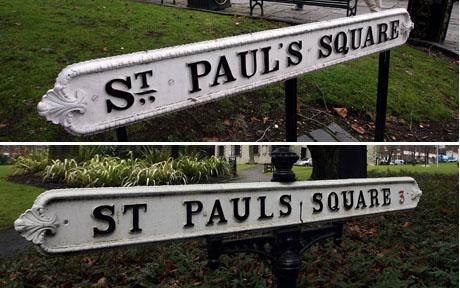
Today’s Edmonton Journal reprinted a great article on the apostrophe following the widely reported decision of the Birmingham city council to stop using apostrophes in signs to save money (and not have do deal with pedants). The article, titled When theyre gone, well all be struggling with English traces some of the issues around the use of this “tadpole-shaped bundle of trouble.” It is worth pointing out that apostrophes are important to humanities computing. They are used, among other things, to mark absence. As the etymology of apostrophe suggests, they point away from the text, like a link, to something missing or passed over (in the sense that you don’t pronounce the missing sylable.) I’m less interested in the controversy over punctuation reform as what we can learn from punctuation about markup and the digital representation of text.

  • Punctuation is both part of the text and about the text. An apostrophe likewise is both part of the string of characters that we could call the text and yet points to something missing that the reader can fill in. This being of it and about it is what is difficult about the textual ontology of markup. See Markup: Buzzetti and Renear.
  • There is, as with most punctuation, a rhetorical dimension to the apostrophe. The word also refers to an exclamatory figure of speech when a speaker turns away and addresses some other imaginary audience often introduced by “O”. For example when Juliet turns away and addresses Romeo in Romeo and Juliet, Act II, Scene 2, “O Romeo, Romeo! wherefore art thou Romeo?” Likewise markup is apostrophic in that it typically addresses the machine rather than the reader. The tags of the anchor element in HTML, for example, are hidden from the reader and provide instruction for the machine should the reader click on the anchored text.
  • The single quotation mark on typewriters and early computers (7-bit ASCII) is one of the most overloaded characters. It is used for all sorts of different things from the single quotation mark, to the apostrophe, to the acute accent. Likewise markup overloads certain characters with special meaning through the general strategy of the escape character. The left angle bracket < gets loaded with a new function in XML markup languages: it serves not as a visible character, but as the mark that sets certain text aside to be interpreted differently as code. The text between angle brackets is turned aside to be interpreted by the machine. That we have escape characters or punctuation like an apostrophe that can turn the interpretation is somehow a important to computing and digital representation. That most keyboards have an Escape key indicates how important is the possibility of escape. It is the key to the possibility of interruption of the machine.

The apostrophe could be the punctuation mark of an escape that always was. It turns us away from using text to appreciate what is gone. They’re gone because they are always escaped. Theyre gone because they were never here.