Shannon sent me a link to the The Museum of Forgotten Art Supplies at Drawger.com. Many of the items are more design or publishing supplies. Many of them are evocative of “the good old days” when we used analogue tools.
Shannon sent me a link to the The Museum of Forgotten Art Supplies at Drawger.com. Many of the items are more design or publishing supplies. Many of them are evocative of “the good old days” when we used analogue tools.
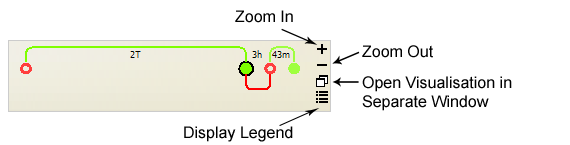
Here is a neat idea for small visualizations to help follow email threads, ThreadVis – Visualising Conversations – Mozilla Thunderbird Add-on. Alexander Hubmann-Haidvogel developed ThreadVis as a Thunderbird Extension as part of his Master’s Thesis, which is available for download (PDF).
When I was in the USA Google Books not long ago, I downloaded a PDF of the public domain work The apology of Socrates (translated by D. F. Nevill). (Note that you can’t get the PDF in Canada, probably because of different copyright laws concerning public domain.) I was double checking that Google didn’t give you easy access to the whole plain text. You either get the PDF (without text) or you can see the Plain Text one page at a time. This makes it hard to run analytical tools for research on public domain texts from Google Books.
What intrigued me, however, were the traces of the scanning in this PDF. For whatever reason there are a number of images of pages partly turned. These images are the trace of a process.


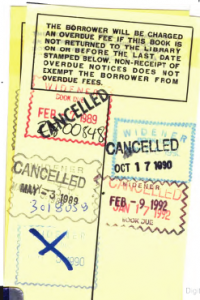
The last one is from the back where the librarians stamp the book when returned. What do we know about the Google scanning technology? CNet has an interesting story, Patent reveals Google’s book-scanning advantage, about how they use infrared to compensate for the curvature of pages. There are also stories like this one in Tech Crunch on how Google Books Adds Hand Scans that suggest humans are part of the process.

Bad meetings are your fault is a great post on Prof. Hacker (Tips & Tutorials for higher ed: productivity & pedagogy in a digital age) sent to me by Stéfan.
I don’t mind meetings, I think it has to do with age and seniority. The older you are the more you like people and the more senior you are, the more you can use meetings to tell others what to do. God probably loves all meetings, that’s why he created the universe – one long meeting he can chair.
Seriously. Meeting can be a great way to keep things moving on projects. People don’t like them because they usually haven’t done what they should have and the meeting will expose that.
I’ve been reading some Martin Heidegger to try to understand how he approaches technology and methodology. An interesting essay in this regard is The Age of the World Picture. Here is an outline of the argument regarding research and method:
The scholar disappears. He is succeeded by the research man who is engaged in research projects. These, rather than the cultivating of erudition, lend to his work its atmosphere of incisiveness. The research man no longer needs a library at home. Moreover, he is constantly on the move. He negotiates at meeting and collects information at congresses. (p. 124)
Heidegger ends on a strange not about the Gigantic leading into a Shadow on 134:
A sign of this event is that everywhere and in the most varied forms and disguises the gigantic is making its appearance. In so doing, it evidences itself simultaneously in the tendency toward the increasingly small. We have only to think of numbers in atomic physics. The gigantic presses forward in a form that actually seems to make it disappear – in the annihilation of great distances by the airplane, in the setting before us of foreign and remote worlds in their everydayness, which is produced at random through radio by a flick of the hand. Yet we think too superficially if we suppose that the gigantic is only the endlessly extended emptiness of the purely quantitative. We think too little if we find that the gigantic, in the form of continual not-ever-having-been-here-yet, originates only in a blind mania for exaggerating and excelling. We do not think at all if we believe we have explained this phenomenon of the gigantic with the catchword “Americanism” (Appendix 12).
The gigantic is rather that through which the quantitative becomes a special quality and thus a remarkable kind of greatness. Each historical age is not only great in a distinctive way in contrast to others; it also has, in each instance, its own concept of greatness. But as soon as the gigantic in planning and calculating and adjusting and making secure shifts over out of the quantitative and becomes a special quality, then what is gigantic, and what can seemingly always be calculated completely, becomes, precisely through this, incalculable. This becoming incalculable remains the invisible shadow that is cast around all things everywhere when man has been transformed into subiectum and the world into picture (Appendix 13).
 Twitter is so yesterday … I’m trying out brightkite.com a location-based social network tool. If you download the iPhone app then you can “Check In” so your friends (or everyone) knows where you are (were). Alternatively you can post a note to your (or a nearbye) location or you can post a photo.
I want to see if this can be used for geo-games or adding a knowledge layer to locations. I can get a “Placestream” by location, but the emphasis of the interface is on friends nearby (all five people in Edmonton that I don’t care about) and what’s happening (the inane “I’m here” posts of the terminally boring.) I want to create a quality layer of location-based knowledge that someone could subscribe to, like a “Local History of Edmonton” that people could turn on to get local history in the wild.
They seem to be collaborating with Layar, which is cool, and they do have an API …
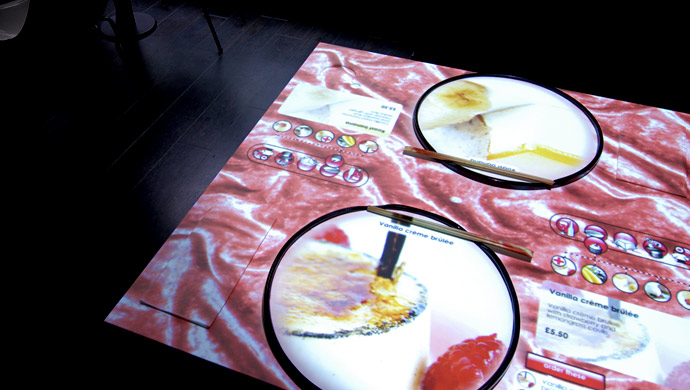
From the Wall Street Journal online I learned about a restaurant in Soho, London called, inamo. The restaurant has projectors over the tables so the table top is an interactive screen. You can project menu choices onto your plate, change the mood, play games, and even order a taxi. I wonder if we are going to see a lot more table-top displays? Will advertising pay for interactive tables all over? What could we do with a seminar room?
The Google Book Search Settlement, if approved by Judge Chin, may be a turning point in textual research. In principle, if the settlement goes through, then Google will release the full 7-10 million books for research (“non-consumptive”) use. Should get even the 500,000 public domain books for research we will have a historic corpus far larger than anything else. To quote the Greg Crane D-Lib article, “What can you do with a million books?” and “What effect will millions of books have on the textual disciplines?”
There is understandably a lot of concerns about the settlement especially about the ownership of orphan works. The American Library Association has a web site on the settlement, as do others. I think we need to also start talking about how to develop a research infrastructure to allow the millions of books to be used effectively. What would it look like? What could we do? Some ideas:
Update: Matt pointed me to an article in the Wall Street Journal on Tech’s Bigs Put Google’s Books Deal In Crosshairs.

Garry pointed me to Percussa AudioCubes. These cubes communicate by infrared to communicate distance information that you can use as input.
Location, orientation and distance information is passed to the software, while you interact with the cubes. The software can connect via MIDI or OpenSoundControl (OSC) to any software or hardware for music or visuals which you already have, or you can use it within your DAW (digital audio workstation) software as a VST plugin, or as a host for VST instruments to let you create sound immediately. (From How do they work?)