 I just got back from a conference in Ireland titled, A Vision Of Digital Humanities In Ireland (this link is to my conference report). The conference was preceded by the announcement and unveiling of DHO Discover. Shawn Day (in photo above) demonstrated the new discovery tool that brings together metadata about 6000 objects across different digital collections in Ireland. The conference was a capstone event for the Digital Humanities Observatory which is now coming to an end.
Topicmarks – summarize your text documents in minutes
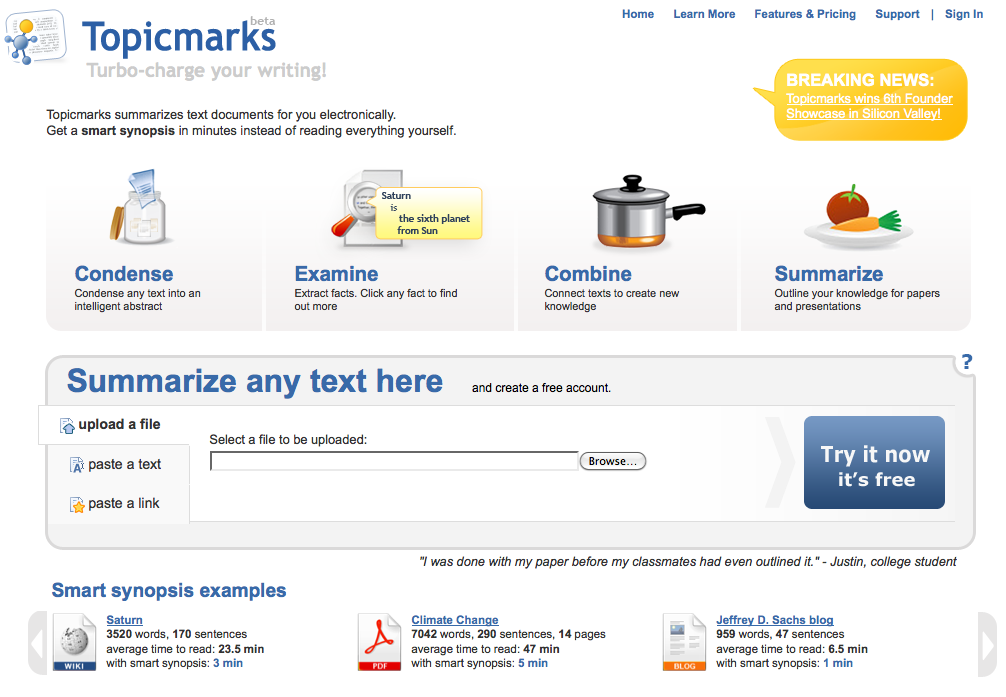
Thanks to Shawn Day’s Day of DH I learned aboutTopicmarks – summarize your text documents in minutes. It is a commercial version of a basic text analysis tool for summarizing readings. They emphasize how much time you spend not reading the whole document analyzed. It reminds me of a playful name we had for a prototype recommendation engine, “Write My Paper”. Look at the screen shot – some of the features they have that we had in TAPoR:
- Ability to paste text, use an URL, or upload a text
- Summarizer that combines different tool results
- Cooking metaphor (we have recipes)
To be honest, TopicMarks deserves points for a simple and clear interface and clear results. They don’t try to do everything. They are also clear on why you would use this (to save time reading.)
1st Game Design Workshop, Mar 11 – Vadim Bulitko – Picasa Web Albums

As part of research we are doing in GRAND we decided we need a lot more experience designing games. Garry and Patrick ran our 1st Game Design Game (Workshop) on Saturday. (The link takes you to pictures Vadim Bulitko took – thanks Vadim.)

Patrick and Garry developed a meta-game (a game about games) where each team had to pick a card or two from each of three piles (who, when/where, and why). The cards then formed the constraints within which we had to design a game. Later we had to pick two more cards which constrained what sort of game it would be and how we were to present it.
The team I was on picked Who=Non-human, Where=Is Poor, and Uses a Microphone. We came up with a game that was so good that we are now busy patenting it. Above all we had fun making costumes and props.
Digging Into Data: Second Round Announced
The second round of the Digging Into Data has just been announced and they now have one more country (the Netherlands) and eight international funders. (You can see the SSHRC Announcement here.)
The Digging Into Data challenge is an international grant program that funds groups that have teams in at least two countries so it is good that they are expanding the countries participating. What is even more extraordinary is that they have one adjudication process across all the funders (rather than an adjudication process where each national team has to apply to their own country’s program – which never works.)
I was part of one of the groups that got funding in the first round with the Criminal Intent project. I’ve found the collaboration very fruitful so I’m glad they are supporting this for another round.
HuCon 2011: Conference Report
I’m at the HuCon 2011: Current Graduate Research in Humanities Computing organized by the Humanities Computing graduate students here at the University of Alberta. My
conference report is here. It is being written as we go. Milena Radzikowska is the keynote speaker.
Metagame: the game debate game

Garry pointed me to Metagame: the game debate game. This card game reminds me of Scruples – you debate issues triggered by cards and bystanders vote for the better argument. Unlike Scruples this game was designed to be played at a conference. Very neat idea that could be adapted to all sorts of fields.
You can support The Metagame on Kickstarter.
The File On H.: Ismail Kadare
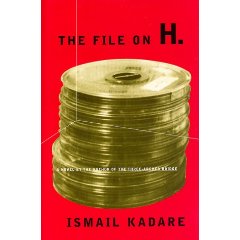
I’ve been meaning for years to blog about Ismail Kadare’s The File On H.. This short book is, I believe, Kadare’s response to the naive views about orality and primitive societies of people like Lord and Parry. Kadare apparently met them at a conference and there is no doubt that the book is some sort of literary response to their study of oral storytelling in the Balkans. The authors of the Wikipedia entry on the book seem to feel that Kadare was trying to alert us to the Albanian oral traditions that Lord and Parry ignored for the Serbo-Croatian ones. I think he was making fun of American academics trying to recover some noble and original orality and also trying to show that there is a continuity between oral storytelling and the constant spying on people of a police state.
<Spoiler Alert>Technology, this time magnetic tape recording, plays an important part in the plot. The two academics bring this new type of machine to Albania to record the local rhapsodes. A jealous Serbian monk stirs up trouble and the recordings get shredded. Ironically, while the two academics have nothing to left when they leave Albania, one of them has caught the bug and been infected with orality. They may not have recordings, but they have learned to do it. Which is the more useful?
The Battle for Control — What People Who Worry About the Internet Are Really Worried About
From Humanist a pointer to a great blog essay by Kent Anderson about The Battle for Control — What People Who Worry About the Internet Are Really Worried About. The essay starts by talking about all arguments for an against the internet making us smarter or stupider. He quotes Adam Gopnick’s nice essay “The Information; How the Internet gets inside us” in the New Yorker that divides us into three groups,
. . . the Never-Betters, the Better-Nevers, and the Ever-Wasers. The Never-Betters believe that we’re on the brink of a new utopia, where information will be free and democratic. . . . The Better-Nevers think that we would have been better off if the whole thing had never happened, that . . . books and magazines create private space for minds in ways that twenty-second bursts of information don’t. The Ever-Wasers insist that at any moment in modernity something like this is going on, and that a new way of organizing data and connecting users is always thrilling to some and chilling to others.
Kent then turns historical looking at both the infoglut trope over time and then, in an original move, he looks at what some of the originators of the Internet thought it would be. He ends by concluding that it is really about control,
We may argue again and again whether the Internet is changing our brains, elevating us, lowering us, making us smarter, or making us stupid. But at the end of the day, it seems the real argument is about control — who has it, who shares it, and who wants it.
Lancashire: Literary Alzheimer’s
In the category of things I meant to blog some time ago is Ian Lancashire and Graeme Hirst’s research into Agatha Christie’s Alzheimer’s-related dementia which was written up by the New York Times in their list of notable ideas for 2009. The write up is by Amanda Fortini, see Literary Alzheimer’s – The Ninth Annual Year in Ideas – Magazine. There is a longer article about this research by Judy Stoffman in the Insight section of the Toronto Star, An Agatha Christie mystery: Is Alzheimer’s on the page? (Jan. 23, 2010)
Lancashire’s specialty is the esoteric field of neuro-cognitive literary theory – in his words “what science says about the creative process versus what authors report about how they create their books.” He started to apply computer analysis to literary texts in 1982.
Ian Lancashire has links to the poster that first got attention and to a paper on his home page. He has also just published a book, Forgetful Muses; Reading the Author in the Text that develops his neuro-cognitive literary theory.
NYT: Armies of Expensive Lawyers, Replaced by Cheaper Software
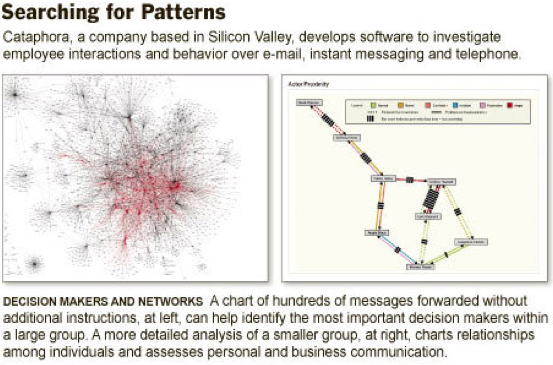
The New York Times has an article about commercial text analysis systems by John Markoff, Armies of Expensive Lawyers, Replaced by Cheaper Software (March 5, 2011, A1 in New York Edition; March 4 online). He describes how companies are building systems that can analyze the immense amounts of documents shared in lawsuits. Traditionally an army of people would comb through the documents, “Now, thanks to advances in artificial intelligence, “e-discovery” software can analyze docuemnts in a fraction of the time for a fraction of the cost.”
Some programs go beyond just finding documents with relevant terms at computer speeds. They can extract relevant concepts — like documents relevant to social protest in the Middle East — even in the absence of specific terms, and deduce patterns of behavior that would have eluded lawyers examining millions of documents.
There is a nice graphic to accompany the article here. Markoff mentions companies like Blackstone Discovery and Cataphora. He also argues that the availability of a large email archive from Enron has made it possible for teams to experiment on a real dataset.