Watch Andy Warhol “Paint” On A Commodore Computer: Gothamist

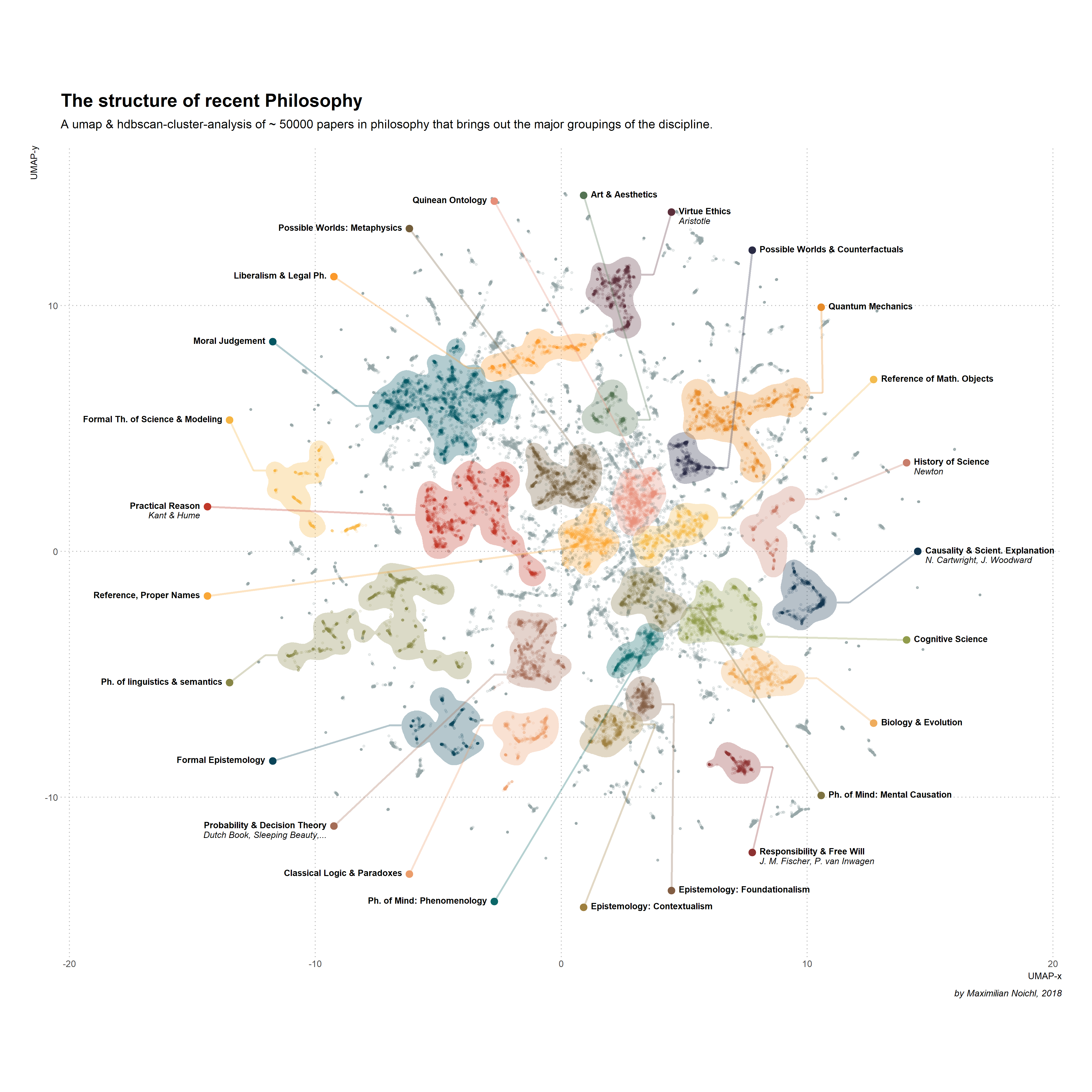
Eric Hayot at the Novel Worlds conference showed a slide with an image of Debbie Harry of Blondie painted on the Amiga by Andy Warhol. There is a video of Warhol painting on the Amiga at the premiere of the Commodore Amiga.

This is discussed in a documentary The Invisible Photograph: Part 2 (Trapped). The documentary also talks about recovering other images from Warhol’s original Amiga that was preserved by the The Andy Warhol Museum.

Technologizer has a nice retrospective on the Amiga, Amiga: 25 Years Later. I remember when it came out in 1985. I had a Mac by then, but was intrigued by the colour Amiga and the video work people were doing with it.

Every Noise at Once

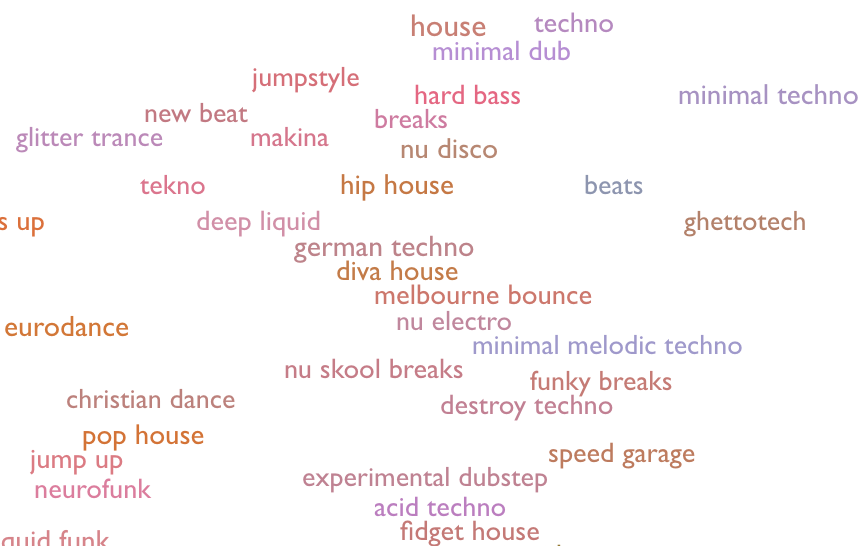
Ted Underwood in a talk at the Novel Worlds conference talked about a fascinating project,  Every Noise at OnceThis project has tried to map the genres of music so you can explore these by clicking and listening. You should, in theory, be able to tell the difference between “german techno” and “diva house” by listening. (I’m not musically literate enough to.)

Nakamura: Transmedia Storytelling within the Media Mix system in Japanese Pop Culture

Today I had the honour to introduce Professor Aki Nakamura from Ritsumeikan University who talked about Transmedia Storytelling within the Media Mix system in Japanese Pop Culture at the JSAC 2018 conference in Edmonton.

He began by introducing us to transmedia storytelling. He talked about how transmedia franchises can extend the fictional world through space and time.
Continue reading Nakamura: Transmedia Storytelling within the Media Mix system in Japanese Pop Culture

Big Tech’s Half-Hearted Response To Fake News And Election Hacking

Despite big hand waves, Facebook, Google, and Twitter aren’t doing enough to stop misinformation.

From slashdot I found a story about : Big Tech’s Half-Hearted Response To Fake News And Election Hacking. This Fast Company story talks about ways that social media companies are trying to prevent the misuse of their platforms as we head into the US midterms.

For Facebook, Google, and Twitter the fight against fake news seems to be two-pronged: De-incentivize the targeted content and provide avenues to correct factual inaccuracies. These are both surface fixes, however, akin to putting caulk on the Grand Canyon.

And, despite grand hand waves, both approaches are reactive. They don’t aim at understanding how this problem became prevalent, or creating a method that attacks the systemic issue. Instead these advertising giants implement new mechanisms by which people can report one-off issues—and by which the platforms will be left playing cat-and-mouse games against fake news—all the while giving no real clear glimpse into their opaque ad platforms.

The problem is that these companies make too much money from ads and elections are a chance to get lots of ads, manipulative or not. For that matter, what political ad doesn’t try to manipulate viewers?

The slashdot story was actually about Mozilla’s Responsible Computer Science Challenge which will support initiatives to embedd ethics in computer science courses. Alas, the efficacy of ethics courses is questionable. Aristotle would say that if you don’t have the disposition to be ethical no amount of training would do any good. It just helps the unethical pretend to be ethical.
The structure of recent philosophy (II) · Visualizations

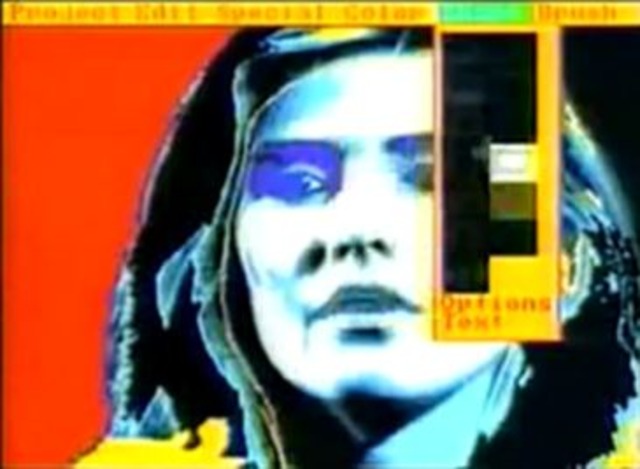
In this codebook we will investigate the macro-structure of philosophical literature. As a base for our investigation I have collected about fifty-thousand reco

Stéfan sent me a link to this interesting post, The structure of recent philosophy (II) · Visualizations. Maximilian Noichl has done a fascinating job using the Web of Science to develop a model of the field of Philosophy since the 1950s. In this post he describes his method and the resulting visualization of clusters (see above). In a later post (version III of the project) he gets a more nuanced visualization that seems more true to the breadth of what people do in philosophy. The version above is heavily weighted to anglo-american analytic philosophy while version III has more history of philosophy and continental philosophy.

Here is the final poster (PDF) for version III.

I can’t help wondering if his snowball approach doesn’t bias the results. What if one used full text of major journals?

Every time Ford and Kavanaugh dodged a question, in one chart

There was a striking difference in style — and substance.

Vox has a nice interactive visualization of Every time Ford and Kavanaugh dodged a question, in one chart. The two visualizations, one for Ford and one for Kavanaugh, show at a glance how the latter dodged a lot more questions. You can click on the sections which are marked as dodgy and see the full text. Nice clear use of visualization to tell a larger story and let the user explore.