SET 26

Image of GROCK

SET 26 is a Swiss design company that sells furniture shaped like letters from the Roman alphabet. Each letter costs about 1,500 Euros and has doors that open revealing shelves. They have a Konfigurator so you can see any combination of 5 letters in the available colours (like the GROCK above.)

I read about this in a strange online Facsimile Magazine while reading a reproduction of a 1970 Time Life Books’ Nature/Science Annual article on “Art’s New Ally – Science.” The article documents a number of technological arts projects including the Experiments in Arts and Technology (E.A.T.) cooperative founded by Billy Klüver and Robert Rauschenberg.

Human Beans: Provocative Design

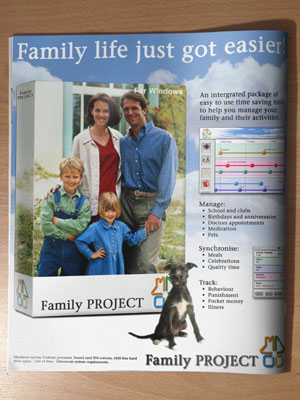
Human Beans: Family Project Fictional Package

Human Beans is a provocative design group that I read about in a great article “Unstated Contributions – How Artistic Inquiry Can Inform Interdisciplinary Research” by Chris Rust in International Journal of Design (vol. 1, no. 3, 2007.) Rust cites Human Beans as an example of designers experimenting with fictional products (like the Family Project) as a form of conceptual art. Their information page says,

Human Beans create provocative concepts.

We make fictional products by hacking commercial culture and we design new services by working with real people

Our aim is to challenge assumptions and point in new directions, we diffuse our thinking through spam, the press, shop shelves and exhibitions.

Rust’s article gives examples of a number of ways that creative practices can intersect with research without becoming research. Artists can generate a world within which researchers can understand and pose questions for methodological research. Artists can provoke questions. Artists can re-present knowledge in more communicative ways. Above all, for Rust, the contribution of the artist is not the explicit propositional knowledge that can be reviewed and tested. The contribution of an artist is something that the audience has to interpret and complete. It isn’t art if an artist studies the use of their work and tries to plan its interpretation to constrain a particular thesis. I should add that Rust seems to have been involved in the UK discussions around what we call research/creation here in Canada.

LEGO Brick: 50 years

googlelego.gif

You know something is up when Google’s graphic of the day is made of LEGO blocks – it is the 50th anniversary of the LEGO block. Gizmodo has a nice LEGO Brick Timeline: 50 Years of Building Frenzy and Curiosities. They explain that Google founders Page and Brin used LEGO blocks to build an expandable disk storage casing for their prototype search engine in 1996.

Bible-copying Robot

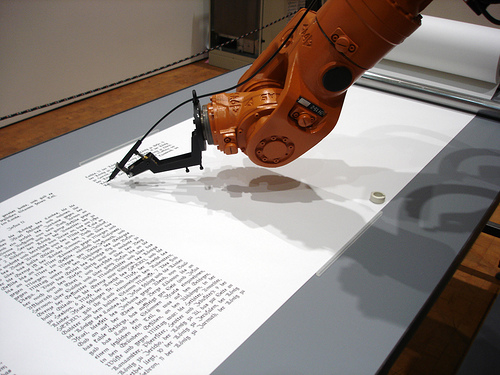
Image of Robotboinboing has a short entry about a German robot that is exhibited writing out the bible. The robot is a RobotLab project (site in German.) The image comes from Marc Wathieu’s Flikr set for the RobotLab where the description of the project reads:

The Kuka robot is silently writing a version of the martin luther bible, which was originally printed in a early font called “Schwabacher”, retranslated here by RobotLab into calligraphy. “Wolfgang von Kempelen, Mensch-[in der]-Maschine” exhibition, ZKM, Karlsruhe (D).

From the lab site it seems they have also programmed it to draw portraits.
Thanks to Lynn for this.

Zonbu: cares about the planet too

Image of Zonbu BoxZonbu is a environmental personal computer with some interesting features. It runs a version of Linux and comes with bundled applications. You buy it with a monthly plan that gives you off-site storage and maintenance. It has no hard-drive, just a flash card for local storage. All of this means it is extremely energy efficient (consumes as much as a light bulb) and that it is easy to run. They also promise to take it back and disassemble it for recycling.As interesting as the green aspect of Zonbu is, I’m also struck by their service model. You buy it for $99 (without keyboard or monitor) and then pay $13 a month or more for the storage and support. You don’t get root access and they manage the computer for you. It comes with all the basic applications. As some commentators have put it – the Zonbu makes for a good second home computer for the family (at least those who don’t want to run PC games.)

Guy sent me this after reading my Blog Action Day grumbling.