
We got the Big See project working in the cave at U Alberta. The Big See software has various 3D modes so it can be displayed for viewing in a CAVE.

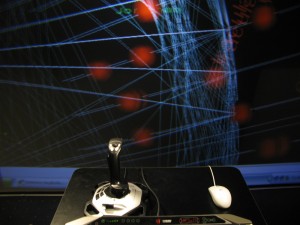
We got the Big See project working in the cave at U Alberta. The Big See software has various 3D modes so it can be displayed for viewing in a CAVE.

The Federation of American Scientists held a National Summit on Educational Games that has released a report titled, Harnessing the Power of Video Games for Learning. This is not, despite the sponsor, a scientific report. It is a call for funding for research into educational games. The report, however, slides into hype about American competitiveness. I think the pitch is that games will save American education and keep the country competitive. So, for example, on the first page it reads,
The success of complex video games demonstrates games can teach higher order thinking skills such as strategic thinking, interpretative analysis, problem solving, plan formulation and execution, and adaptation to rapid change.
The phasing may be unfortunate, but I read this as suggesting that financial success demonstrates educational value. Does that mean that the success of Celine Dion demonstrates that pop music can teach higher order skills? Further on they write,
Many companies and industries have transformed themselves by taking advantage of advances in technology, and new management methods and models of organization. As a result, they realized substantial gains in productivity and product quality while lowering costs. No such transformation has taken part in education. Education is not part of the IT revolution. (p. 6)
How can scientists say that education is not part of the IT revolution? Have they been to a school or university recently? For that matter, where are the companies using computer games to teach management methods and models of organization? (Perhaps the financial sector was playing a bit too much World of Warcraft to worry about managing our pensions.) My impression is that gains in productivity have come through automation and inventory control.
My counter proposal would be to invest in board games for teaching higher order skills. Lets bring back Monopoly (or the Landlord’s Game it was based on) as a way of learning about property, mortgages, and bankruptcy. Board games would be cheaper and probably teach the same higher order skills.
I’m sure I’m being unfair, and they do call for more research into what skills games could teach which is needed.

Announcing Digital Studies / Le champ numérique. This is a new journal from the SDH/SEMI (Society for Digital Humanities).
Apparently Stewart Butterfield, one of the co-founders of Flickr was a philosophy major. He got his BA in philosophy from the University of Victoria and an MA from Cambridge. Did philosophy make a difference? Hard to tell, but he gives a talk on How to Make a Fortune with your Liberal Arts Degree according to the Lavin Agency that represents him. The site quotes him to the effect, “You can always pick up how to figure out profit and loss, but it’s harder to pick up the other stuff on the fly.”
His co-founder and partner Caterina Fake, now working on Hunch, studied English and has a thoughtful blog here.
Just goes to show how useful the humanities are.
The Guardian online has a story about how novelist Philip Roth predicts novel will be minority cult. According to the story by Alison Flood (Monday 26th of October, 2009),
He said it was “the print that’s the problem, it’s the book, the object itself”. “To read a novel requires a certain amount of concentration, focus, devotion to the reading. If you read a novel in more than two weeks you don’t read the novel really. So I think that kind of concentration and focus and attentiveness is hard to come by – it’s hard to find huge numbers of people, large numbers of people, significant numbers of people, who have those qualities,” he said.
I wonder if it true that screens take less concentration than books. I can believe it about television, but not about doing things on the screen like programming or even playing a console game. I can finish most books much faster and with less hard work than playing a console game (which may say something about my gaming skills.) Is it really the form of the object (screen vs book) or the content (typical TV show vs difficult novel)?
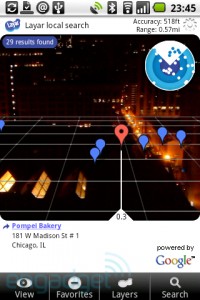
Technically Personal posted a very useful list of 15 Stunning Augmented Reality Apps for the iPhone. This includes Layar which is now available for the iPhone (see image above.) These AR apps make it possible to start developing AR games.
Thanks to Sean for this.
This weekend I was at a workshop on Application Programming Interfaces for the Digital Humanities. See the philosophi.ca wiki conference report.
The workshop looked at the possibilities and issues around APIs for digital humanities resources. I think it is fair to say that lots of projects have been exposing APIs but they aren’t being used much. We need to encourage projects to develop mashups that take advantage of the APIs.
This workshop, more than any other I’ve been at was heavily twittered (#apiworkshop) which was interesting and annoying. At times people seemed to space out and not participate as they rushed to document what was happening or contribute some bon mot. I should admit that I am part of the problem – I posted a few and was writing my conference report live which was just as distracting. I guess we all have develop an etiquette for situations where you are not just part of an audience, but are expected to participate.
 I received an invitation to add a photo of a “TRAFF-O-MATIC” detector cover to a Flick pool about O-Matic Mania. Looking at the pool of photos begs the question where “o-matic” as a suffix came from.

A couple of weeks ago I went to Paris for a meeting and was able to visit the new (see my Flickr set on the Bibliothèque Nationale). It is hard to tell from one short visit how it is as a library, but it is a stunning building to walk around. It spoke to me of exclusion – a cave (or inferno) of knowledge that you get progressive access to. The deepest levels are reserved for the true scholars (not tourists like me.)