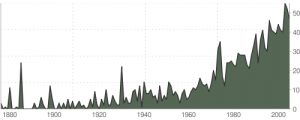
JSTOR: Data for Research Visualization

"Dialogue" in Philosophy Journals

Thanks to Judith I have been playing with JSTOR’s Data for Research (DfR). They provide a faceted way of visualizing and search the entire JSTOR database. Features include:

  • Full-text and fielded searching of the entire JSTOR archive using a powerful faceted search interface. Using this interface one can quickly and easily define content of interest through an iterative process of searching and results filtering.
  • Online viewing of document-level data including word frequencies, citations, key terms, and ngrams.
  • Request and download datasets containing word frequencies, citations, key terms, or ngrams associated with the content selected.
  • API for content selection and retrieval. (from the About page)

I’m impressed by how much they expose. They even have a Submit Data Request and an API. This is important – we are seeing a large scale repository exposing its information to new types of queries other than just search.


Princetonian: Kindles yet to woo University users

Thanks to Sean for pointing me to a story about Princeton’s experiment with Kindles replacing textbooks. In a pilot program students in certain courses were given a Kindle DX with all their course readings. Princeton was partnering with Amazon.com (Bezos went to Princeton) as part of a sustainability initiative to save paper. The problem is that the students didn’t like using the Kindles.

Much of my learning comes from a physical interaction with the text: bookmarks, highlights, page-tearing, sticky notes and other marks representing the importance of certain passages — not to mention margin notes, where most of my paper ideas come from and interaction with the material occurs,” he explained. “All these things have been lost, and if not lost they’re too slow to keep up with my thinking, and the ‘features’ have been rendered useless.

Stan Katz (who was one of the instructors experimenting) is quoted in the Princetonian story supporting the student view. He found the Kindle hard to annotate and he found that without page numbers it was hard for students to cite accurately.

The Kindle doesn’t give you page numbers; it gives you location numbers. They have to do that because the material is reformatted,” Katz said. He noted that while the location numbers are “convenient for reading,” they are “meaningless for anyone working from analog books.

There is a Slashdot summary with lots of comments too.

Adonis Meeting

I was a meeting organized by the Adonis project (See TGE Adonis | Très grand équipement du CNRS pour les sciences humaines et sociales) to look at international collaboration. Adonis is running a number interesting projects:

  • Revues.org is a platform for e-journals in France.
  • Calenda is a shared calendar of events for French academics.
  • Hypotheses is a shared blog environment for news about projects.
  • Lodel is their content management system for publications.

Some other projects mentioned were:

  • Plume hosts and lets people discover open source software from university research projects.
  • SourceSup is a project management and code versioning environment for academic projects.

We are struggling with issues of international collaboration, archiving data, interoperation and so on. We all see the value to large national (or international) digital archives, but the funding is oriented to projects and not long-term archiving. Some of the issues that came up:

  • Lou Burnard made an important distinciton between archiving and backup. A lot of people want backup for their work or their project and think that archiving services will provide this; they don’t really understand that backup is not archiving. That doesn’t mean that backup isn’t important. Apparently in the student riots in Paris last year a number of computers with irreplaceable data were destroyed.
  • The limitations of centralized solutions. We are all tempted by the thought of long-term central funding to run services, but there are dangers to such centralization. If central funding is cut or shifted (as happened with the AHDS) then everything disappears. Can we imagine decentralized solutions? Would they work? I’d like to see more social research initiatives that support decentralized solutions. I think in the current economic climate we have to explore these.
  • David Robey made the point that we have to do a better job of explaining the value of digital resources and services. We need to educate ourselves to gather evidence of value and that includes the opportunity costs.
  • Paolo D’Ivorio argued that there are certain primitive functions that scholarly systems need including Citation (reliable ways to point to other works), Consensus (agreement in a field as to what is of value and how to assess that), and Discovery/Dissemination (ways of finding and getting at scholarship.)

You can follow some of the meeting is you search Twitter for #ADONIS.

import random

Stephen Ramsay sent me one of my first Python programs that I wrote in response to his telling me about Perl poems. No doubt I was also influenced by Jerry McGann and his ideas on deformation.

#!/usr/bin/python

import random

def Random_Means(Words):
    return random.randrange(len(Words))

How_Much = ["How much", "All", "Some", "Every", "The", "No"]
Of_What = ["interpretation", "rhetoric", "fiction", "fabrication",
	 "deformation","representation"]
Could_Be = ["could be", "was", "is", "will be", "would be"]
At_End = [".", "!", "?"]

All = Of_What[Random_Means(Of_What)]
Interpretation = Could_Be[Random_Means(Could_Be)]
Is = How_Much[Random_Means(How_Much)]
Just = Of_What[Random_Means(Of_What)]
Deformation = At_End[Random_Means(At_End)]

print Is + " " + All + " " + Interpretation + " " + Just + Deformation #?

This playful exercise then led to Untitled #4 which led to our dialogue with the same name which led to the Animation!

SlightlyMorbid: Emergency notification system

Not long ago I blogged about death and your online identity. Now I’ve come across a service called SlightlyMorbid which will send prepared messages to contacts when they are contacted by a trusted party. It is a sort of dead-man’s switch for a bunch of last emails to your online friends who wouldn’t otherwise hear of your death. Great name for a service, though.

Mozilla Labs Jetpack | Exploring new ways to extend and personalize the Web

Picture 1

Peter sent me a link to Mozilla Labs Jetpack, a project to develop a way that makes it easy for people to extend the power of their browsers using Javascript. It strikes me that there is a desire and need for an easy programming extension that provides, as HyperCard did years ago, a way for amateurs to extend their environment with widgets. Widgets, gadgets, and other small utilities have their place, but we need a common ground for them for the paradigm to take off.