Shawn Day on his Randomosity blog has links to some good explanations of the Soundex algorithm for finding names that sound the same, but are spelled differently as in “Smith” and “Smythe”. For example, Eastman’s Online Geneaology Newsletter has a post on Soundex Explained that walks you through the algorithm.
Category: Text Analysis
State of the Union Parsing Tool
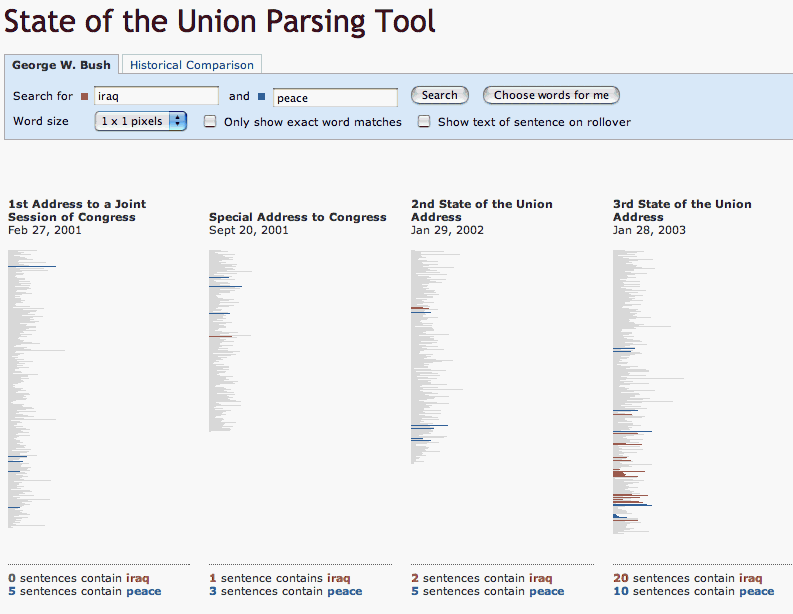 Yet another George W Bush, State of the Union visualization tool can be seen at State of the Union Parsing Tool. I commented earlier on the New York Times, State of the Union in Words. It seems that Bush’s State of the Union addresses are becoming the standard text for visualizations.
This one on Style.org colorizes the lines with the found words. You can set the size of the words (and therefore text representation.)
Humanities Computing Links
 I have set up an account on the TAPoR portal where I have created a list of Humanities Computing Links. Because it is on the portal you can analyze the texts. I have also tagged them so you can look at a subset like, Text Analysis.
Centre National de Resources Textuelles et Lexicales
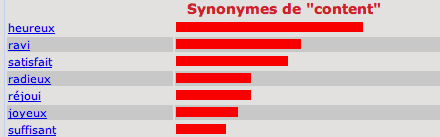 The Centre National de Ressources Textuelles et Lexicales (CNRTL) is a centre attached to the Analyse et Traitement Informatique de la Langue Fran?ßaise (ATILF / CNRS) lab at Nancy Universit?©. They have a portal for lexical, morphological and etymological work in French. It takes a French word and will give you synonyms, dictionary entry, etymology and so on. Neat. I wonder if it can be mashed into a TAPoR tool?
This is thanks to Jean-Guy.
Comparing Texts
Matt asked me if we can use TAPoRware tools to compare different texts so I wrote a short recipe on Comparing Two Texts. This assumes that the texts you are comparing are not different versions of the same text, but completely different texts.
It strikes me that we have to think through how the TAPoRware tools could be adapted for comparison.
Happy Holidays
 Happy Holidays to all my readers. If you’re still looking for gifts you can always check out the U.S. Government Gifts and Memorabilia for Sale page at Firstgov.gov. There is even a web site for the Drug Enforcement Administration shop with holiday ornaments (see image to the left) that come with a “interpretative insert”.
Or you can do text analysis on a small corpus I put together from pages found by Google on the subject of “happy holidays”. See Geoffrey Rockwell’s Links (Holidays) and click on Analyze.
Chirag Mehta: US Presidential Speeches Tag Cloud
US Presidential Speeches Tag Cloud is a sliding series of word clouds for “speeches, official documents, declarations, and letters written by the Presidents of the US between 1776 – 2006 AD.” Chirag Mehta has organized the clouds with time slider so you can move from the latest, “2006-01-31: State of the Union Address” by George W. Bush back to John Adams, “1776-01-15: Foundation of Government”. By moving the slider you can see changes in the high frequency words. Bill Clinton, surprisingly (to me), talked a lot more about families than Bush.
Mehta describes how he generated this at the bottom of the page. Thanks to Gord for this.
Levitated: Jared Tarbell
 The design firm Levitated which I blogged before has a collection of open source examples like Text Space which could be easily adapted for text poetics tools.
Many of the examples seem to be source from parts of books he has written for like Flash.MX.3D.Cheats.
The Dictionary of Words in the Wild
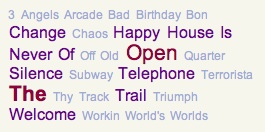 The Dictionary of Words in the Wild is an experiment in public textuality that I’m leading. Andrew MacDonald has done the programming and is contributing images (along with others). You can get an account and upload pictures of words or phrases. We have an application programming interface that you can use to then create web applications that call the dictionary. Join, sample, load! We need pictures.
James pointed me to a similar experiment, The Visual Dictionary – a visual exploration of words in the real world. This focuses on single words and has a ranking/rating system. It doesn’t, however, have the API we have. I wonder how we can interoperate? Can such dictionaries be a movement?
Meditation on Electronic Tools
A tool would have a handle with grooves to hold tight. It’s easy to swing into place.
It would have an inhuman steel end. An end unlike my soft flesh. Perhaps the nail dead at the end of the digit.

A tool scratches out its world. A tool outreaches, extends the hand in sight, and where it doesn’t fit (so often), it scrapes a groove. It claws what it can afford.
And when it’s finished there’s a pop, a clunk, a ping, and a burr to be swept away. When it’s left, the palm is open to stroke the surface of the craft. A satisfaction puts the tool away.
So few parts of the world fit this tool, other than my hand. Perhaps they are not made for work but for the stroking, the holding, and the gripping turn.
Which is why I need so many of them, within reach, laid out in frames, carried in bags, on belts, and ready-at-hand and unforseen.
Then, I’ll pause in the workshop and not do anthing at all. I’ll hold these tools in my mind which is not how to use them.
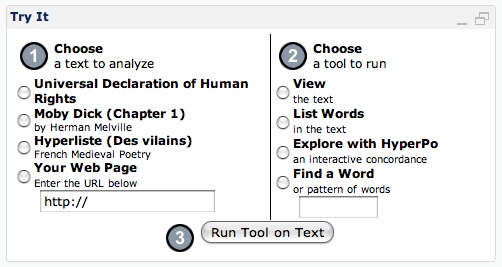
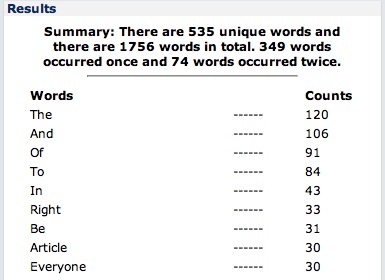
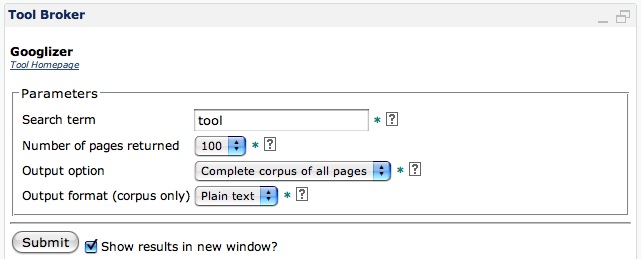
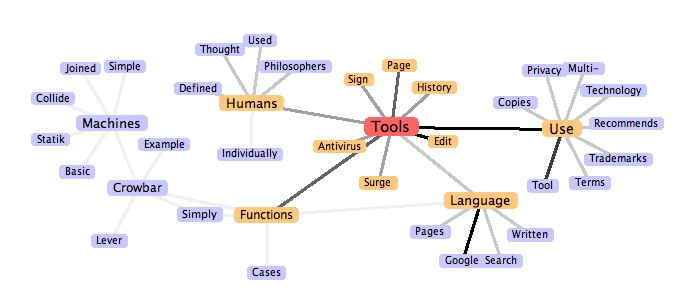
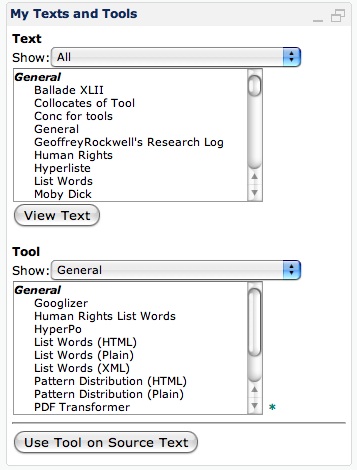
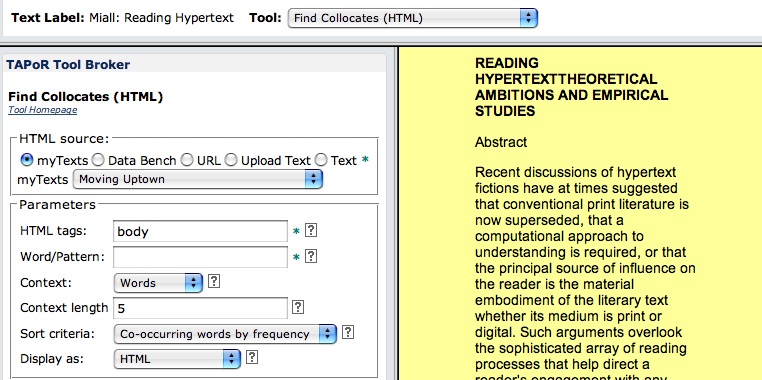
Images all from the TAPoR portal and TAPoRware.