I was just sent an invitation to IconoTag by an old friend, Jame Turner. It is a multilingual image tagging research project where you choose a language and tag 12 images in that language. I’m not sure what the research is, but it reminds me of the Google’s Image Labeler which seems loosely based on Luis von Ahn’s work – projects like CAPTCHA and reCAPTCHA.
HuCon 2010: Current Graduate Research in Humanities Computing
Reminder to all friends in the area of tomorrows HuCon 2010: Current Graduate Research in Humanities Computing. We have Jon Bath and Yin Liu giving keynotes and speakers from U of Alberta and U of Saskatchewan.
“The best DH conference of the prairies!”
Day of Digital Humanities 2010: You are invited to participate
Well, we are starting up the second Day of Digital Humanities project. You are invited to participate!.
You can see what we did in last year’s project here. The idea was to have digital humanists blog one day of what they did and then combine it all into a dataset that can be studied. We call it “autoethnography of a community.” It was fascinating and stressful to run last year. I’m hoping I can enjoy it more this year.
The project will run on March 18th, 2010. We are hoping that we will get more graduate students and more colleagues from outside North America!
Informatica Umanistica: Interrupting Digitization
Informatica Umanistica has just published a paper of mine on digitization titled, “Interrupting Digitalizatin and Thinking about Text”. The article starts,
One of the memes of new media is that the form of communication determines the content. As McLuhan puts it the medium is the message, and therefore, as we digitize the evidence of human culture from the Roman forum to Hamlet we inaugurate not just a new edition of our knowledge, but a new knowing and with it a new way of thinking. This paper will not engage the question of technological determinism, instead it will assume that the enthusiasts are right and ask then what is digitization? or what is the message of the digital form? Asking such questions is an interruption in the rush to digitize everything; imagine the scanner has broken down for a moment letting us pause and ask if we really understand the digital, if we understand what is gained and lost, and if we understand the possibilities before us or how we are constrained.
YouTube – Digital Preservation and Nuclear Disaster: An Animation
Seamus pointed us to a great animation on YouTube, Digital Preservation and Nuclear Disaster. They nicely dramatize the challenges and need for digital preservation.
Scott Smallwood and Musical Interactives
Scott Smallwood came to talk to our interactives group about his work on musical instruments. Scott was involved with the Princeton Laptop Orchestra (PLOrk) and demonstrated one of the hemispherical speakers that they designed so that laptop musicians could join and play with others. The idea was that a laptop musician, instead of plugging into a sound system (PA), should be able to make sound from where they are just like the analogue instruments. I wonder what the visualization equivalent is? Will these new pocket projectors we can begin to imagine visualization instrument that are portable. Pattie Maes and Pranav Mistry’s demo of SixthSense at TED is an example of creative thinking about outdoor interface.
Peter Baskerville, Worth of Children and Women
Peter Baskerville spoke today on “Worth of Children and Women: Life Insurance in Early Twentieth Century Canada” as part of the CIRCA Colloquium. He talked about changes in perceptions regarding children in the early 20th century. They went from being perceived as economic assets (you can send you kids to work) to being seen as worthwhile in and of themselves (you can enjoy them as children.) He looked at census data about insurance as the Canadian census up till 1921 asked questions about who had insurance. Insurance gives you a sense of what people valued. I’m amazed how much one can infer from census data along with contextualization.
Peter found a startling number of children (1 in 10) were insured and for kids under 15 there was no difference between the percentage of boys and girls. When asking why, he noticed that French Catholics were far more likely to insure their kids than other ethno/religious groups. French Catholic kids under the age of 10 are statistically the most likely to die, which may be due to the fact that French Catholic mothers stopped breast-feeding earliest which meant that kids were switching to water or non-pasteurized milk younger. This would suggest that parents were insuring kids to be able to pay of burial costs. Burial fees were also a source of income for RC parish priests so they had pragmatic reasons to encourage parishioners to take out insurance.
He also thinks that insurance is symbolically important. It shows the regendering of the public sphere as women value themselves through insurance.
A Rant on Excellence
The recent issue of the CAUT Bulletin has a great article by Elizabeth Hodgson titled A Rant on Excellence. She rightly noticed how “supersaturated” excellence has become in the academy. We all pretend we want to be excellent or world-class, but realistically we are just good enough.
These incidents suggest to me, as a literary critic, that “excellence” (with its cognate “world-class”) has become a supersaturated term like “patriot” or “family values,” a word that means both everything and nothing. This word “excellence” seems to have acquired both an indefinable and yet profound value to senior administrators, as if they know what it means, and what it looks like, as if its value is immeasurable and its attainment all-important — and therefore as if anything or anyone not excellent is therefore worthless.
Hodgson concludes with the effects of the cult of excellence which include the proliferation of measurements of excellence which have the effect of turning us towards measurable activities. The measurable activities that prove we are excellent ironically distract us from what we are good at and therefore make us less than excellent.
I would like to see a study of university mission statements and the effect of excellence-talk on them.
Kids consume media as a full-time job—many getting overtime
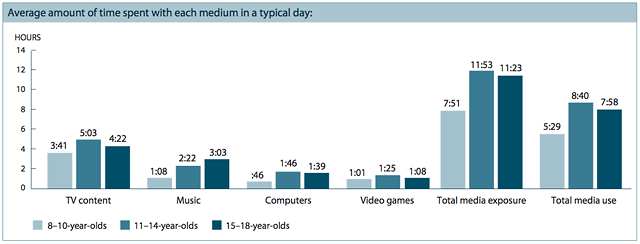
ars technica has a good summary of the Kaiser Family Foundation Report: Generation M2: Media in the Lives of 8-18-Year-Olds. Their story, Kids consume media as a full-time job—many getting overtime (Chris Foresman, Jan. 21, 2010) ends with some good news,
The report notes that kids spend less time reading magazines or newspapers, though online reading has supplanted that to some degree. However, the average time spent reading books has stayed relatively steady, at about an hour per day. Only the heaviest of media users reported increases in poor grades or low levels of personal contentment. And it seems parents that are active about placing restrictions on media use have kids that consume significantly less media than kids without restrictions. Leaving the TV off, limiting hours of TV, video game, or computer use, and having rules about types of content all help curb media use. One final bit of good news: kids on average spent almost two hours a day engaged in physical activity, up slightly from five years ago.
The bad news is that media consumption is becoming a full time job for kids taking up all the time they are asleep or at school. Is there anything other than media consumption?
Whatever happened to Second Life? | Analysis | Features | PC Pro

Willard, on Humanist, asked about an article titled, Whatever happened to Second Life? ,
Does this decline in popularity matter? What, do you suppose, does it tell us about VR techniques generally?
According to the article Linden Labs is making more money than ever,
Money is, of course, what makes the world go around – even the virtual ones. So has the Second Life economy suffered the same nervous breakdown as the real-world markets over the past year or so? Amazingly, it appears not.
Linden Labs claims Second Life has turned over more than $1 billion in its six-year history. Nor is it slowing down; quite the opposite in fact. Linden claims the in-world economy grew by a staggering 94% year-on-year from Q2 2008 to Q2 2009.
It sounds like it may be sex that is making money for Linden Labs.
Another answer to the question Willard poses about VR is that now we have tools like the OpenSimulator which allows us to build and adapt virtual worlds on our own server. OpenSimulator is compatible with the Second Life client, but we can customize it to do different things, for example, we can turn it into an authoring environment for an Augmented Reality Game platform. Place your items in virtual space and they show up in the corresponding real space.
There is a discussion about SL and this story at iDC https://lists.thing.net/pipermail/idc/2010-January/004138.html . In particular. Simon Biggs points to a report on education and SL (PDF) he wrote.