From Sean I found out about the Parrot AR.Drone which has to be the coolest iPhone accessory around. You control a drone over wifi and see through it’s camera on your iPhone. They apparently have gaming modes where you can duel layered bots or other drones. I can’t help thinking this is too cool to be real. See their video channel on YouTube.
Ritsumeikan: Possibilities in Digital Humanities
The last week and a bit I have been in Kyoto to give a talk at a conference on the “Possibilities in Digital Humanities” which was organized by Professor Kozaburo Hachimura and sponsored by the Information Processing Society of Japan and by the Ritsumeikan University Digital Humanities Center for Japanese Arts and Culture.
While the talks were in Japanese I was able to follow most of the sessions with the help of Mistuyuki Inaba and Keiko Susuki. I was impressed by the quality of the research and the involvement of new scholars. There seemed to be a much higher participation of postdoctoral fellows and graduate students than at similar conferences in Canada which bodes well for digital humanities in Japan.
Continue reading Ritsumeikan: Possibilities in Digital Humanities
ISP Quarrel Partitions Internet: Wired.com
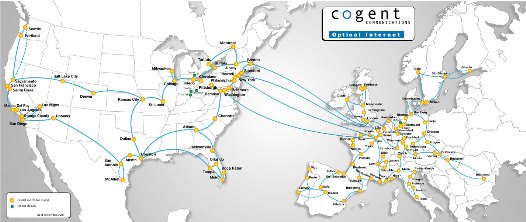
Wired.com has an interesting story about how an ISP Quarrel Partitions Internet. Cogent Communications, a US-based ISP shut down all connection with a Swedish ISP, Telia that made it impossible for Cogent customers to reach Telia customers on the Internet and vice-versa. And we thought the Internet was designed to bypass blockage! It turns out certain ISPs can arbitrarily block interconnection when in commercial disputes. They can do this by de-peering to disconnect from another ISP and then packet filtering of those packets that work their way through other channels.
This raises questions about the standard story of the Internet that presents packet-switching as a technology that makes it impossible for the Internet to be censored. As we have discovered under the general rubric of net neutrality, the ISPs now have the technology to block, slow, and filter packets (and have done so.) Thanks to Nancy for this.
Digging Into Data
The Digging Into Data (DID) grants awards have been posted. The “Using Zotero and TAPoR on the Old Bailey Proceedings: Data Mining with Criminal Intent” project which I am part of was one of the ones funded. From the description:
Description: This project will create an intellectual exemplar for the role of data mining in an important historical discipline – the history of crime – and illustrate how the tools of digital humanities can be used to wrest new knowledge from one of the largest humanities data sets currently available: the Old Bailey Online.
This program is significant in a number of ways:
- It encourages (forces) international cooperation. Brett Bobley and the others involved in the councils deserve a lot of credit for developing a model for international programs and overcoming all the differences between funding agencies in record time. We all know that good research is often international, but this program rewards such cooperation. I hope the next round involves other countries – this is a model to be extended and emulated.
- One of the things that made a difference is that this program had a single evaluation process. The respective funding agencies agreed to work with one international assessment committee, thereby relinquishing a certain amount of control. This is significant because other attempts have kept separate panels which leads to projects being approved by one and not another. (This happens even within Canada.) DID shows that our councils are cooperating and willing to release control for the good of research – we should recognize that and encourage more.
- It focuses on using large data-sets and they negotiated access to a number of data-sets to support this. The work they did convincing content providers to provide access to full-text collections was beneficial in and of itself.
- It focuses on demonstrating research results from “digging into data” where computational techniques are applied to data. It isn’t a tools program, but a “what can you do with tools and lots of data” program. The time was right.
The number of letters of intent and applications is indicative of how successful this program was in identifying a research support need. As researchers we usually only think only about our work and ignore the host of conflicting demands of councils. Grant councils are also answerable – the design of programs is an administrative art that is rarely recognized by those who benefit. DID stands out in my mind as a successful experiment. If anything is was too successful – the low success rate shows they underestimated the number of applications and many deserving projects weren’t funded. Now the challenge to the councils is to scale up and build on this to meet the demand. The challenge to those of us funded is to live up to the potential and show that this works in order to make room for all the other deserving projects.
Ridiculous User Interfaces In Film, and the Man Who Designs Them
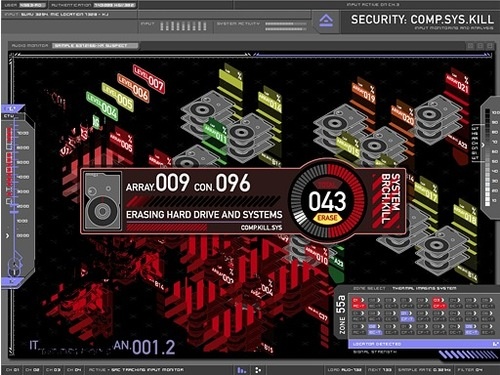
Gizmodo has a short article on Ridiculous User Interfaces In Film, and the Man Who Designs Them. The article showcases graphic designs by Mark Coleran who did work for movies like Mission Impossible 3, Mr & Mrs Smith, and Children of Men. There is a screen reel that summarizes his work and he responds here in his blog. Thanks to Stan for this.
Teaching Literature and Language Online
A paper that Stéfan Sinclair and I wrote on “Between Language and Literature: Digital Text Exploration” has just be published by the MLA in a volume edited by Ian Lancashire, Teaching Literature and Language Online.
tweenbots: kacie kinzer
Thanks to twitter I’ve discovered the future of robots and they are tweenbots. The tweenbots is a playful project by Kacie Kinzer who let loose simple rolling bots with a flag that identified where they were going. She then videotaped people helping the little robot on its way.
Kokoromi Collective: One Button Games
The Kokoromi Collective have an interesting invitational challenge – One Button games. Design a game with only one button as input. Neat.
Kokoromi is an experimental game collective formed by a rare union of Montreal gamemakers and curators to promote games as an art form and expressive medium worldwide. Based in Montreal, Quebec, Canada, Kokoromi produces events, develops games, and hosts a blog at www.kokoromi.org. (About Us)
GRAND NCE funded
The Graphics, Animation and New Media Canada Network of Centres of Excellence has been funded, see NCE News Release.
New Media, Animation, and Games — these technologies are the building blocks of the Digital Age. The Science, Technology and Innovation Council report in 2008 recognized this as a priority research sub-area within Canada’s Science and Technology Strategy. This application responds to the needs identified in that report. The GRAND NCE will undertake a comprehensive research program whose goal is to understand the underlying technologies and to make selective advances in a coordinated, multidisciplinary setting that lead to social, legal, economic, and cultural benefits for Canadians.
This brings significant challenges because the ability to access, manipulate, and disseminate information in its various media forms radically changes on almost a daily basis. The research program will meet these challenges through a dynamic set of interconnected projects built on a conceptual framework of five themes. Three themes focus on the technology clusters identified by the Science, Technology and Innovation Council: (1) New Media Challenges and Opportunities, (2) Games and Interactive Simulation, and (3) Animation, Graphics and Imaging. The other two cross-cut the first: (4) Social, Legal, Economic and Cultural Perspectives, and (5) Enabling Technologies and Methodologies. Thirty projects each explore a different aspect of selected problems. Fifty Network Investigators lead projects, with Collaborating Researchers and Partners from the public and private sectors participating as domain experts and receptors to exploit the resulting new knowledge and technologies. (Executive Summary)
This truly interdisciplinary NCE is led by Kellog S. Booth at UBC and includes network investigators from across the country. The U of Alberta lead is Jonathan Shaeffer. I’m one of the network investigators at U of A and will be working on serious games. Isn’t that grand!

Information Visualization for Text Analysis
Googling around I came across a nice succinct chapter on Information Visualization for Text Analysis from a book called Search User Interfaces by Marti Hearst (Cambridge University Press, 2009).
The chapter goes from visualizations for text mining to concordances and then to citation relationships. It shows some of the usual suspects like TextArc and Wordle.