Web Mining for Research is a white paper I’ve just written to get my ideas down about how we should be using the Web as evidence not just for social science research, but in the humanities. Digital humanities is more than studying old wine in new digital bottles – the challenge is to do humanities research using the digital as evidence. For me the challenge is how to rethink philosophy now that we can mine concepts in their sites, to paraphrase Ian Hacking.
Category: Philosophy of Computing
Derrida: “The Word Processor”
A new freeing up of the flow can both let through anything at all, and also give air to critical possibilities that used to be limited or inhibited by the old mechanisms of legitimation – which are also, in their own way, word-processing mechanisms. (p. 32)
Paper Machine by Jacques Derrida and translated by Rachel Bowlby has an essay on “The Word Processor” that is one of the better discussions of how word processing is changing writing. Some quotes:
“But when we write ‘by hand’ we are not in the time before technology; there is already instrumentality, regular reproduction, mechanical iterability. So it is not legitimate to contrast writing by hand and ‘mechanical’ writing, like a pretechnological craft as opposed to technology.” (p. 20)
The machine remains a signal of separation, of severance, the official sign of emancipation and departure for the public sphere.” (p. 20)
As you know, the computer maintains the hallucination of an interlocutor (anonymous or otherwise), of another ‘subject’ (spontaneous and autonomous, automatic) who can occupy more than one place and play plenty of roles: face to face for one, but also withdrawn; in front of us, for another, but also invisible and faceless behind its screeen. Like a hidden god who’s half asleep, clever at hiding himself even when right opposite you. (p. 22)
With pens and typewriters, you think you know how it works, how ‘it responds.’ Whereas with computers, even if people know how to use them up to a point, they rarely know, intuitively and without thinking — at any rate, I don’t know — how the internal demon of the apparatus operates. … We know how to use them and what they are for, without knowing what goes on with them, in them, on their side; and this might give us plenty to think about with regard to our relationshi with technology today – to the historical newness of this experience. (p. 23)
Is it really new to use technologies without understanding?
For Derrida the age of the book is passing.
This is not the end but we are probably moving to another regime of conservation, commemoration, reproduction, and celebration. A great age is coming to an end.
For us, that can be frightening. We have to mourn what has been our fetish. (p. 31)
I like the French term for word processor, “traitement de texts” – seems more accurate to what is happening.

Meditation on Electronic Tools
A tool would have a handle with grooves to hold tight. It’s easy to swing into place.
It would have an inhuman steel end. An end unlike my soft flesh. Perhaps the nail dead at the end of the digit.
A tool scratches out its world. A tool outreaches, extends the hand in sight, and where it doesn’t fit (so often), it scrapes a groove. It claws what it can afford.
And when it’s finished there’s a pop, a clunk, a ping, and a burr to be swept away. When it’s left, the palm is open to stroke the surface of the craft. A satisfaction puts the tool away.
So few parts of the world fit this tool, other than my hand. Perhaps they are not made for work but for the stroking, the holding, and the gripping turn.
Which is why I need so many of them, within reach, laid out in frames, carried in bags, on belts, and ready-at-hand and unforseen.
Then, I’ll pause in the workshop and not do anthing at all. I’ll hold these tools in my mind which is not how to use them.
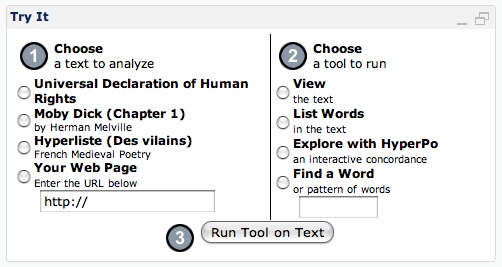
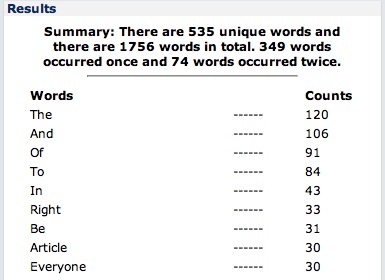
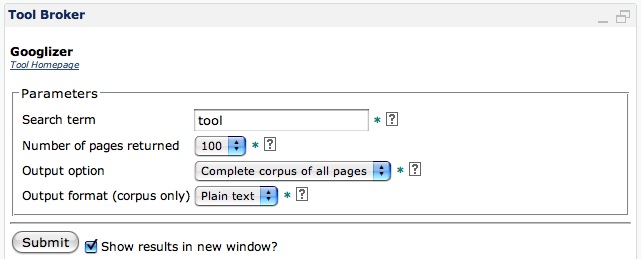
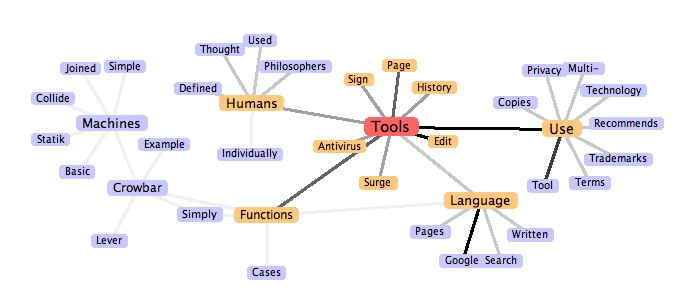
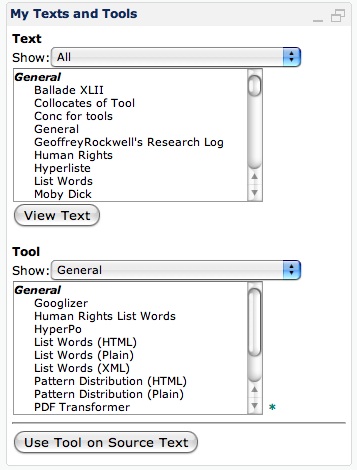
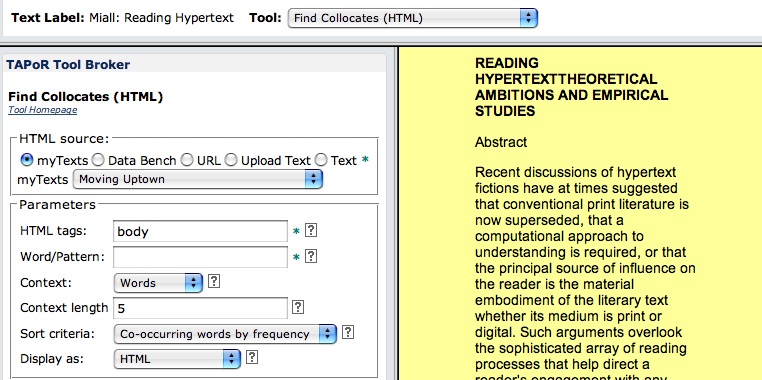
Images all from the TAPoR portal and TAPoRware.
Plaintext Tools
Plaintext_Tools is a Zwiki (zope wiki) for the discussion of, “Theory and poetics of tools and codes. The analog and the digital. … ” It is run by the Center for Literary Computing at West Virginia University. Most of the wiki at the moment seems to be essays by Alan Sondheim with a few pages by others. I like the list of topics so far.
Roboethics: Are we ready to debate this?
Humanist just had an intriguing post about The First International Symposium on Roboethics. This is being hosted by the Home > Benvenuti” href=”http://www.scuoladirobotica.it/”>Scuola di Robotica (School of Robotics) in Genoa which describes itself as a “CyberSchool. I wouldn’t have thought robotics and ethics were mature enough as an area for a symposium, but the section on the site on Roboethics Debate changed my mind. Since Kurzweil published The Age of Spritual Machines the debate has shifted from science fiction circles (Azimov’s 3 + 1 rules) to academic circles.
I should note that the Debate section of the Roboethics site, while interesting, has some inaccuracies. I don’t think Ray Kurzweil was “one of the develop of the Java programming language”. That would be Bill Joy.
TPM Online: Battleground God
Is a belief in God rationally consistent? Battleground God by TPM (The Philosopher’s Magazine) is a set of (presumably) branching questions designed to test how consistent your belief in God is. I got caught in a contradiction around justifying belief based on inner conviction (how can inner conviction be a source of belief if madmen are so convinced) which demonstrates how such a hypertext can be thought provoking and annoying.
What is strange about the “battleground” is the that contradiction is represented as “health.” Since when is consistency healthy?
Alltogether a good example of interactivity for philosophy, something rare indeed.
Coté: the Dispositif
My colleague Mark Coté is working with an interesting idea borrowed from Foucaut, the “dispositif”. He has a short paper/abstract in the Proceedings of the GENEALOGIES DE LA BIOPOLITIQUE. He defines dispositif as,
The dispositif’s something literally “lost in translation” with English-language interlocutors’ a grid of intelligibility; a heterogeneous ensemble of discursive and nondiscursive elements that come together in response to an urgent need, a combinatory machine that allows us to ‘see’ and ‘speak’ and in the process producing not ‘ideology’ but their own ‘truths’. (Coté, Mark, “The Soft Revolution”,
Conference Proceedings : Genealogies of Biopolitics, Oct. 18, 2005)
How is a dispositif a machine? How is it different from a tool? Does it give us a way of understanding the limitations of tools?
Continue reading Coté: the Dispositif
Kurzweil: Ramona and KurzweilAI.net

KurzweilAI.net is a web site by Ray Kurzweil dedicated to Artificial Intelligence. From there you can launch an avatar “Ramona” with whom you can converse. (If you have Windows you can install the FX Player and see her move and speak.) If you click on “The Brain” there is a great visualization of the connections between people, concepts, implementations (like Eliza) and related things. Clicking on items shows the connections and brings up short defintions and links. This is implemented in Java. Thanks to Alexandre Sévigny for this.
Continue reading Kurzweil: Ramona and KurzweilAI.net
The new cold-war: Ready.Gov

The Department of the Homeland Security now has a site, Ready.gov to help us ready for biological, chemical and nuclear threats. It is full of wisdom like,
Studies have shown that taking steps to temporary seal off a room using common materials enhances the safety of a room against the impact of a chemical plume. (Ready.gov – FAQ)
Reminds me of the paranoia I grew up with during the cold war. How to prepare for the end of the world. Perhaps that’s the point – a bit of fear goes a long way. Look at the graphics from the ready.com home page. The women looking up to a “ready” man. The Buisness looking confidently at us like the Ready Kids (who are coming soon.)
Ready-to-fear.
So why is the Ad Council advertising Ready.com on the Guardian Unlimited site? That’s where I saw the ad … Is the Department of Homeland Security so insecure they have to advertise in a left-wing UK online news site? Is the Ad Council just randomly buying advertising space? Is someone trying to make fun of Ready.com?
Moore’s Law: What if
The BBC has a nice little article about that perennial subject, Moore’s law, that proposes “the number of transistors on a chip could double every 24 months”. See Law that has driven digital life, by Jo Twist (is that name for real?) The story raises an issue that comes around every … well … 24 months – will Moore’s law hold as we get to the physical limits of current chip technology.
Even Dr Moore is surprised about the longevity of the observation, but he admits the “law” has become a self-fulfilling prophesy.
I’m more interested in what would happen if computing ceased to appear to be improving technologically. What would happen if we couldn’t make faster and smaller computers? What would happen if the culture of computing couldn’t assume the hardware would improve dramatically and continually? We are addicted to the futurism and hype(r) of computing – for there to be a slow down would change the subculture.
Then again, will the industry even admit if things did slow down – if we did hit limits? That’s the nature of technology – there is always an improvement in your future.
Continue reading Moore’s Law: What if