
The Maker community is getting around to important philosophical kits. See the Existential Emergency Phone.
Thanks to Guy for this.
The Maker community is getting around to important philosophical kits. See the Existential Emergency Phone.
Thanks to Guy for this.
Luciano sent me this link to a stunning multipoint touch installation at Queensland University of Technology, Brisbane, The Cube at QUT – world’s biggest multitouch installation. I like how they have the touch at ground level, but the screen extends up.
I note that the Cube folk also have a Lego Education Learning Centre. I’m doubly envious.

Textal is a moble app (for the iPhone) that lets you “explore the words used in your favourite book, document, website, or twitter stream.” It looks beautiful, but I can’t find it on the app store. I like the idea of having something like this for my iPad on which I read more and more.
In Dublin I heard DAH student Maura McDonnell present on Visual Music (her blog), which is her PdD research area. Visual Music is one term among many of experiments in light and sound and her blog is a nice collection of resources on this new media form.
From her blog I learned that there is a also a Center for Visual Music that has documentation and an online store.

Maura’s own work can be seen online, see Silk Chroma. The image above is taken from the Vimeo video.
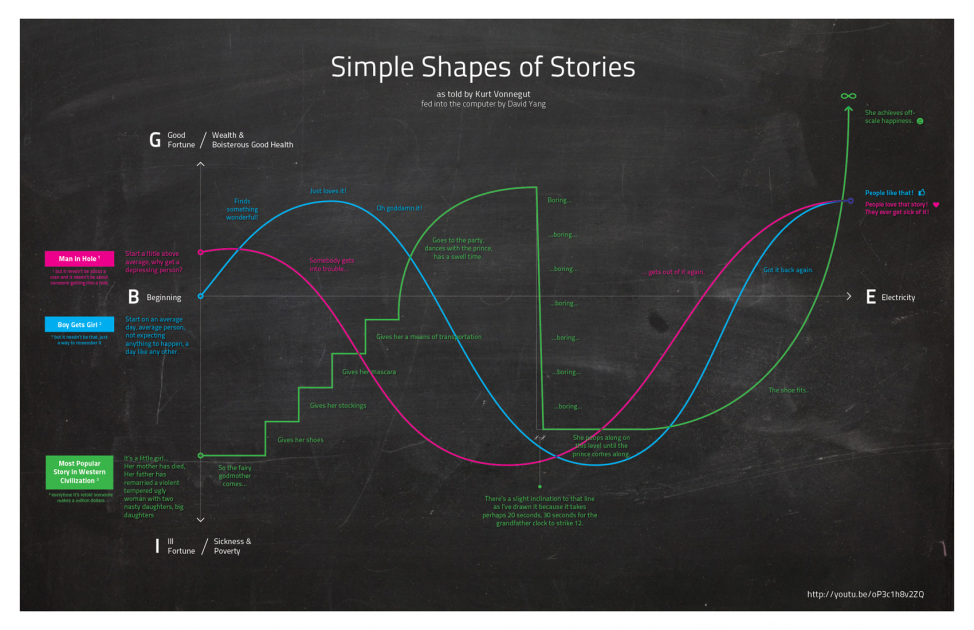
I’ve been meaning to blog on the video circulating of Kurt Vonnegut talking about the Shape of Stories. He describes the curves followed by popular stories like “boy meets girl” and suggests computers could even understand such simple curves. In Lapham’s Quarterly you can read the text of this lecture with illustrations. See Kurt Vonnegut at the Blackboard. In this version he asks about the value of such systems, a question which could apply equally to computer generated visualization,
The question is, does this system I’ve devised help us in the evaluation of literature? Perhaps a real masterpiece cannot be crucified on a cross of this design. How about Hamlet?
He concludes that the system doesn’t work because the truth is ambiguous. We simply don’t know in complex works (like Hamlet) if news is good or bad. Good literature is open to interpretation.
But there’s a reason we recognize Hamlet as a masterpiece: it’s that Shakespeare told us the truth, and people so rarely tell us the truth in this rise and fall here [indicates blackboard]. The truth is, we know so little about life, we don’t really know what the good news is and what the bad news is.
Many have noticed this amusing play on visualization including an infographic on Visua.ly, Kurt Vonnegut on the Shapes of Stories:

Prism is the coolest idea I have come across in a long time. Coming from the University of Virginia Scholar’s Lab, Prism is a collaborative interpretation environment. Someone comes up with categories like “Rhetoric”, “Orientalism” and “Social Darwinism” for a text like Notes on the State of Virginia. Then people (with accounts, which you can get freely) go through and mark passages. This creates overlapping interpretative markup of the sort you used to get with COCOA in TACT, but unlike TACT, many people can do the interpretation – it can be crowdsourced.
They are planning some visualizations of the results including what look like the types of visualizations that TACT gave where you can see words distributed over tagged areas.
Bethany Nowviskie explains the background to the project in this Scholar’s Lab post.
While I couldn’t attend, the Edmonton Dorkbot had a live coding event organized by Scott Smallwood. See Vadim Bulitko’s photos at Edmonton Dorkbot, Oct 11 (click the links to go to the YouTube videos).
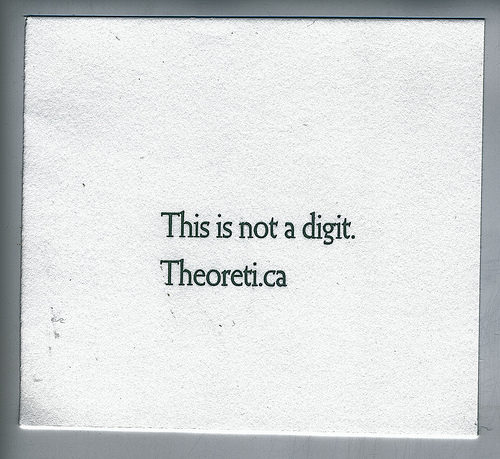
I’m taking a Letterpress course at SNAP (Society for Northern Alberta Print-Artists) and today I set my first type and printed my first text. I love being a student again. See the photos at Letterpress (a Flickr set).
Calen sent me this link of two chatbots talking with each other, AI vs. AI. Two chatbots talking to each other. I can’t help thinking the dialogue was scripted, but that doesn’t change the pleasure of imagining a chatbot getting irritated with another.
Peigi sent me a link to Locacious a great new iPhone app that lets you create walking tours. (Location + Loquacious = Locacious … Get it?) The walking tours are made up of locations with an image, text (links), and audio. Historians are using it to author urban history tours like “Jane Jacobs in Greenwich Village; The Flatiron District.” the app is free, but you apparently have to pay to upload your tour so that others can access it.
Note: the Locacious app seems to have been retired. See iOSnoops entry.