Addicted to Games?

Today I came across stories about game addiction. One is from the BBC that had an episode of Panorama titled Addicted to Games?. The web page has video clips and articles like Can video gaming cross from innocent fun to addiction? by Raphael Rowe. (BTW the web page will expire in 11 months – I guess the BBC pulls pages after a year.) Edge has an article reviewing this episode, Was Panorama’s Game Addiction Report Fair? where they conclude:

Videogames are a powerful form of entertainment. Last night’s Panorama report acknowledged this, and – despite an anxiously concerned tone throughout – also acknowledged that the vast majority of gamers have nothing to fear from their hobby. But beyond a superficial look at basic game mechanics, the report made little attempt to find out why, for the unlucky and unfortunate young men it interviewed, gaming had become such an all-encompassing force in their lives.

From the Los Angeles Times is an article about Video game addiction: Researchers identify risk factors which reports on a study just released by Pediatrics (Jan. 17 issue) that says,

“Greater amounts of gaming, lower social competence, and greater impulsivity seemed to act as risk factors for becoming pathological gamers, whereas depression, anxiety, social phobias, and lower school performance seemed to act as outcomes of pathological gaming.” (quote from original study in LAT article)

Edge again has an article ESA Refutes Pediatrics Videogame Studies commenting briefly on the research.

The CBC has an article by Amina Zafar on Video game addiction: Does it exist? which is longer, thoughtful, and has lots of useful links down the side. It is part of a “special video games feature package”, Pushing Buttons.

NY Times: Humanities Scholars Embrace Digital Technology

The next big idea is data according to a New York Times article, Humanities Scholars Embrace Digital Technology by Patricia Cohen (November 16, 2010.) The article reports on some of the big data interpretation projects like those funded by the Digging Into Data program like the Mining with Criminal Intent project I am on.

Members of a new generation of digitally savvy humanists argue it is time to stop looking for inspiration in the next political or philosophical “ism” and start exploring how technology is changing our understanding of the liberal arts. This latest frontier is about method, they say, using powerful technologies and vast stores of digitized materials that previous humanities scholars did not have.

I’m not sure this is a new generation as we have been at this for a while, but perhaps the point is that the new generation is now looking away from theory towards the large-scale data issues.

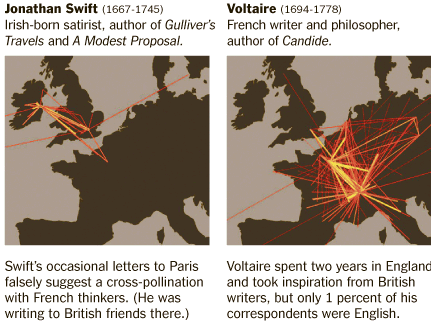
What stands out about the projects mentioned and others is that the digital humanities and design fields are developing new and subtler forms of large-scale data mining and interpretation that use methods from other disciplines along with a sensitivity to the nature of the data and the questions we want to ask. The image above comes from Stanford’s Visualization of Republic of Letters project. There is nothing new about visualization or network analysis, but digital humanists are trying to adapt methods to messy human data – in other words interpreting the really interesting stuff so that it makes sense of something to someone.

Perhaps we may be able to show that following theses are true and important to the broader community:

  • Interesting data has to be interpreted to be interesting. Someone has to pose the questions that make data useful.
  • There is too much of data and it is messy; therefore it can’t by interpreted automatically. Real world analysis always involves questions, choices, data curation, mixing techniques, and iterative interpretation of results to generate knowledge.
  • Interesting data always has to be explained to someone in some context. Results are only useful knowledge if they are published in some fashion that makes them accessible to an intended audience.
  • Humanists have been the curators and interpreters of information which is why the subtle skills of questioning, curating, editing, analyzing, interpreting and representing are all the more needed now. Without humanists (and I include librarians and archivists in this category) who are comfortable with digital data and methods we will have only too much data and too many unused tools.

Thanks to Judith for pointing me to this NYT article.

UK: Graduate employment not where you expected

The Guardian has a story about (university) graduate employment and unemployment, Graduate unemployment at highest level for 17 years (Jessica Shepherd, The Guardian, November 1, 2010). What interested me was the statistics about how different types of degrees fared.

Those who had studied Chinese had the highest starting salary at £24,540 a year, while fine art graduates started on the lowest wage at £14,625. …

The government describes engineering degrees as “strategically important” for the economy. But 11.9% of civil engineering graduates were out of work six months after they graduated, as were 11.8% of mechanical engineering graduates. Geography and psychology graduates were least likely to be unemployed. Some 7.4% and 8.3% were out of a job respectively.

The author is well aware of the irony that the statistics don’t support the British government’s assumptions about which programs are valuable and therefore worthy of funding support. Arts and humanities are likely to see deep cuts. As for informatics, the article reports that,

Graduates with degrees in IT fared worst. One in six – or 16.3% – were unemployed six months after graduation. The previous year, 13.7% were out of work after the same period.

Google: Our commitment to the digital humanities

Google has announced the first projects they are funding to use Google Books and have announced a commitment to the digital humanities of nearly a million dollars. See Official Google Blog: Our commitment to the digital humanities.

we’d like to see the field blossom and take advantage of resources such as Google Books that are becoming increasingly available. We’re pleased to announce that Google has committed nearly a million dollars to support digital humanities research over the next two years.

Globe: Supercomputers seek to ‘model humanity’

Supercomputers seek to ‘model humanity’ (Omar El Akkad, Focus Seciton, F4). The online version of the story, unlike the print version, includes a screen shot of the Conjecturator that Patrick Juola is leading.

The article quotes me extensively from an interview after the Mind the Gap workshop. The article focuses on the Digging into Data projects in Canada including the With Criminal Intent project. At least one quote attributed to me, however, must be from someone in the classics Digging project.

The Shape of Things to Come — Rice University Press

Jerome McGann and Rice have published the Proceedings of The Shape of Things to Come — Rice University Press in record time. The conference took place in March and the essays are now up on line and coming out in print. (See my blog entry and conference report on the original conference.)

“Certain questions,” Jerome McGann writes in his introduction, “are especially insistent: How do we sustain the life of these digitally-organized projects; how do we effectively address their institutional obstacles and financial demands; how do we involve the greater community of students and scholars in online research and publication; how do we integrate these resources with our inherited material and paper-based depositories; how do we promote institutional collaborations to support innovative scholarship; how do we integrate online resources, which are now largely dispersed and isolated, into a connected network?”

My paper is titled As Transparent As Infrastructure. I argued that there has been a turn to infrastructure as a way to get sustained funding for things, but that don’t really know what infrastructure is and we are tempted to turn into infrastructure things that are still being negotiated.

Brain training games don’t train your brain | THINQ.co.uk

Brain training games don’t train your brain according to a study by Adrian Owen of the Cambridge Medical Research Council.

The participants were subjected to a barrage of cognitive test before and after the experiment but the study found that they showed no improvement when compared to a control group which just buggered about on the Internet.

The story come via BBC.