I Wrote a Book with GPT-3 AI in 24 Hours — And Got It Published

“How do we know that you haven’t written the poems you claim were authored by GPT-3?” the publisher asked in one of our calls.

That was what my life had become. Convincing a publisher that AI really had written the poems. No, I hadn’t done any editing. Yes, all the poems were generated in 24 hours and translated to Finnish with Google Translate — within those same 24 hours. Yes, I own the copyright, not OpenAI. Yes, they know and they said yes.
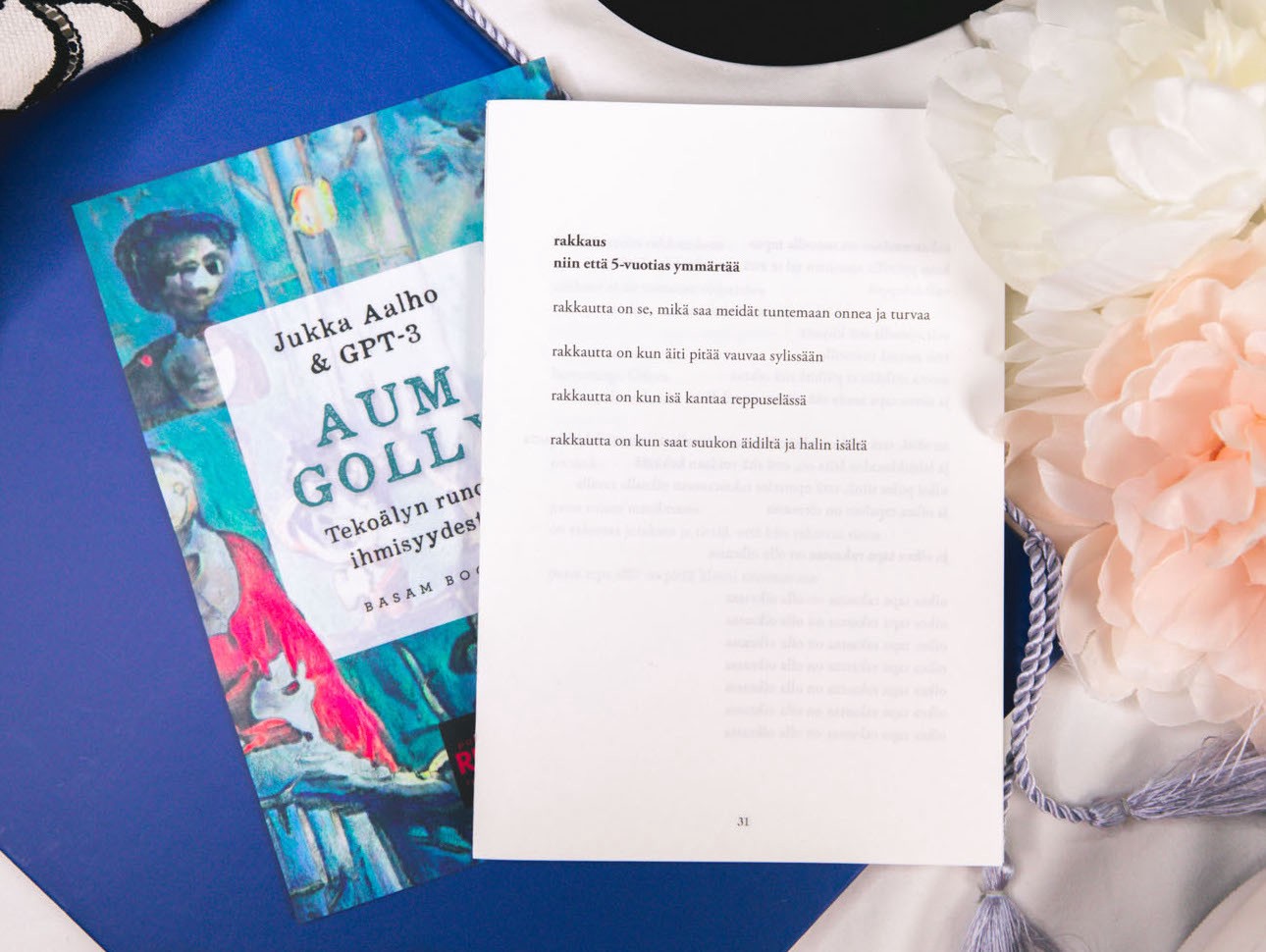
From Humanist I learned about the Medium post by Jukka Aalho I Wrote a Book with GPT-3 AI in 24 Hours. Aalho wrote a short book of poetry in 24 hours using GPT-3. I’ve bought the book and I’m not impressed by the poems. Perhaps they were better in Finnish. Here is one of the better ones (where the bold was the prompt),

why do we need to be happy, really
wouldn’t it be enough if we just don’t suffer

but everyone seems to be so very consumed by it
as if it’s the most important thing they can do
is try to get a grip on this
and I guess if that’s what they want
then I suppose I don’t have to be the one telling them
that they are mistaken
that they are making a big mistake
but how could they know that if no one tells them?
I don’t know

I’m just rambling

I’m rambling again

I’m sorry

What’s more impressive is that he got it published, but that may be because people like me would want to check it out.

Aalhu’s reflections on how such AIs might change creativity and editing are, however, quite interesting.


Vol. 31 No. 1 (2022): Ethics in the Age of Smart Systems: Special Issue | The International Review of Information Ethics

The Special Issue of the International Review of Information Ethics has just been fully put up at Vol. 31 No. 1 (2022): Ethics in the Age of Smart Systems: Special Issue. In addition to co-editing it, I co-authored an Editorial commenting On Dialogue and Artificial Intelligence that deals with the LaMDA as sentience issue.

This special issue came out a series of dialogues that AI4Society organized with our partners. These were followed by a symposium on “Ethics in the Age of Smart Machine.”

Workplace Productivity: Are You Being Tracked?

“We’re in this era of measurement but we don’t know what we should be measuring,” said Ryan Fuller, former vice president for workplace intelligence at Microsoft.

The New York Times has essay on  Workplace Productivity: Are You Being Tracked? The neat thing is that the article tracks your reading of it to give you a taste of the sorts of tracking now being deployed for remote (and on site) workers. If you pause and don’t scroll it puts up messages like “Hey are you still there? You’ve been inactive for 32 seconds.”

But Ms. Kraemer, like many of her colleagues, found that WorkSmart upended ideas she had taken for granted: that she would have more freedom in her home than at an office; that her M.B.A. and experience had earned her more say over her time.

What is new is the shift to remote work due to Covid. Many companies are fine with remote work if they can guarantee productivity. The other thing that is changing is the use of tracking for not just manual work, but also for white-collar work.

I’ve noticed that this goes hand in hand with self-tracking. My Apple Watch/iPhone offer a weekly summary of my browsing. It also offers to track my physical activity. If I go for a walk, somewhere close to a kilometer it asks if I want this tracked as exercise.

The questions raised by the authors of the New York Time article include Whether we are tracking the right things? What are we losing with all this tracking? What is happening to all this data? Can companies sell the data about employees?

The article is by Jodi Kantor and Arya Sundaram. It is produced by Aliza Aufrichtig and Rumsey Taylor. Aug. 14, 2022