Replication as a way of knowing in the digital humanities

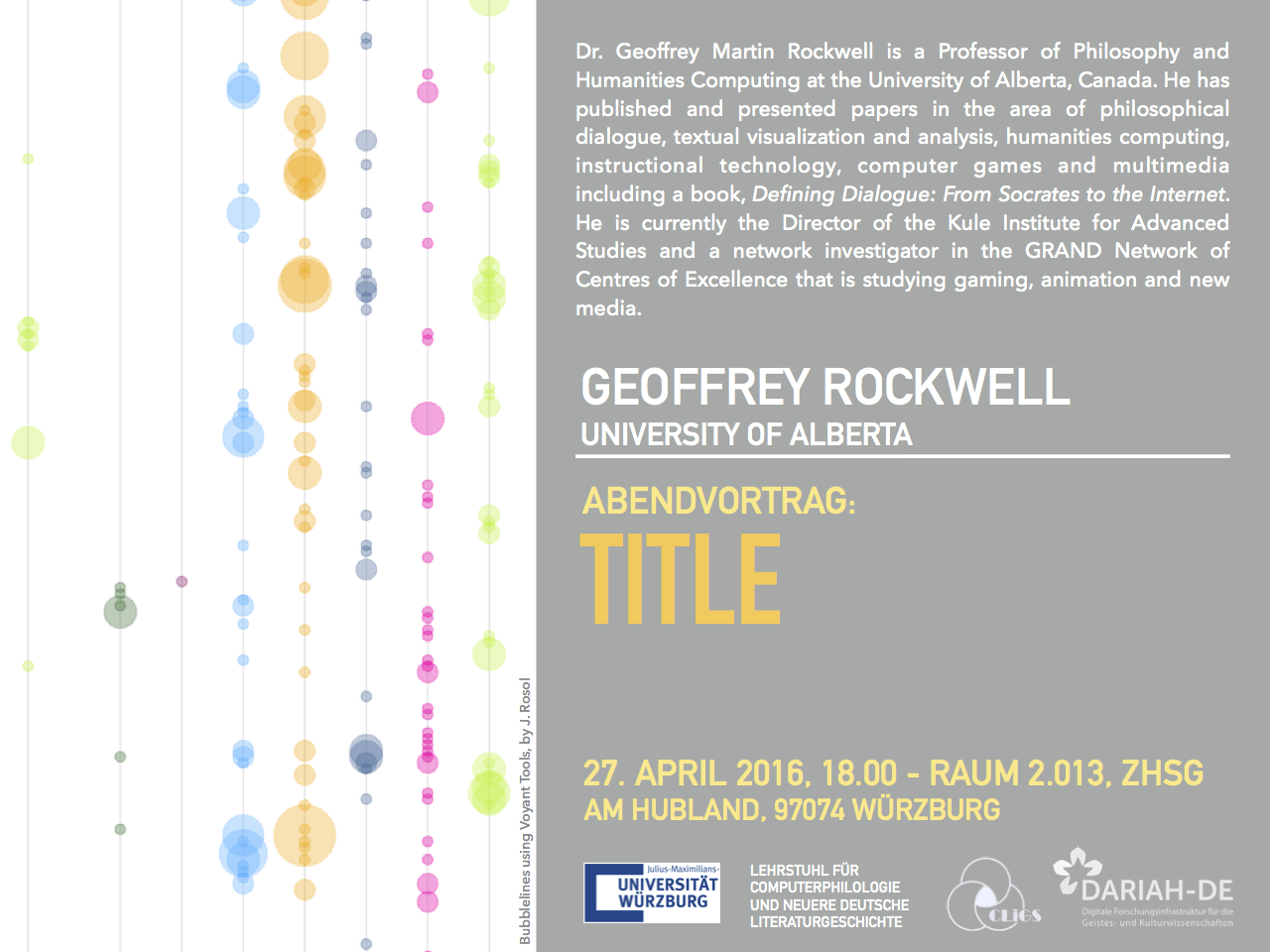
Poster for Replication Talk

At the end of April I gave a talk at the University of Würzburg on Replication as a way of knowing in the digital humanities. This was sponsored by the Dr. Fotis Jannidis who holds the position of Chair of computer philology and modern German literature there. He and others have built a digital humanities program and interesting research agenda around text mining and German literature. The talk tried out some new ideas Stéfan Sinclair and I are working on. The abstract read:

Much new knowledge in the digital humanities comes from the practices of encoding and programming not through discourse. These practices can be considered forms of modelling in the active sense of making by modelling or, as I like to call them, practices of thinking-through. Alas, these practices and the associated ways of knowing are not captured or communicated very well through the usual academic forms of publication which come out of discursive knowledge traditions. In this talk I will argue for “replication” as a way of thinking-through the making of code. I will give examples and conclude by arguing that such thinking-through replication is critical to the digital literacy needed in the age of big data and algorithms.
The Rise and Fall Tool-Related Topics in CHum

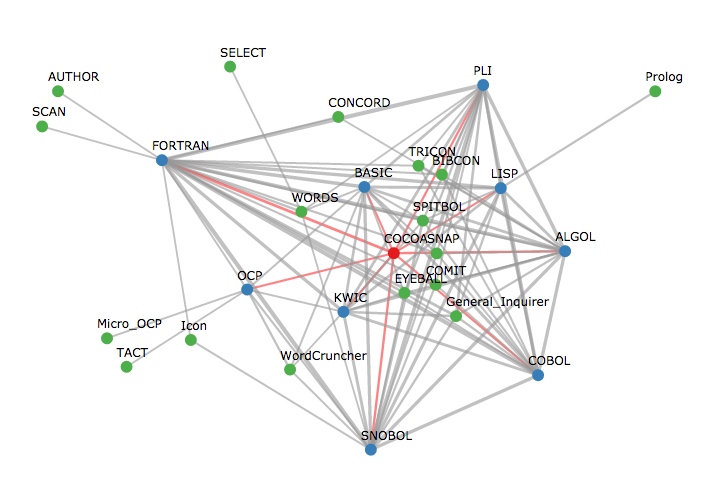
Tool Network Image
Tool network with COCOA selected

I just found out that a paper we gave in 2014 was just published. See The Rise and Fall Tool-Related Topics in CHum. Here is the abstract:

What can we learn from the discourse around text tools? More than might be expected. The development of text analysis tools has been a feature of computing in the humanities since IBM supported Father Busa’s production of the Index Thomisticus (Tasman 1957). Despite the importance of tools in the digital humanities (DH), few have looked at the discourse around tool development to understand how the research agenda changed over the years. Recognizing the need for such an investigation a corpus of articles from the entire run of Computers and the Humanities (CHum) was analyzed using both distant and close reading techniques. By analyzing this corpus using traditional category assignments alongside topic modelling and statistical analysis we are able to gain insight into how the digital humanities shaped itself and grew as a discipline in what can be considered its “middle years,” from when the field professionalized (through the development of journals like CHum) to when it changed its name to “digital humanities.” The initial results (Simpson et al. 2013a; Simpson et al. 2013b), are at once informative and surprising, showing evidence of the maturation of the discipline and hinting at moments of change in editorial policy and the rise of the Internet as a new forum for delivering tools and information about them.