Ning: Andreessen gets into social networking

The Globe and Mail has a story, Andreessen gets into social networking, on Ning, a “platform” for creating your own social network. It’s like an open FaceBook that lets you create a network for your family or for a class. You can create private or public networks; the public ones are visible and you can join them. You can pay Ning to make money off ads and for other services. Andreessen is, of course, the famous founder of Netscape. (So this is what he is up to now.)
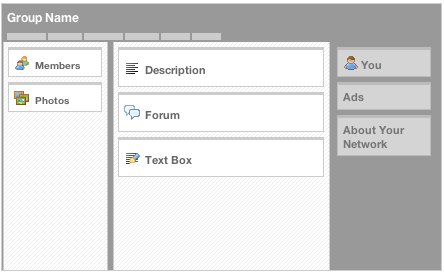
Ning Screen Shot
Ning has a nice simple interface for choosing what you want on the portal. You drag the modules you want to the different columns. It lets you see what you can have and lets you arrange what you want.
YouTube: Web 2.0 … The Machine is Us/ing Us

Web 2.0 … The Machine is Us/ing Us is a great short (4.3 minutes) video on digital text, hypertext and XML. It makes the point about how XML and tagging enrich text with knowledge that can be manipulated in innovative ways. The video does this by showing the editing of text where what is typed is the message and demonstrates the message. This is by Michael Wesch, a Cultural Anthropologist at Kansas State. See the Digital Ethnography group blog his is part of.

Thanks to Terry for this.

Deus In Machina | Exploring Religion and Technology in Comparative Perspective

Image of woman and technologyThis weekend I attended parts of a conference called Deus in Machina | Exploring Religion and Technology in Comparative Perspective that was organized by Jeremy Stolow. The conference started with a great paper by Barbara Kirshenblatt-Gimlett, “Social Sofware and Contemporary Jewish Life” that dealt ways in which new social networking tools are being used to reach out to youth. She talked about the The Open Source Judaism Project and other projects that are supported by ?û?¶?™ ¬ª MATZAT.

Geoffrey Rockwell on Facebook

So I got a Facebook account. (See Geoffrey Rockwell.) I’m not sure how to use it as a professor – do students really want their profs in their space?

For a good biography of Facebook see the profile by Sid Yadav from Augst 25, 2006 on Mashable.com:

Facebook is the second largest social network on the web, behind only MySpace in terms of traffic. Primarily focused on high school to college students, Facebook has been gaining market share, and more significantly a supportive user base. Since their launch in February 2004, they’ve been able to obtain over 8 million users in the U.S. alone and expand worldwide to 7 other English-speaking countries, with more to follow.