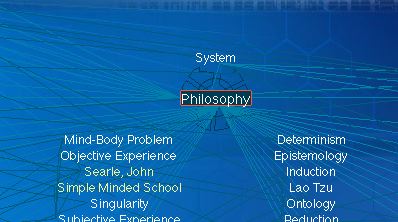
KurzweilAI.net is a web site by Ray Kurzweil dedicated to Artificial Intelligence. From there you can launch an avatar “Ramona” with whom you can converse. (If you have Windows you can install the FX Player and see her move and speak.) If you click on “The Brain” there is a great visualization of the connections between people, concepts, implementations (like Eliza) and related things. Clicking on items shows the connections and brings up short defintions and links. This is implemented in Java. Thanks to Alexandre Sévigny for this.
Continue reading Kurzweil: Ramona and KurzweilAI.net
Category: Philosophy of Computing
The new cold-war: Ready.Gov

The Department of the Homeland Security now has a site, Ready.gov to help us ready for biological, chemical and nuclear threats. It is full of wisdom like,
Studies have shown that taking steps to temporary seal off a room using common materials enhances the safety of a room against the impact of a chemical plume. (Ready.gov – FAQ)
Reminds me of the paranoia I grew up with during the cold war. How to prepare for the end of the world. Perhaps that’s the point – a bit of fear goes a long way. Look at the graphics from the ready.com home page. The women looking up to a “ready” man. The Buisness looking confidently at us like the Ready Kids (who are coming soon.)
Ready-to-fear.
So why is the Ad Council advertising Ready.com on the Guardian Unlimited site? That’s where I saw the ad … Is the Department of Homeland Security so insecure they have to advertise in a left-wing UK online news site? Is the Ad Council just randomly buying advertising space? Is someone trying to make fun of Ready.com?
Moore’s Law: What if
The BBC has a nice little article about that perennial subject, Moore’s law, that proposes “the number of transistors on a chip could double every 24 months”. See Law that has driven digital life, by Jo Twist (is that name for real?) The story raises an issue that comes around every … well … 24 months – will Moore’s law hold as we get to the physical limits of current chip technology.
Even Dr Moore is surprised about the longevity of the observation, but he admits the “law” has become a self-fulfilling prophesy.
I’m more interested in what would happen if computing ceased to appear to be improving technologically. What would happen if we couldn’t make faster and smaller computers? What would happen if the culture of computing couldn’t assume the hardware would improve dramatically and continually? We are addicted to the futurism and hype(r) of computing – for there to be a slow down would change the subculture.
Then again, will the industry even admit if things did slow down – if we did hit limits? That’s the nature of technology – there is always an improvement in your future.
Continue reading Moore’s Law: What if
What is bullshit?
Slate has a cute review on Defining Bullshit – A philosophy professor says it’s a process, not a product. By Timothy Noah (Wednesday, March 2, 2005). The review essay concludes that bullshit is a lie (or lying), but a disregard for the truth – the bullshitter doesn’t really care what is true – they just want to spout and be heard. Sounds like a lot of blogs to me.
What is a tool?
Language is the principal – or perhaps the only – tool of the philosopher. For Wittgenstein, and for analytic philosophy in general, philosophy consists in clarifying how language can be used. The hope is that when language is used clearly, philosophical problems are found to dissolve. (Analytic philosophy – Wikipedia)
Bernie Frischer asked me what a tool is in the context of humanities computing. Setting aside a discussion of the discourse of tools and ends, here is a first pass:
- An algorithm for the transformation of data. In the case of humanities computing this would typically be for the transformation of linguistic data or strings.
- A utility program that implements an algorithm (see 1.) or simple set of processes in a form that can be used easily. Generally a tool is not a full blown interactive program like a word processor. Thus Excel I would not call a tool as you can use it interactively and you can use it to do many different things. You can, however, run transformations within it.
- A technique that involves transformative or interpretative practices some of which might be automated on the computer. Thus a technique includes both human and automatable practices. Even more generally one can talk about methods that might be made up of various techniques.
- A interactive environment or game in which one can run a set of transformations for a single purpose. See 2. above. There is obviously a grey area between an atomistic tool that does one thing (just what is the doing of “one” thing) and an environment that is multipurpose. At what point does a tool become an environment for processes that isn’t really ONE tool but more a workbench of tools. My point, however, is that we will call an environment a tool if it is used in a context for one end. Thus Excel becomes a tool if I just use it to sort columns of text.
Now back to the real problem which is the presumption that a tool is utilitarian – that is something used not for play, but for achieving a well defined goal.
Liberty Alliance and Microsoft
The Liberty Alliance Project was set up to counter Microsoft’s Passport technology that threatened to put Microsoft at the centre of secure commerce and identiy technology for the net. Now that Passport is being declared dead (see InformationWeek), perhaps the alliance of equally commercial firms can get off the high horse of “liberty” and call themselves something less pretencious. Just how would technology for building identity for web transactions contribute to liberty?
Data Privacy and the Patriot Act
The Globe and Mail has a story U.S. Patriot Act could affect data on Canadians, B.C. privacy head says by Rod Mickleburgh (Saturday, October 30, 2004 – Page A13 ) about a report by the BC privacy commissioner that concludes that if BC outsourced their health data management or storage then the FBI could get access to that data due to provisions in the Patriot Act. Basically the Patriot act gives US agents the right to ask US companies for access to data they store even if protected by another countries’ privacy regulations. This is likely to affect US companies bidding on services abroad. I suspect we are going to see a slow move among countries to avoid dealing with US telecommunications and data management companies.
Continue reading Data Privacy and the Patriot Act
Roell on Knowledge Worker
Martin Roell has an extended and thoughtful blog entry on the term “knowledge worker”, Das E-Business Weblog: Terminology: “Knowledge Worker”. It starts with a reaction I had to his paper that I blogged earlier (see Roell: Distributed KM.) He then surveys some deeper discussions of what is at stake and ends up with a pragmatic point about communication in business (which he, not I has to do) and the importance of being understood by managers. Setting aside the pragmatics, here is a list of alternative terms that overlap in interesting ways,
- business person (what’s the difference between knowledge worker and business person?)
- epistemologist (someone who studies knowledge)
- philosopher (someone who loves wisdom, but doesn’t necessarily possess it)
- sophist (someone who thinks he is wise, but probably isn’t)
- office worker
- clerk
- computer (in the old sense of someone who does computations)
- manager
Hacking: Historical Ontology
One of the books I read on vacation was Historical Ontology by Ian Hacking, who I met once or twice when I was a grad student at U of T. (Neither of us understood what the other was up to, but that’s another story.)
While Hacking doesn’t do the philosophy of computing, he does philosophy of ideas, especially mathematical and scientific ideas. Historical ontology (or “dynamic nominalism”) is the name for his style of reasoning that he acknowledges is from Foucault.
His work is important to the philosophy of computing in a number of ways. First, he describes a style of historical analysis that we need to practice on the concepts of computing. It is looking at thick concepts and their instruments. Second, his historical ontology is the critical mirror to the simulation view of computing. The simulation view is that you understand by simulating objects or modelling virtually. Object oriented programming is a deeper version of this – programming is the defining of objects and behaviours, a description of a possible world – historical ontology is the analysis of such possible worlds. Object making vs object understanding.
Thus what he says about how we invent things (or construct them) has an explicit application to computing. In some science cases he argues that we invent physical things; for example when we create a new element that was potentially there, but doesn’t exist in nature. He pushes this further to a paradoxical view to the effect that as we invent (or develop) the concepts for things we, in effect, bring them into existence (as something to be thought about.)
Continue reading Hacking: Historical Ontology
Grey Goo Meme
When does a meme get a life of its own? Nanotech guru turns back on ‘goo’, by Paul Rincon for the BBC, is a story about how Eric Drexler’s concerns about the phrase he coined in 1986 in Engines of Creation for a disatrous epidemic of nanobot replication which turns everything into “grey goo”. Stephen Strauss in The Globe and Mail (Sat. July 24, 2004, p. F9) writes about how the meme travelled – A far-fetched theory that won’t come unstuck. Prince Charles and others at the ETC Group in Winnipeg are trying to divert the meme away from disaster to questions that need to be asked now about biotechnology. (See Nanotechnology Publications, ETC Group – these include briefs on the Nonotech and the Precautionary Prince.)
This meme could get a big boost in popular culture when the movie version of Michael Crichton’s Prey comes out. Prey is one of Crichton’s better works (books like Timeline seem written as movie scripts, not science fiction to be read) and it dramatizes an out-of-control nanotech development with interesting implications for identity. When it comes out as a movie we could see Grey Goo go Global. So lets track the meme with some Web stats. Below are the stats for today (July 25th, 2004). After the movie comes out I will repeat the queries and compare.
Continue reading Grey Goo Meme