We’ve been playing with ways to make text analysis tools like word clouds that don’t need parameters work automatically on loading a page. See TAPoRware Word Cloud documentation. Here is an example.
Category: Text Analysis
An alternate beginning to humanities computing
Reading Andrew Booth’s Mechanical Resolution of Linguistic Problems (1958) I came across some interesting passages about the beginnings of text computing that suggest an alternative to the canonical Roberto Busa story of origin. Booth (the primary author) starts the book with a “Historical Introduction” in which he alludes to Busa’s project as part of a list of linguistic problems that run parallel to the problems of machine translation:
In parallel with these (machine translation) problems are various others, sometimes of a higher, sometimes of a lower degree of sophistry. There is, for example the problem of the analysis of the frequency of occurence of words in a given text. … Another problem of the same generic type is that of constructing concordances for given texts, that is, lists, usually in alphabetic order, of the words in these texts, each word being accompanied by a set of page and line references to the place of its occurrence. … The interest at Birkbeck College in this field was chiefly engendered by some earlier research work on the Dialogues of Plato … Parallel work in this field has been carried out by the I.B.M. Corporation, and it appears that some of this work is now being put to practical use in the preparation of a concordance for the works of Thomas Aquinas.
A more involved application of the same sort is to the stylistic analysis of a work by purely mechanical means. (p. 5-6)
In Mechanical Resolutions he continues with a discussion of how to use computers to count words and to generate concordances. He has a chapter on the problem of Plato’s dialogues which seems to have been a set problem at that time and, of course, there are chapters on dictionaries and machine translation. He describes some experiments he did starting in the late 40s that suggest that Searle’s Chinese Room Argument of 1980 might have been based on real human simulations.
Although no machine was available at this time (1948), the ideas of Booth and Richens were extensively tested by the construction of limited dictionaries of the type envisaged. These were used by a human untutored in the languages concerned, who applied only those rules which could eventually be performed by a machine. The results of these early ‘translations’ were extremely odd, … (p. 2)
Did others run such simulations of computing with “untutored” humans in the early years when they didn’t have access to real systems? See also the PDF of Richens and Booth, Some Methods of Mechanized Translation.
As for Andrew D. Booth, he ended up in Canada working on French/English translation for the Hansard, the bilingual transcript of parlimentary debates. (Note that Bill Winder has also been working on these, but using them as source texts for bilingual collocations. ) Andrew and Kathleen Booth wrote a contribution on The Origins of MT (PDF) that describes his early encounters with pioneers of computing around the possibilities of machine translation starting in 1946.
We date realistic possibilities starting with two meetings held in 1946. The first was between Warren Weaver, Director of the Natural Sciences Division of the Rockefeller Foundation, and Norbert Wiener. The second was between Weaver and A.D. Booth in that same year. The Weaver-Wiener discussion centered on the extensive code-breaking activities carried out during the World War II. The argument ran as follows: decryption is simply the conversion of one set of “words”–the code–into a second set, the message. The discussion between Weaver and A.D. Booth on June 20, 1946, in New York identified the fact that the code-breaking process in no way resembled language translation because it was known a priori that the decrypting process must result in a unique output. (p. 25)
Booth seems to have successfully raised funds from the Nuffield Foundation for a computer at Birkbeck College at the University of London that was used by L. Brandwood for work on Plato, among others. In 1962 he and his wife migrated to Saskatchewan to work on bilingual translation and then to Lakehead in Ontario where they “continued with emphasis on the construction of a large dictionary and the use of statistical techniques in linguistic analysis” in 1972. They retired to British Columbia in 1978 as most sensible Canadians do.
In short, Andrew Booth seems to have been involved in the design of early computers in order to get systems that could do machine translation and that led him to support a variety of text processing projects including stylistic analysis and concording. His work has been picked up as important to the history of machine translation, but not for the history of humanities computing. Why is that?
In a 1960 paper on The future of automatic digital computers he concludes,
My feeling on all questions of input-output is, however, the less the better. The ideal use of a machine is not to produce masses of paper with which to encourage Parkinsonian administrators and to stifle human inventiveness, but to make all decisions on the basis of its own internal operations. Thus computers of the future will communicate directly with each other and human beings will only be called on to make those judgements in which aesthetic considerations are involved. (p. 360)
Long Bets Now
Have you ever wanted to go on record with a prediction? Would you like put money (that goes to charity) on your prediction? The Long Bets Foundation lets you do just that. It is a (partial) spin-off of The Long Now Foundation where you can register and make long-term predictions (up to thousands of years, I believe.) The money bet and challenged goes to charity; all you get if you are right is credit and the choice of charity. An example prediction in the text analysis arena is:
Gregory W. Webster predicts: “That by 2020 a wearable device will be available that will use voice recognition capability and high-volume storage to monitor and index conversations you have or conversations which occur in your vicinity for later searching as supplemental memory.” (Prediction 16)
Some of the other predictions of interest to humanists are: 177 about print on demand, 179 about reading on digital devices, and 295 about a second renaissance.
The Long Bet has some interesting people making predictions and bets (a prediction becomes a bet when formally challenged) including Ray Kurzweil betting against Mitch Kapor that “By 2029 no computer – or “machine intelligence” – will have passed the Turing Test.” (Bet 1)
Just to make life interesting there is a prediction 137 that “The Long Bets Foundation will no longer exist in 2104.” 63% of the voters seem to agree!
Towards a pattern language for text analysis and visualization
One outcome of the iMatter meeting at Montreal was . I have started a white paper on TADA that tries to think towards a Pattern Language for Text Analysis and Visualization. This white paper is not the language or a catalogue of patterns, but an attempt to orient myself towards what such a pattern language would be and what the dangers of such a move would be.
TextAnalyst – Text Mining or Text Analysis Software
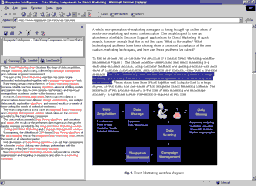 TextAnalyst is text mining and analysis software from Megaputer. It is hard, without buying it, to tell what it does. They do have what sounds like a neat plug-in for IE that does analysis on the web page you are looking at (see screenshot with this post.) The plug-in, TextAnalyst for Microsoft Internet Explorer summarizes web pages, provides a semantic network and allows natural language querying.
Solr: Open search server
 Solr is a “search server” based on Lucene that offers “Advanced, Configurable Text Analysis” and XML handling.
Text fields are typically indexed by breaking the field into words and applying various transformations such as lowercasing, removing plurals, or stemming to increase relevancy. The same text transformations are normally applied to any queries in order to match what is indexed. (Tutorial)
Philomine: PhiloLogic Text Mining
Philomine is an extension to the software Mark Olsen and company developed for ARTFL, PhiloLogic. The Rationale and Design Notes page explains text mining in the humanities with examples from ARTFL. As they explain,
Philomine was a common 19th century French name (particularly Qu?©b?©cois), probably derived from Philomena, patron Saint of “lost causes” amongst other things.
State of the Union Visualization
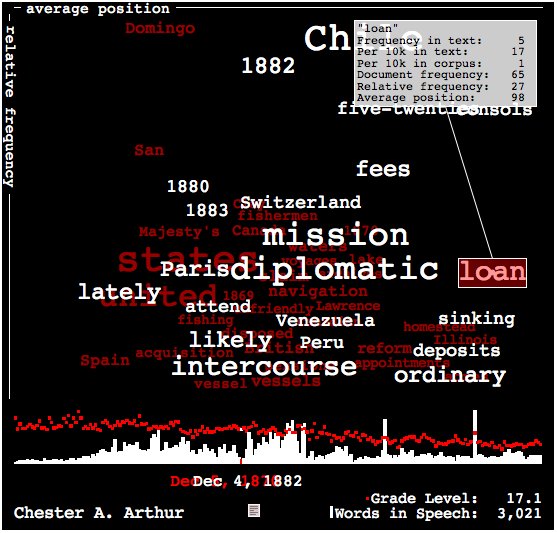 Brad Borevitz of onetwothree.net has developed another visualization of language in presidential State of the Union Addresses at State of the Union. He calls it a “data toy” and it combines a number of different graphs. One nice feature is that if you click on one Address and then another the word cloud for the first appears behind (and in red) the second for comparison purposes.
I have blogged other such visualization toys that use the State of the Union Addresses like State of the Union Parsing Tool and the SOTU Rich Prospect Browsing of the New York Times.
Thanks to Nick for this.
CNW Group: Mediavantage
 The CNW Group that has it’s Canadian base in Toronto has a new service called MEDIAVANTAGE that has many of the features of a multimedia news crawling, managing, and visualizing service. From the Flash intro it looks like users define keywords to track. Mediavantage then shows you results from different sources. It can send alerts and graphs result history.
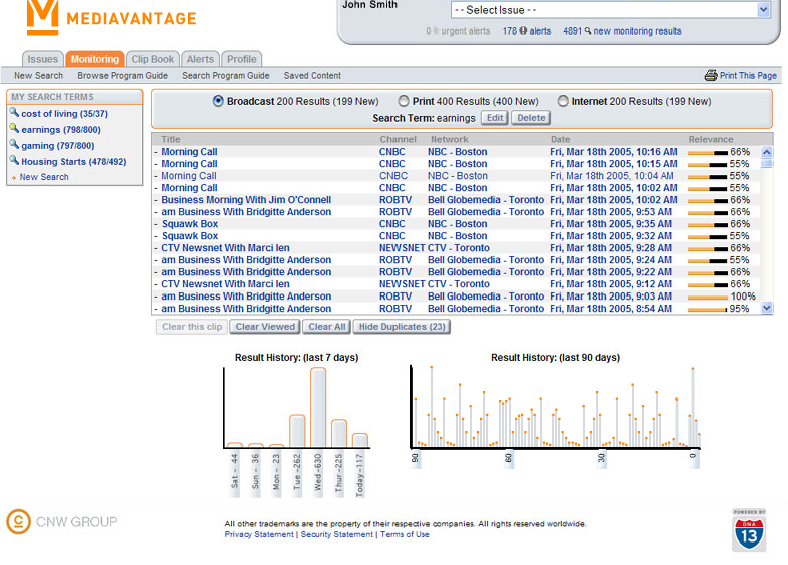
The interesting part is that they track TV news and provide text summaries that look like the text off close captioning. Subsets of results can be shared by e-mail and PDF. This is a news mining tool for business that offers a model for what Web Mining for Research might look like.
Thanks to Terry for this.
Web Mining for Research
What’s Web Mining for Research is a white paper I wrote on the TADA wiki trying to define an emerging research practice that draws on the web as evidence of human behaviour. I’m not happy with the phrase, but it hard to know what to call it. Text mining refers to mining large text databases, not the web. Web mining means all sorts of things. What stands out for me as important is that we have in the Web a massive body of evidence for philosophical and cultural analysis, something we haven’t had before. While a chance in evidence may seem trivial, the resulting change in research practices is not.