Canada’s Innovation Strategy

Knowledge Matters: Skills and Learning for Canadians – Section 3: Strengthening Accessibility and Excellence in Post-Secondary Education is part of Canada’s Innovation Strategy. It calls for dramatic increases in graduate admissions (5% per year until 2010!) and making post-secondary education financially accessible. Of interest to me is the statement,

INCREASINGLY, SUCCESS IN THE KNOWLEDGE-BASED ECONOMY REQUIRES INDIVIDUALS WHO ARE CREATIVE AND WHO HAVE HIGHLY DEVELOPED PROBLEM-SOLVING AND COMMUNICATION SKILLS.

High-performance firms attribute much of their success to developing a wide range of competencies. Information and communications technologies also require these skill sets. Teamwork is an essential part of the production process, and interpersonal skills are becoming key determinants of business success. For this reason the arts, humanities and social sciences are increasingly valued as preparation for employment. Also important are multidisciplinary learning and teaching techniques that develop an ability to think creatively and work collaboratively.

What strikes me from the Executive Summary is how this document foreshadows the Rae Report.

SSHRC Knowledge Project: Trip Report

Lynn Hughes and I spent three days at the Knowledge Project, an event put together by the Social Science and Research Council of Canada. Wednesday was devoted to reporting back about the Transformation (more in another post.)
Thursday was an all day poster session (or, as Marc Renaud called it, a trade-show) for Strategic Research Clusters, MCRIs, CURAs, and INEs – in other words many of the large SSHRC-funded projects were there. Lynn and I are PIs on iMatter or Interactive Matter, a Strategic Cluster on digital media creation and interpretation in the arts and humanities.
What is interesting is that SSHRC, despite having impressive handouts for the “Knowledge Project”, does not have a web site for it.

Perimeter Institute

The BlackBerry Brain Trust is an article in Wired, Issue 13.01, by Duff McDonald about the Perimeter Institute for Theoretical Physics that was set up in Waterloo with funding from Mike Lazaridis of RIM. Here is what the article says about the new building:

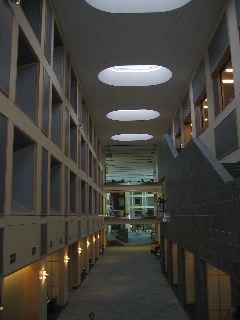
Made largely of patterned glass, the 65,000-square-foot complex has a soaring atrium, multiple fireplaces, a bistro, a squash court, and a 205-seat auditorium for lectures and string quartet performances. It looks more like a resort than a think tank where some of the smartest people in the world are contemplating the foundations of quantum physics. The elegant structure answers the question (as the architect put it), How do you design a place in which to think?

Good question! How do you design a place to learn and discover?
Continue reading Perimeter Institute

Arizona: Arts, Media and Engineering (Again)

Herberger College of Fine Arts is the college at Arizona State University for arts, theatre, music and dance that is collaborating with the school of engineering on the Arts, Media and Engineering research and education program that I blogged before. (See Arizona State: Arts, Media and Engineering.)
It looks like they have MFAs in Art, Dance and Theatre (and PhD in Music) each of which can have a concentration in “Interdisciplinary Digital Media” or “Interdisciplinary Digital Media and Performance”.