ACAATO Report: Student Mobility within Ontario’s Postsecondary Sector

COU – CUCC (College University Consortium Council) has an interesting report dated September 2005 on “Student Mobility within Ontario’s Postsecondary Sector” which looks at students going from university to the colleges and the other way. It seems the number of college students planning to go on to university is going up. “College studentsí goals increasingly include both a diploma and a degree.” (p. 17) Also, the largest percentage of university graduates going to college are in teh social sciences and humanities.

Seven percent of each of social science and humanities graduates was attending college at six months
and just fewer than 5% were attending college two years after graduation. Graduates from the social science or humanities areas made up the majority of those going on to college. Although these areas made up only 36% of surveyed graduates they are responsible for 60% of the graduates who attended college at six months and 50% at two years. (p. 14)

I’m guessing that a number of humanities students go to college to get a job specific diploma once they have a sense of their career goals.

Glion Colloquium

Thanks to the Tomorrow’s Professor Listserv at Stanford I cam across the
” href=”http://www.glion.org/?a=6202&p=1512″>Glion Declaration
on “The University at the Millenium”. The declaration of the identified IT and alliances as two opportunities:

Two opportunities ó new alliances and the use of information technology ó now offer the possibility of expanding the range and usefulness of scholarship and providing unprecedented benefits to society.

Continue reading Glion Colloquium

Holy Mackarel Smackarel: when multimedia was black and white

continue.gif

The founders of Mackarel, David Groff and Kevin Steele, have created A Biased History of Interactive Media which has a great chapter on When multimedia was black and white which reminds me (an old HyperCard programmer) of the “good old days.” The chapter is a great little intro to early multimedia on the Mac. They mention a number of then new HyperCard stacks like Robert Winter’s CD Companion to Beethoven’s Ninth Symphony leading up to their Mackarel Stack, which I remember. The interface to the chapter is deliberately HyperCard-like.

Chapter 2 is about “When bevelled edges were cool” … remember those days? Shudder?

Dogpile: Search Comparison Visualization

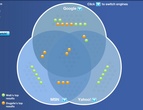
StÈfan has a blog entry on Dogpile Search Comparitor tool which produces a venn diagram of the results from different search engines. The interface, however, has a fatal flaw. You can’t link to the resulting sites that are common to more than one search engine (and presumably are the ones you want). The little pills in the middle – which stand for the shared results link to a Dogpile listing, not to the resulting site itself.

Online Library Budgets

The Globe and Mail today had a section on Education with an article about A new world of digital libraries by Kate L. Barrette. The story quotes Michael Ridley, Chief Information Office and Chief Librarian at the University of Guelph to the effect that now they spend 63% of their acquisitions budget on digital resources (31% for print) compared to five years ago when it was 20% digital. That is a big change in the ratio of digital to print.
Continue reading Online Library Budgets