About a year ago I posted a note about Digital Pens (Anoto, io2, and Fly). An old friend Terry Jones came across the entry and says this about his experience:
The paper is about $8 cdn delivered to your door so its expensive but compared to the cost of a tablet you can buy a LOT of paper.
The really cool thing I like about it is that each page is unique. So in my notebook when I update a page here and a page there and go back to this page and then crerate a new page etc… when I park the pen each of the documents I updated on paper gets updated online. There is also a timeline function in the viewer that lets me see when the various pieces of “ink” appeared on the pen page! I like to be able to write someone a note while I am working on their computer and then when I get back to the office I have a copy too (in the pen) even though I have left them the paper copy. I like the fact that on the subway I don’t feel like a total geek and a target writing on a tablet. I am just writing in a notebook with a pen that is only a little fatter than some modern pens. I like the fact that a notebook boots instantly so to jot down a quick reminder is NOT a 5 minute process of booting a tablet PC, making a note and shutting down.
I bought mine cheap on eBay ($51) and since then bought 3 more at around $60 on eBay and so far every person that has tested them out isn’t giving them back. They come back after a couple of office with their wallet instead of the pen… its been quite funny!
Terry, besides being organizing barefoot waterskiing competitions, is one of the most intuitive experts I have ever worked with. What he describes is ubiquitous computing the way it should be – not about what toys you show off or how you should change for technology, but developing technologies that fit our workstyles.
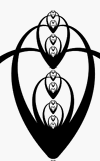 mandalabrot.net is the home of kiddphunk (Ian Timourian) and his visualizations, experiments and remixes. He has a number of Context Free Design Grammar experiments. Timourian also has a photo kiddphunk site with an doubled way of showing images.