The Motorola DynaTAC 8000X was one of the first modern cellular phones. It was a brick, but consumers lined up for them in 1984. See the story at CNN.com – First modern cell phone was a true ‘brick’ – Apr 27, 2005.
Category: History of Computing and Multimedia
More on Moore’s Law and the original magazine
Apparently there has been a search for a mint copy of the original 1965 Electronics magazine in which Moore’s article proposing Moore’s Law appeared. Well, now a copy has been found, see BBC NEWS | Technology | Moore’s Law original issue found. It was under the floorboards of a hoarder. (Why under the floorboards and how was it found? Because his wife complained about the mess!) Double thanks to Judith Altreuter for alerting me to this and then pointing out a typo.
Ritchie: Evolution of Unix Time-sharing system
 I’m reading around the history of programming in Go To and was intrigued by the connection between Unix and time-sharing.
This connection is made explicitly in the title of a paper by one of the developers of Unix, Dennis M. Ritchie,
The Evolution of Unix Time-sharing System (PDF). As an interesting aside, the key proposal by the development group that got them a PDP-11 to work on proposed to develop a text editing system and their system ended up supporting the word processing of the patent group. Unix and Electronic Textuality! I knew it.
In early 1970 we proposed acquisition of a PDP-11, which had just been introduced by Digital. In some sense, this proposal was merely the latest in the series of attempts that had been made throughout the preceding year. It differed in two important ways. First, the amount of money (about $65,000) was an order of magnitude less than what we had previously asked; second, the charter sought was not merely to write some (unspecified) operating system, but instead to create a system specifically designed for editing and formatting text, what might today be called a `word-processing system.’ The impetus for the proposal came mainly from J. F. Ossanna, who was then and until the end of his life interested in text processing.
For more on Ossanna and the history of troff see The GNU Troff Manual – 2 Introduction.
Continue reading Ritchie: Evolution of Unix Time-sharing system
Gray’s Mostly Apple Movies
Thanks to StÈfan’s blog I discovered Gary L. Gray’s Some Cool QuickTime Movies page which has a number of historic clips like the original “1984” Macintosh commercial and Steve Jobs talking about the history of computing when introducing the Mac. (He makes it a question of freedom – freedom from the domination of IBM.)
3 Classic Anime

I’ve been dipping into Japanese manga and anime culture. Japanese science fiction animated movies like Akira (1988), Ghost in the Shell (1995) and Metropolis (2001) have a visual grammar that has influenced computer game design and cyberpunk movies like the Matrix. They also have a willingness to tackle interesting philosophical issues like the nature of the soul or “ghost” in a cybernetic world (Ghost in the Shell).
In effect, boys anime and manga, like the fumetti I read as a kid in Italy (see uBC – Enciclopedia), combine smart speculative fiction plots with soft porn and tech-heavy violence. This mix can be seen in the Fraco-Belgian adult Bande DessinÈe like Moebius.
Whether we approve of this mix, and, of course, we don’t, there is an energy to boy culture and it is the source for much of the style of online culture.
Continue reading 3 Classic Anime
Dispense with your horse: The Watley Review
Just discovered! Humour for history of computing geeks, Watley Classified Advertorial: Babbage Machine. And they also sell “Difference Engine Manipulator Pads” (mouse-pads).
The Home Computer, Back Then
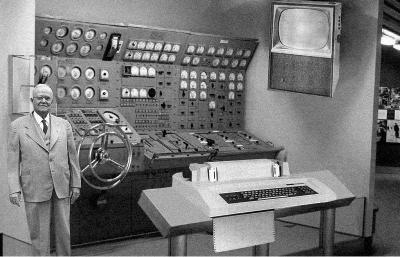
Scientists from RAND Corporation have created this model to illustrate how a “home computer” could look in the year 2004. However the needed technology will not be economically feasible for the average home. Also the scientists readily admit that the computer will require not yet invented technology to actually work, but 50 years from now scientific progress is expected to solve these problems. With teletype interface and the Fortran language, the computer will be easy to use.
I noticed this intriguing image and caption up in a display in our labs and thanks to St?©fan Sinclair traced it to Matt Kirschenbaum’s blog where a comment then took me to Urban Legends Reference Pages: Inboxer Rebellion (Does Not Compute). Pity it’s a hoax – why wasn’t Rand thinking about the home computer back then? If you look closely the teleprinter is distorted and the suit is too short for the display, but the caption is so good it should be true.
In the beginning was the command line, v. 2
The Command Line In 2004 is an annotated version of Neal Stephenson’s “In the Beginning was the Command Line.”. Garrett Birkel got permission to update it with annotations.
See my previous entry on the Stephenson original at, grockwel: Research Notes: Stephenson: In the beginning was the command line. This is from Slashdot.
Used Mechanical Bride
I bought a used paperback copy of McLuhan’s first book, The Mechanical Bride. It is a non-linear book; a collection of ads and other clippings from magazines and newspapers, each with questions and commentary by McLuhan. McLuhan encourages us to jump to any section or exhibit as each view is a way into “the circulating point of view” of the book.
Ours is the first age in which many thousands of the best-trained individual minds have made it a full-time business to get inside the collective public mind. To get inside in order to manipulate, exploit, control is the object now. (p. v of Preface)
The book sets out to help the reader by analysing how print media works by returning to it and analyzing it like art or literature.
It was this amusement born of his rational detachment as a spectator of his own situation that gave him the thread which led him out of the Labyrinth. And it is in the same spirit that this book is offered as an amusement. (p. v of Preface)
The detached reader is amused by the manipulation and that is a way back, but back out of the Labyrinth to what?
Most of the exhibits in this book have been selected because of their typical and familiar quality. The represent a world of social myths or forms and speak a language we both know and do not know. (p. v of Preface)
McLuhan calls these ads, cartoons, news clips and so on, “folklore of industrial man” and quotes anthropologist C. B. Lewis to the effect that folklore is not made by the folk, but for them.
The ads he turns up are even more obvious in their manipulation today (or were they always obviously?) One ad for RCA radios is titled “Freedom to LISTEN- Freedom to LOOK” and goes on with rubbish about radio and television promoting freedom. One wonders if such ads lose any power once they look dated or did McLuhan just do a great job at readjusting our reading of such media?
Now that we have all been educated to understand media (thanks to McLuhan), Why are there still ads? Why are we still fooled?
Continue reading Used Mechanical Bride
tinfoil.com – early recorded sound site
tinfoil.com – Early Recorded Sounds and Wax Cylinders is one of those fantastic early media sites. It has audio clips of early recordings along with all sorts of other stuff.