According to a BBC story titled, Google to scan famous libraries (Tuesday, Dec. 14, 2004, BBC News, UK Edition), Google, working with the University of Michigan, will scan selected books from the libraries of Michigan, Stanford, Harvard, Oxford and the New York Public Library. The scanned books will be mostly books out of copyright, and the online pages may have some links to Amazon. The full collection of seven million volumes will take six years to digitize at Michigan.
Continue reading Google Library Scanning
Category: Markup and Text Representation
Manuscript Retrieval
UMass Amherst reports that Researchers create tool to automatically search handwritten historical documents” href=”http://www.umass.edu/umhome/news/articles/7683.php”>Researchers create tool to automatically search handwritten historical documents. Working with 1,000 scanned pages of George Washington’s manuscripts, a team of researchers at the University of Massachusetts at Amherst have developed a manuscript retrieval system that can find words like “regiment” in the handwritten manuscripts. There is a demo at Handwritten Manuscript Retrieval.
This is thanks to Matt Patey.
My TEI Publisher
My TEI publisher by Eric Lease Morgan is publishing system built on Perl and MySQL that lets you manage authors, subjects, templates, stylesheets and articles. While it doesn’t have the review management tools of other online journal systems, it seems clean and it works with TEI/XML articles. Neat
Michigan: Digital Conversion (Scanning) Services
I was asked recently about how to scan large amounts of old newspapers. These two links came from Humanist and provide a good survey of what a professional library digitization units do.
The University of Michigan Digital Library Production Service has a site on their Digital Conversion Services.
The University of Illinois, Urbana Champaign, has a Digital Imaging and Media Technology Initiative which offers Imaging Advice.
Both these links came from Kevin Hawkins on Humanist.
MetaMap: Metadate Subway Map
MetaMap is a project by James Turner and VÈronique Moal at the UnivÈrsite de MontrÈal that nicely presents a subway map visualization of the variety of metadata standards. You can travel the subway lines of standards learning about this virtual underground polis.
Continue reading MetaMap: Metadate Subway Map
Jerry McDonough: METS
Metadata Encoding and Transmission Standard (METS) is a hub standard that links metadata and files. Jerry McDonough of the New York University Libraries presented on METS at the TEI Members’ Meeting. He showed a neat use of METS to joint an MPEG video clip to a TEI transcript, but the heart of his talk was about the proliferation and interaction of standards like TEI, EAD, METS, IMS, and so on. There is a temptation to think that with a bit more a standard like the TEI can embrace (swallow) other standards giving us one instead of many. He argued that a) we don’t technically need to merge related standards, and b) it is not right to do that. He pointed to the politics and histories of these groups/standards. We need a sociology of standards.
Continue reading Jerry McDonough: METS
TEI Members’ Meeting, Daniel Pitti opening on TEI and EAD
I am at the 2004 TEI Annual Members’ Meeting at John Hopkins in Baltimore. We just got wireless so I can post notes on the talks.
Daniel Pitti from IATH gave the opening on the TEI and EAD.
Continue reading TEI Members’ Meeting, Daniel Pitti opening on TEI and EAD
</BUSH>
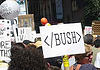
XML Protest Politics. I found this on a fascinating blog by dpwolf (David Wolf).
Surviving by accident: print your blog
digital information will never survive and remain accessible by accident: it requires ongoing active management. The information and the ability to read it can be lost in a few years. (“Digital Information Will Never Survive by Accident” in SAP INFO)
So what can we do individually to ensure that some of the content of this age survives, “by human accident”? What if we had a Print your blog day once a year when you print out your blog entries for that year on acid-free paper and stored them in the attic. Given that there are millions of blogs, and that these blogs describe other things on the web, we might get a reasonable accidental record as an alternative to centralized archiving projects.
Continue reading Surviving by accident: print your blog
text-e
text-e was an online symposium that is interesting both as an online event and in terms of content. The site is tri-lingual (French, English and Italian) and brought a number of speakers, like Umberto Eco, around the subject of “impact of the Web on reading, writing and the diffusion of knowledge” in 2001.
Continue reading text-e